Author: Devika R
June 16, 2026
8 min read
The Real Problem Isn't a Lack of Jobs
1. Introduction
Every year, thousands of students graduate with engineering degrees hoping to start successful careers.

Yet many of them face a frustrating reality.
Months after graduation, they are still searching for opportunities.
This creates an obvious question:
If companies are hiring, why are so many engineering graduates struggling to find jobs?
The answer may surprise many students.
The problem isn't always a shortage of jobs.
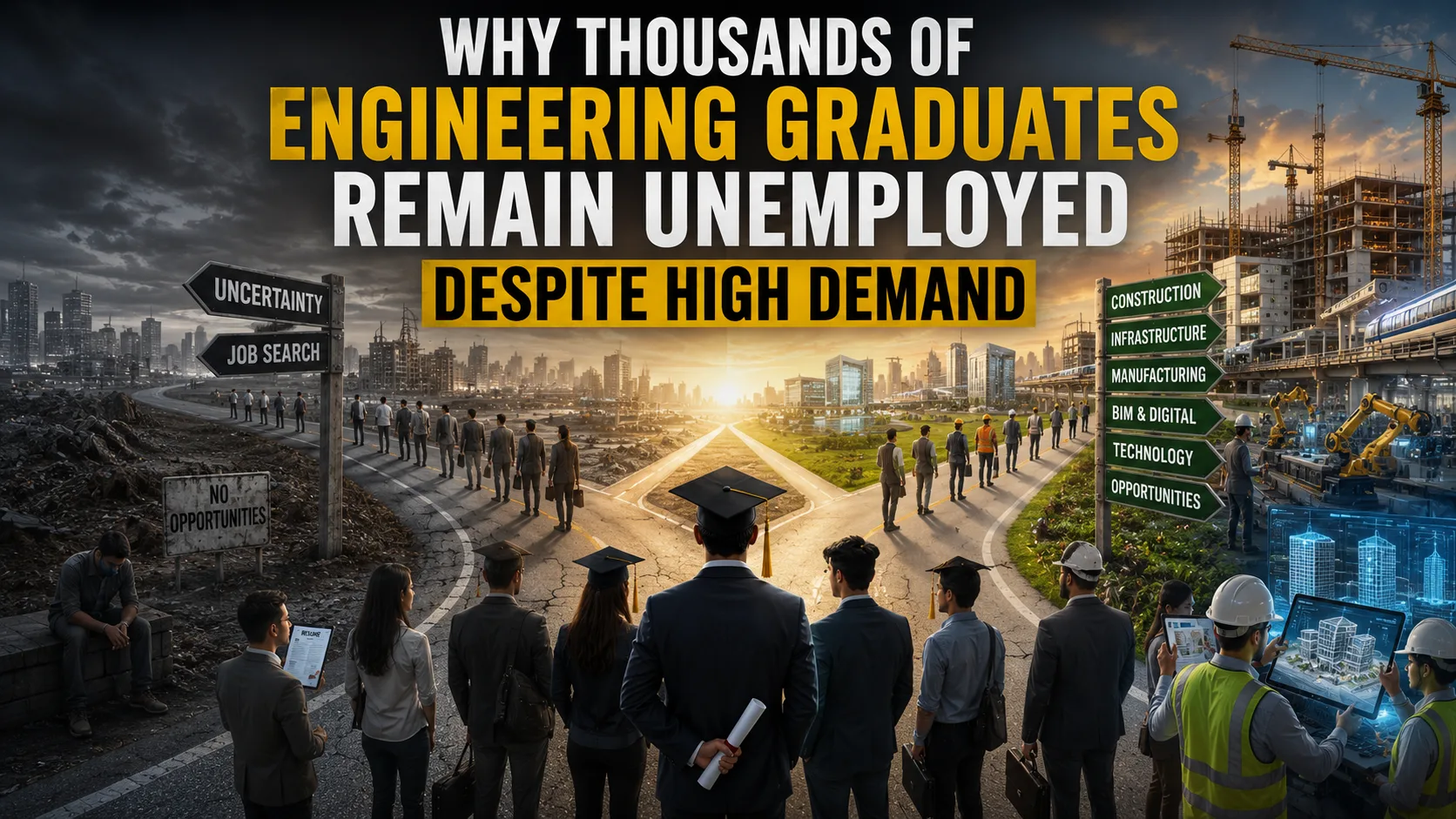
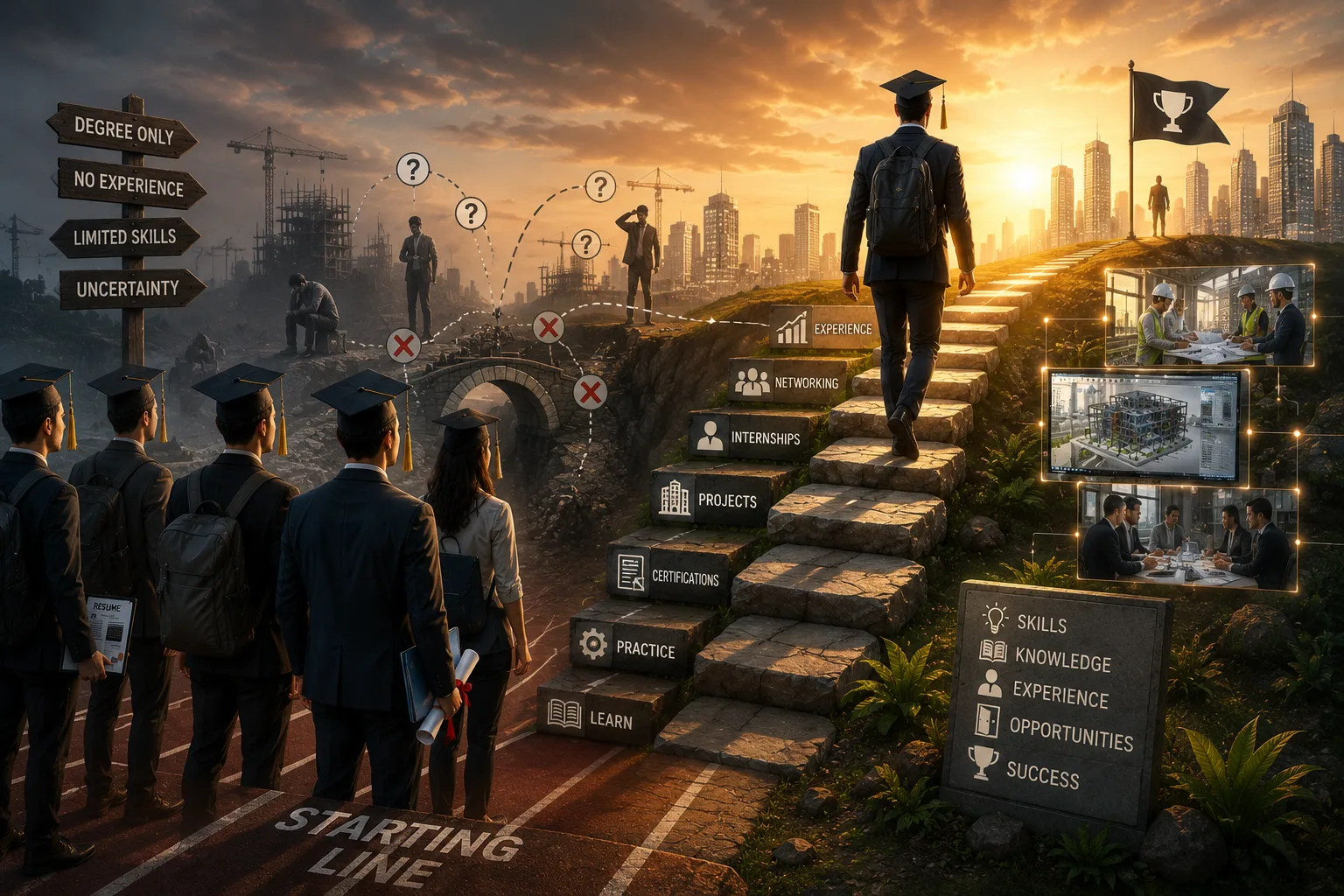
In many industries—including construction, infrastructure, manufacturing, BIM, and technology—the bigger challenge is the growing gap between academic education and industry expectations.
2. The Engineering Paradox
India produces one of the largest numbers of engineering graduates in the world.

At the same time, employers frequently report difficulties finding candidates who are ready to contribute from day one.
This creates a strange situation:
- Graduates say jobs are unavailable.
- Companies say skilled candidates are difficult to find.
Both statements can be true.
The gap lies somewhere in the middle.
3. What Colleges Teach vs What Industry Expects
Most engineering programs focus on:
- Theory
- Fundamentals
- Examinations
- Academic projects
- Semester-based learning
These are important foundations.
However, employers usually evaluate candidates differently.
They often look for:
- Problem-solving ability
- Communication skills
- Practical software knowledge
- Project understanding
- Team collaboration
- Professional attitude
This difference creates a challenge for fresh graduates entering the workforce.
4. The Skills Gap Is Growing
One of the most discussed topics across industries today is employability.

Employers increasingly expect graduates to understand:
Many students complete four years of engineering without significant exposure to how projects actually function outside the classroom.
As a result, they often enter interviews feeling unprepared.
5. The Construction Industry Is a Perfect Example
Take the construction and infrastructure sector.
Most civil, mechanical, electrical, and architectural graduates learn engineering principles during college.
But companies often expect additional practical skills such as:
- BIM workflows
- Revit
- Navisworks
- Project documentation
- Coordination processes
- Construction standards
This doesn't mean college education failed.
It simply means industry evolves faster than academic curricula.
6. The Degree Gets You Through the Door
Many students believe:
"Once I get my degree, companies will hire me."
Unfortunately, the job market no longer works that way.
Today, a degree is often the starting point—not the final qualification.
When multiple candidates have similar academic backgrounds, employers usually look at:
- Practical exposure
- Technical skills
- Internship experience
- Communication ability
- Learning attitude
This is often where candidates differentiate themselves.
7. Why Communication Skills Matter More Than Students Realize
Technical knowledge alone rarely secures a long-term career.
In real workplaces, professionals must:
- Explain ideas clearly
- Attend meetings
- Coordinate with teams
- Discuss project challenges
- Present solutions
Many technically capable graduates struggle because they have never been trained to communicate in professional environments.
Employers notice this quickly.
8. The Rise of Industry-Oriented Hiring
A noticeable shift is happening across multiple sectors.
Companies increasingly prefer candidates who can contribute quickly rather than candidates who only possess academic knowledge.
This is why internships, project exposure, and practical learning have become more valuable than ever.
Employers often ask:
"What have you worked on?"
rather than:
"What subjects did you study?"
9. Why Some Graduates Find Jobs Faster Than Others
Interestingly, the difference is not always intelligence.
It is often preparation.
Graduates who actively develop additional skills usually stand out.
They invest time in:
- Industry software
- Project understanding
- Communication improvement
- Portfolio development
- Professional networking
These efforts make them more visible to employers.
10. The Opportunity Most Students Overlook
The good news is that the skills gap can be closed.
Unlike a degree program that takes years, practical skills can often be developed much faster through:
- Internships
- Industry-focused training
- Project-based learning
- Professional certifications
- Self-directed learning
The students who recognize this early often gain a significant advantage.
At BIM Cafe Learning Hub, one pattern appears repeatedly during interactions with students and employers.
Most graduates are not lacking intelligence or potential.
What they often lack is exposure to how the industry actually operates.
Employers increasingly value candidates who understand:
- project workflows
- coordination processes
- professional communication
- practical problem-solving
Because once graduates enter the workplace, they are expected to contribute within real project environments—not classroom environments.
11. The Future Belongs to Adaptable Engineers
Engineering careers are changing.
The most successful professionals are no longer those who simply complete a degree.
They are the ones who continuously learn, adapt, and stay aligned with industry needs.
Technology will continue evolving.
Software will continue changing.
Industries will continue demanding new skills.
The ability to learn and adapt may become the most valuable skill of all.
Final Thoughts
The unemployment challenge among engineering graduates is often misunderstood.
The issue is not simply a lack of opportunities.
In many cases, it is a mismatch between academic preparation and industry expectations.
The encouraging part is that this gap can be bridged.
Students who focus on:
- practical skills
- communication
- project understanding
- industry exposure
place themselves in a much stronger position for long-term career growth.
Because in today's job market, employers are not only looking for degrees.
They are looking for professionals who are ready to contribute.
12. Related Reads
- BIM Career Roadmap: From Fresher to BIM Manager
- Complete BIM Workflow Explained
- Why BIM Professionals Are in High Demand in the Gulf
- MEP Coordination in BIM: The Part Most Learners Never Fully Understand
Professional BIM Course
Master BIM Course
Structural Design Concepts and BIM
Certified MEPF BIM Master Course
Electrical BIM Professional Program
RenderLab – Master 3D Modeling & Photorealistic Rendering
Multi-Tool Mastery for Architects & Engineers
BIM Coordinator Workflow Program
BIM FastTrack – 30 Day Intensive Training
Global Architectural & Structural BIM Project Program