Author: Devika R
August 25, 2026
7 min read
Three Models. One Location. Three Different Answers.
Imagine a coordination meeting.
The architectural model shows a finished ceiling at 2.8 metres.
The structural model has a beam running through the same space.
The MEP model needs a large HVAC duct to pass below it.
The clash detection software identifies the conflict.
Great. Problem found.
But now comes the difficult question:
What should actually change?
Should the duct move?
Should the beam change?
Should the ceiling drop?
Or does the design itself need to be reconsidered?
This is where BIM coordination becomes much more than clash detection.
A Clash Is Not a Solution
Software can tell you:
“These two elements occupy the same space.”
It cannot automatically tell you:
“This is the best solution for the project.”
That decision may depend on:
- Design intent
- Structural requirements
- MEP system requirements
- Available space
- Maintenance access
- Construction sequence
- Project standards
- Client requirements
- Cost and programme impact
So the real coordination process begins after the clash is identified.
Who Gets to Move?
This is one of the questions beginners rarely encounter until they work on a live project.
Consider a simple example.
Structural beam vs HVAC duct
The duct cannot pass through the beam.
Possible solutions could include:
Option A: Move the duct.
Option B: Adjust the duct elevation.
Option C: Modify the structural design.
Option D: Revise the ceiling zone.
There is no universal rule saying:
“MEP always moves.”
Or:
“Structure always gets priority.”
The correct decision depends on project requirements and engineering constraints.
That's why experienced BIM professionals don't resolve clashes simply by moving whichever element is easiest to edit.
The BIM Coordinator Isn't Just a Clash Finder
A BIM Coordinator often sits between different disciplines.
They may need to understand enough about each system to ask the right questions.
For example:
Architect: “We cannot reduce the ceiling height.”
Structural Engineer: “The beam cannot be moved without redesign.”
MEP Engineer: “The duct requires this clearance.”
Now the BIM team has a coordination problem.
The answer may require discussion between the disciplines rather than another software command.
This is why communication and engineering understanding matter alongside BIM software skills.
What Happens During Real Clash Resolution?
A typical coordination cycle can look like this:
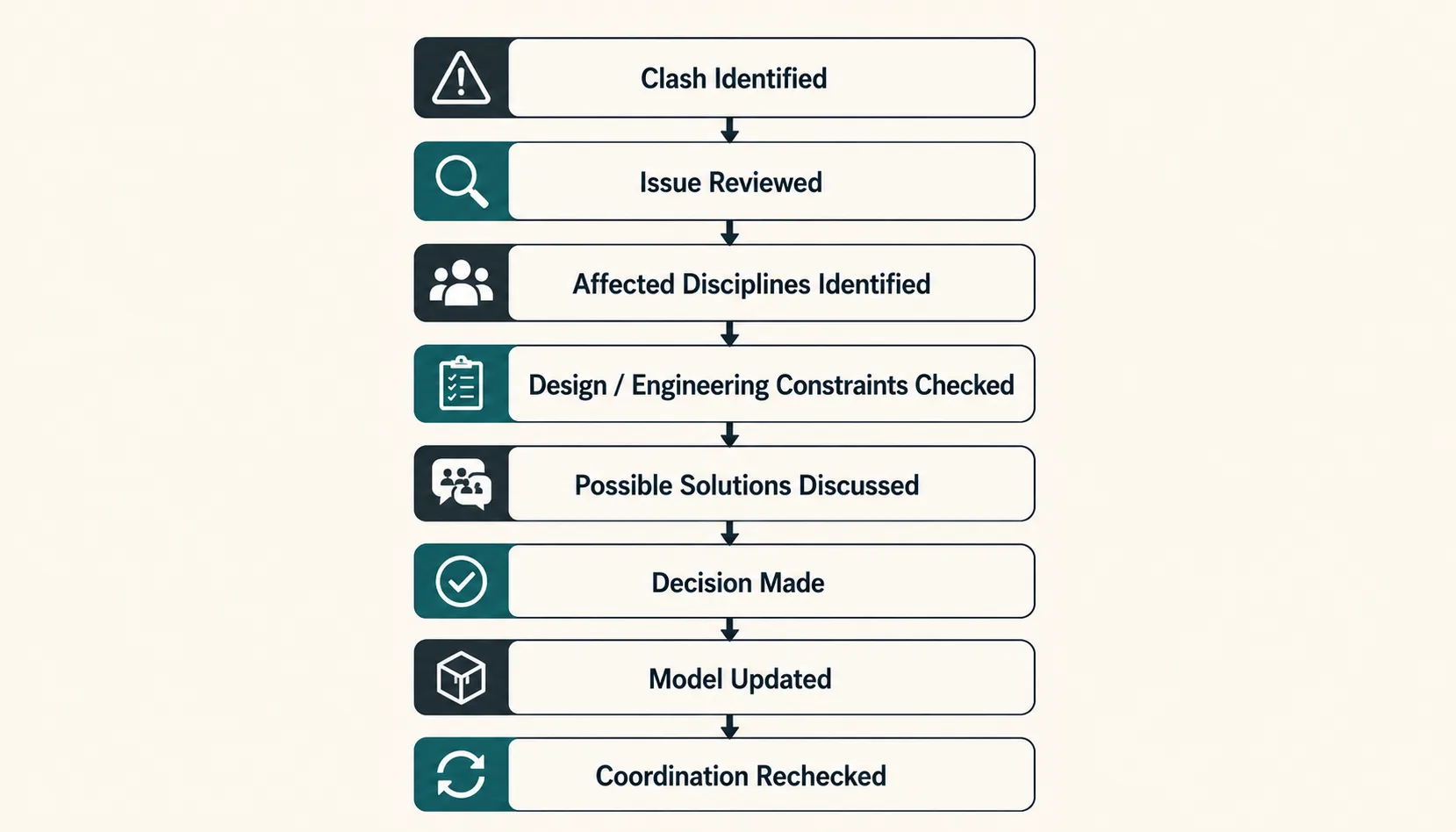
The final step is important.
A clash isn't truly resolved just because someone moved an element.
The updated model needs to be checked again.
Not Every Clash Is Equally Important
Another common beginner mistake is treating every clash as a major problem.
Imagine a coordination report containing hundreds of clashes.
Does that mean the project has hundreds of critical issues?
Not necessarily.
Some conflicts may be:
- Genuine physical clashes
- Acceptable intersections
- Duplicate detections
- Clearance issues
- Temporary modelling conditions
- Issues requiring design review
Professional BIM model coordination therefore involves prioritising issues rather than blindly trying to achieve “zero clashes.”
The question becomes:
Which issues actually matter to construction, performance, safety, or project requirements?
The Difference Between Clash Detection and Clash Resolution
This distinction is worth remembering.
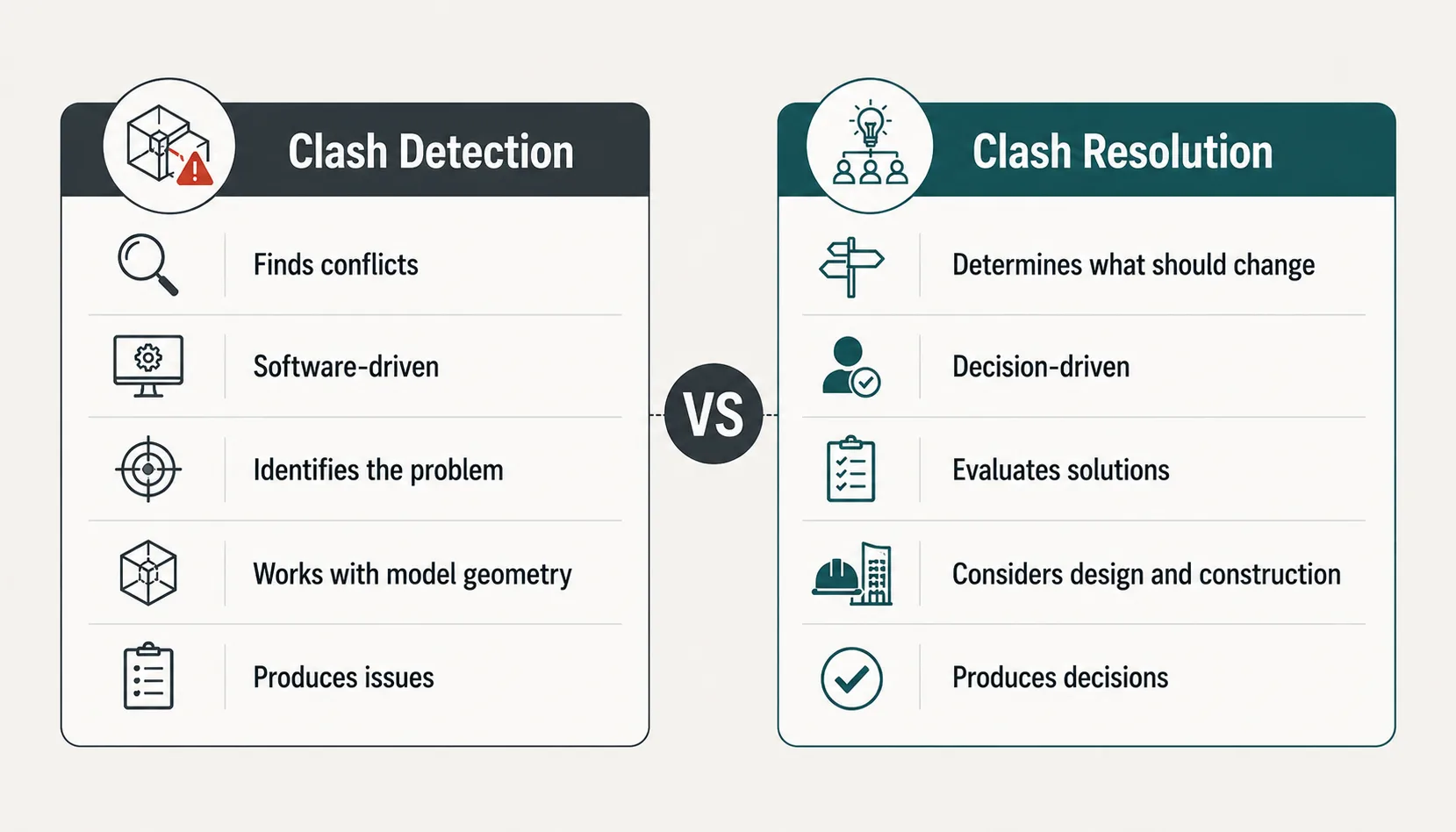
Detection tells you where the problem is.
Coordination determines what to do about it.
What If the Models Don't Agree?
Sometimes the conflict isn't between physical elements.
It can be between information.
For example:
- Architectural drawing shows one door location.
- Structural information reflects another layout.
- MEP design uses an earlier revision.
Now the question isn't:
“Which element should move?”
It's:
“Which information is current and approved?”
This is where revision control, project standards, information management, and communication become important.
A BIM Coordinator may need to check the latest approved information before making any modelling decision.
The RFI Can Become Part of the Solution
Not every coordination problem can be solved by the BIM team.
If the design information is unclear or conflicting, an RFI (Request for Information) may be required.
For example:
The proposed HVAC route conflicts with the structural beam and cannot maintain the required clearance. Please confirm the approved routing or design adjustment.
The response becomes part of the project's decision trail.
This is an important lesson for BIM professionals:
Sometimes the correct action isn't changing the model.
It's asking the right question.
Coordination Is Also About Constructability
A solution can look perfect inside Revit and still be difficult to build.
Imagine a pipe route that technically avoids every clash—but leaves almost no space for installation or maintenance.
The model may be “clash-free.”
The solution may still be poor.
Good BIM coordination considers whether the proposed solution is:
- Buildable
- Accessible
- Maintainable
- Practical
- Consistent with project requirements
This is where constructability thinking becomes valuable.
A Better Way to Think About BIM Coordination
Instead of asking:
“How do I remove this clash?”
Ask:
“Why did this conflict occur, what constraints are involved, and what solution creates the least impact on the project?”
That shift in thinking separates basic software operation from professional BIM coordination.
Why Coordination Meetings Matter
A coordination meeting isn't simply a screen-sharing session where people look at red clash markers.
The real purpose is to make decisions.
A productive meeting may answer:
- Which issues are critical?
- Who needs to review them?
- What solution is proposed?
- Does the solution affect another discipline?
- Who is responsible for the revision?
- When should it be completed?
The meeting creates a shared understanding.
The model records the resulting change.
What Students Often Get Wrong
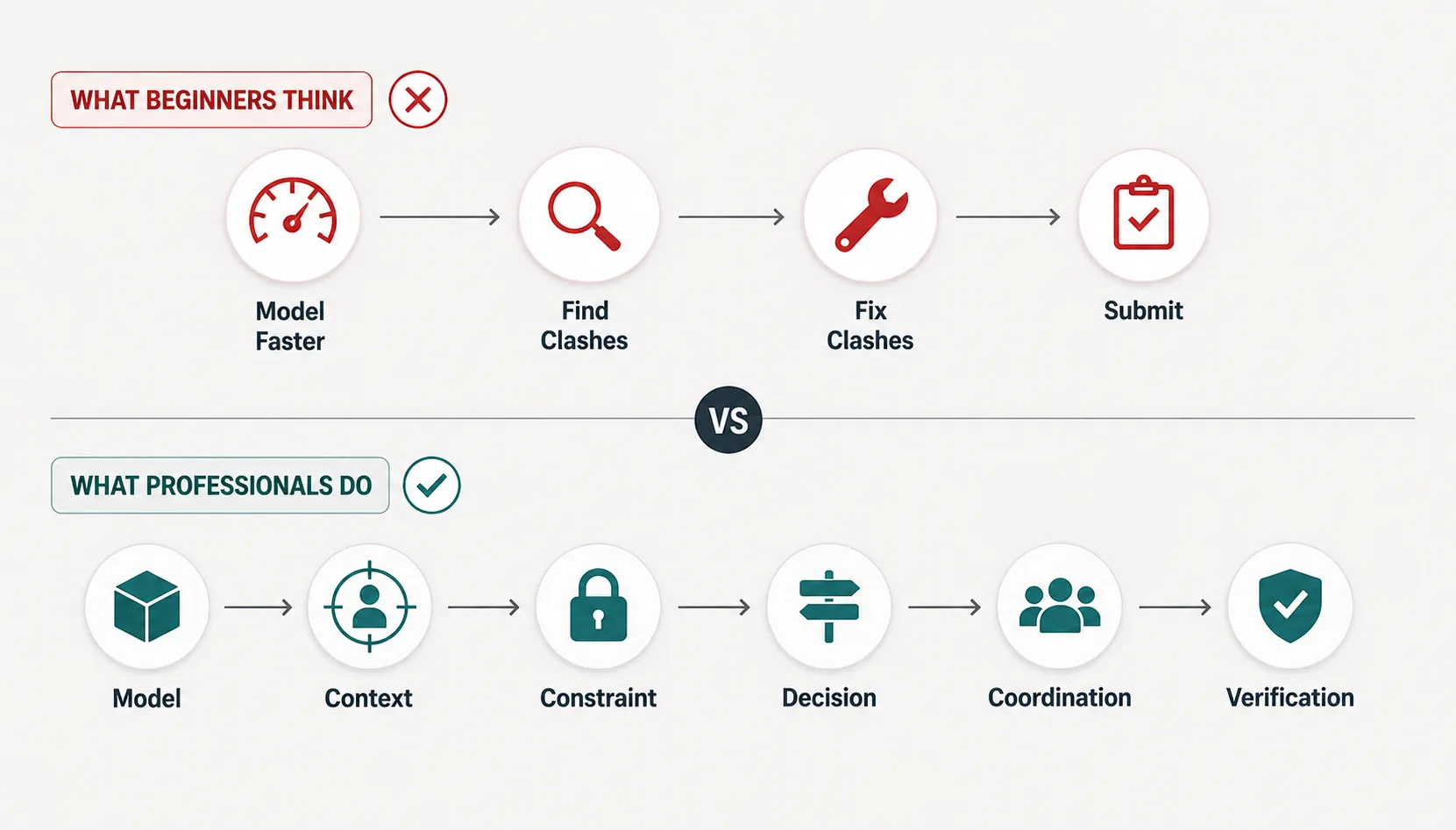
A beginner may think becoming good at BIM means:
- Model faster
- Find clashes
- Fix clashes
- Submit
Real projects are rarely that simple.
Professional BIM work requires you to understand:
- Model
- Context
- Constraint
- Decision
- Coordination
- Verification
The more you understand the reasoning behind a model change, the more valuable your BIM skills become.
The Skill Behind Good Coordination
The strongest BIM professionals don't necessarily know every answer immediately.
They know what questions to ask.
When they see a clash, they think:
- What is the design intent?
- Which system has the least flexibility?
- Is there a code or clearance requirement?
- Can the proposed change affect another discipline?
- Is the latest design information being used?
- Can the solution actually be constructed?
- Does the client need to approve the change?
That mindset takes BIM coordination beyond software.
From Clash Detection to Decision Making
The evolution is simple:
Beginner
“There is a clash.”
Developing BIM Professional
“There is a clash. I'll find a way to move the elements.”
Experienced BIM Professional
“There is a clash. Let's understand the constraints before deciding what should change.”
That difference may look small.
On a complex project, it can make a huge difference.
Final Thoughts
BIM coordination isn't about making the clash report disappear.
It's about making better project decisions before they become construction problems.
A BIM model can show where two systems conflict.
But people still need to understand why they conflict, what can change, what shouldn't change, and what the final solution means for the project.
That's why the best BIM professionals aren't simply fast modelers or skilled clash-detection operators.
They understand the consequences of a decision before making the change.
And when three disciplines disagree, the goal isn't to find someone to blame.
It's to find a solution the building can actually live with.
Frequently Asked Questions
What is BIM coordination?
BIM coordination is the process of bringing information from different disciplines together, identifying conflicts, reviewing their impact, and developing coordinated solutions before construction.
Is clash detection the same as BIM coordination?
No. Clash detection identifies potential conflicts. BIM coordination goes further by evaluating those conflicts, discussing possible solutions, implementing changes, and verifying the result.
Who decides which element should move in a BIM clash?
There is no universal rule. The decision depends on design intent, engineering requirements, constructability, project standards, client requirements, and the impact on other disciplines.
What does a BIM Coordinator do during clash resolution?
A BIM Coordinator helps organise and review coordination issues, brings the relevant disciplines together, tracks decisions, and verifies that agreed changes are properly coordinated.
Can a clash-free model still have problems?
Yes. A model can have no detected geometric clashes and still have issues involving design intent, missing information, incorrect standards, access, constructability, or coordination requirements.
Why is construction knowledge important for BIM coordination?
Because a technically possible modelling solution may not always be practical to construct, install, access, or maintain. Understanding construction helps BIM professionals evaluate solutions more realistically.
Professional BIM Course
Master BIM Course
Structural Design Concepts and BIM
Certified MEPF BIM Master Course
Electrical BIM Professional Program
RenderLab – Master 3D Modeling & Photorealistic Rendering
Multi-Tool Mastery for Architects & Engineers
BIM Coordinator Workflow Program
BIM FastTrack – 30 Day Intensive Training
Global Architectural & Structural BIM Project Program