Author: Devika R
October 6, 2026
6 min read
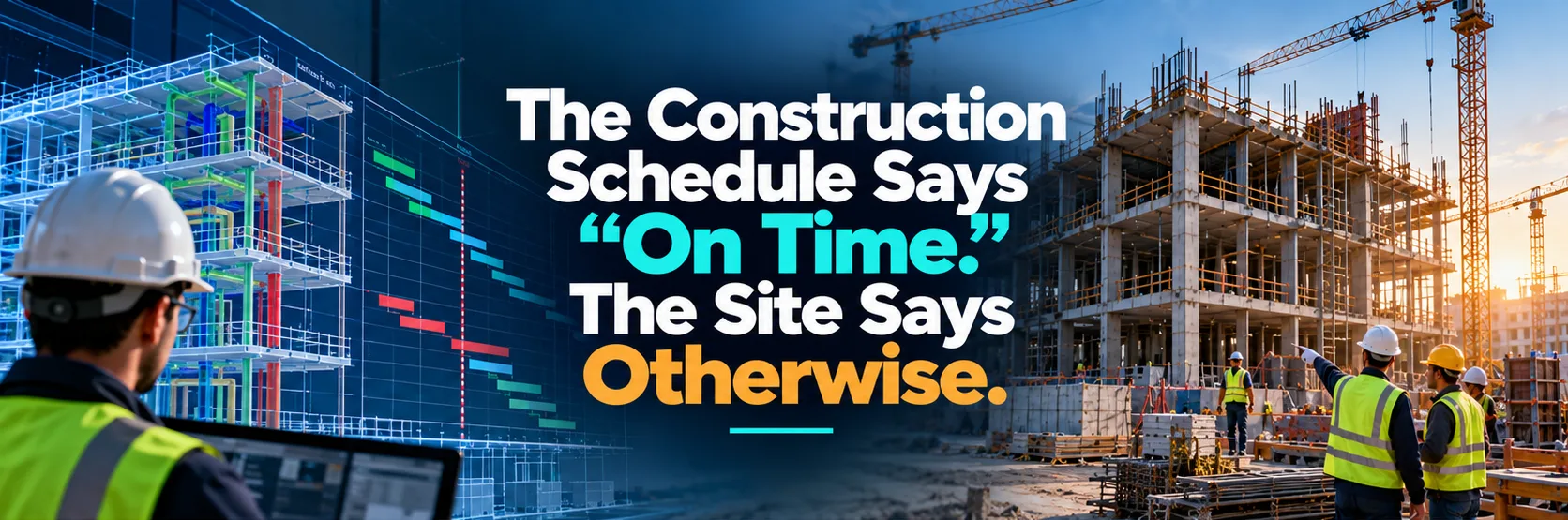
What happens when the project plan and construction reality start telling different stories?
The schedule says the work should be on track.
The BIM model shows the planned sequence.
The progress report looks fine.
Then someone walks onto the site and says:
“We’re not actually there yet.”
It sounds like a simple project-management problem.
But on a complex construction project, it can be much harder to see where the gap began.
A project doesn’t exist only in a schedule or a model. It exists in the physical work happening every day.
And sometimes, those three versions of the project don’t quite agree.
The Plan Looks Fine
Before work begins, the project team has a plan.
Activities are arranged in sequence. Expected dates are assigned. Different trades are planned around one another.
The BIM environment can add another layer by showing how the construction sequence relates to the physical project.
On screen, everything can look surprisingly clear.
But construction has a habit of introducing things that weren’t visible in the original plan.
A delivery arrives late.
Another trade isn’t finished.
A design changes.
An area isn’t accessible.
A site condition turns out to be different from what was expected.
One small change can affect several activities after it.
Then the Site Tells a Different Story
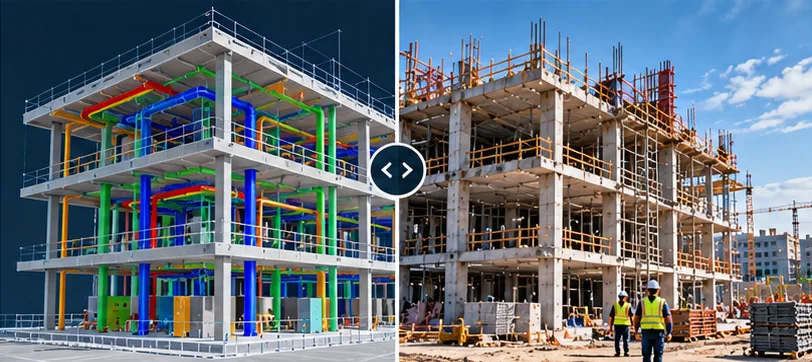
Imagine a floor that was supposed to be ready for the next activity this week.
The schedule says it should be.
The model shows what the completed area should contain.
But when the team visits the site, part of the work is still unfinished.
Nothing is necessarily wrong with the model.
Nothing is necessarily wrong with the original schedule either.
The problem is that the project has moved on while the information hasn’t caught up.
That gap can be easy to miss when different teams are looking at different sources of information.
Where BIM Can Help
This is one reason model-based planning can be useful.
Instead of looking at the building only as a finished object, teams can connect planned activities with the elements being constructed.
That makes it easier to ask practical questions:
What should be happening now?
What was supposed to be completed already?
What comes next?
Which work depends on something that hasn’t been finished?
The value isn’t in creating a more impressive animation.
It is in making the construction sequence easier to understand.
But BIM Can’t See Everything
This is important.
A model can show what is planned.
It cannot automatically know why a team couldn’t complete something yesterday.
It may not know that a material delivery was delayed.
It may not know that another contractor is still working in the same area.
It may not know that actual site conditions forced a change.
And it certainly cannot replace the people who understand what is happening on the ground.
That’s why the question isn’t:
“Can BIM replace the construction schedule?”
It is:
“Can BIM help the team understand the difference between the plan and reality?”
That is a much more useful question.
When the Plan and Reality Meet
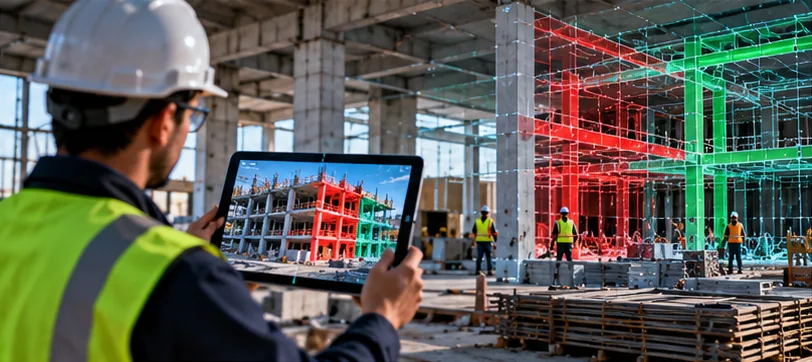
This is where newer digital workflows become interesting.
Site photographs, field updates, model information and project records can increasingly be brought together.
The goal isn’t to create another dashboard that someone checks once a week.
The goal is to make differences visible early.
If a planned activity hasn’t happened, the team should be able to recognise it.
If one delay affects another activity, that relationship should be easier to understand.
If the physical work is progressing differently from the original plan, the project team should know before the difference becomes a much larger problem.
A Schedule Can Be Correct and Still Be Outdated
This is perhaps the most important point.
A schedule isn’t necessarily wrong because the project has changed.
It simply represents a particular understanding of what was expected to happen.
The same applies to a BIM model.
The problem begins when teams continue making decisions from information that no longer represents the current situation.
That is why updating information matters just as much as creating it.
The Real Value Is in the Conversation
A useful BIM workflow doesn’t eliminate conversations between the office and the site.
It can make those conversations better.
Instead of:
“Why are we behind?”
the discussion can become:
“This activity was expected to be complete by now. What changed?”
Instead of discovering a problem at the end of the week, the team can start asking about it while there is still time to respond.
That shift—from reporting what happened to understanding what is changing—can be valuable on any complex project.
What This Means for BIM Professionals
This also changes the way BIM professionals need to think about their work.
The job isn’t only to create a model that looks right.
It is to understand how that model connects with the way a project is actually being delivered.
That means being aware of:
- Construction sequence
- Project changes
- Site conditions
- Information updates
- Dependencies between activities
- The people who rely on project information
A BIM professional doesn’t need to become a project scheduler to understand these relationships.
But understanding how the model connects to construction makes the work far more useful.
The Site Gets the Final Say
A project can look perfectly organised on a screen.
But eventually, someone has to build it.
That’s where the difference between planned progress and actual progress becomes real.
The schedule tells us what was expected.
The BIM model can help us understand what that work looks like.
The site tells us what actually happened.
The opportunity is not to choose one over the other.
It is to bring them closer together.
Because the most useful digital construction workflow may not be the one that predicts everything perfectly.
It may simply be the one that helps a project team notice, early enough:
“This isn’t going according to plan. What do we need to do now?”
Frequently Asked Questions
What is 4D BIM?
4D BIM connects the project model with the construction sequence, helping teams understand how planned work progresses over time.
Can BIM track actual construction progress?
BIM can support progress tracking when model information is connected with current site information. The model itself does not automatically know what has been built.
Is BIM a replacement for a construction schedule?
No. BIM and scheduling serve different purposes. When used together, they can help teams better understand planned activities, dependencies, and actual progress.
Why can a project be “on schedule” on paper but delayed on site?
Schedules are based on planned activities. Changes in design, materials, site conditions, access, labour or preceding activities can affect what actually happens.
Does BIM eliminate construction delays?
No. BIM can help teams identify relationships, communicate changes and spot differences between planned and actual work, but it cannot eliminate the underlying causes of delays.
Why is updating BIM information important during construction?
Because project conditions change. Information that no longer reflects the current project can lead to decisions based on an outdated picture of the work.
Professional BIM Course
Master BIM Course
Structural Design Concepts and BIM
Certified MEPF BIM Master Course
Electrical BIM Professional Program
RenderLab – Master 3D Modeling & Photorealistic Rendering
Multi-Tool Mastery for Architects & Engineers
BIM Coordinator Workflow Program
BIM FastTrack – 30 Day Intensive Training
Global Architectural & Structural BIM Project Program