Author: Devika R
October 15, 2026
6 min read

Construction is one of the world’s largest industries. It builds the homes people live in, the hospitals they depend on, the roads they travel on and the infrastructure that supports entire economies.
Yet there is a problem hiding behind all that activity: construction has struggled to improve productivity at the same pace as other industries.
McKinsey’s analysis of 42 countries found that global construction productivity increased by only about 10% between 2000 and 2022, compared with 50% for the overall economy and 90% for manufacturing. More recent research continues to show that the problem has not disappeared.
The question is no longer whether construction has a productivity problem.
It is why it has been so difficult to solve.
Construction Is Not a Factory
A factory can repeatedly produce the same product in a controlled environment.
A construction project is different.
Every project has its own:
- Site conditions
- Design
- Client requirements
- Contractors
- Subcontractors
- Materials
- Regulations
- Schedule
- Workforce
The work moves from one location to another, and teams that may never have worked together before are expected to deliver a highly coordinated result.
That makes productivity much harder to improve.
A faster worker cannot solve a project where the required material has not arrived.
A larger workforce cannot fix a design decision that changes every few weeks.
And better software cannot compensate for a process in which five different teams are working from five different understandings of the project.
Where the Hours Go
Construction productivity is not simply about how quickly someone installs a wall or pours concrete.
A significant amount of project time can disappear into activities that don’t directly create physical output.
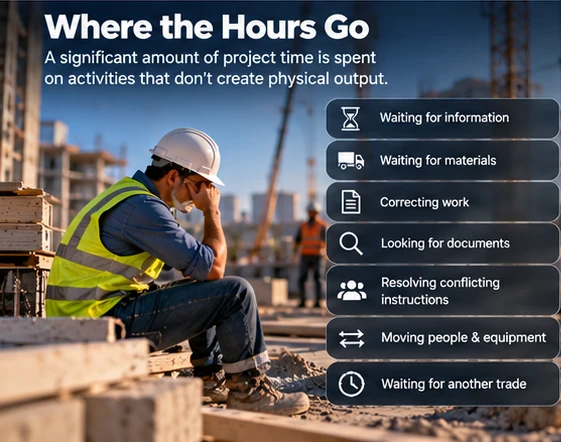
- Waiting for information.
- Waiting for materials.
- Correcting work.
- Looking for documents.
- Resolving conflicting instructions.
- Moving people and equipment.
- Reworking something that was installed incorrectly.
- Waiting for another trade to finish.
These small losses accumulate.
A few minutes here and an hour there may not look serious on a single task. Across hundreds of workers and thousands of activities, they can become a major project cost.
This is one reason productivity cannot be improved simply by telling people to work faster.
Rework Is More Expensive Than It Looks
Imagine a mechanical service that cannot be installed because another element is already occupying the required space.
The problem may appear on site in a matter of minutes.
But the consequences can spread much further:
- Site interruption
- Redesign
- Coordination
- Material adjustment
- Labour rescheduling
- Installation again
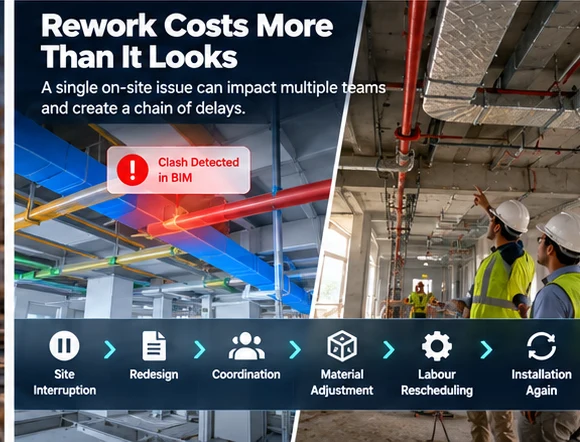
The visible problem is one installation.
The actual productivity loss involves several teams.
This is why reducing rework is often more valuable than simply trying to increase the speed of individual tasks.
The Fragmentation Problem
Construction is also highly fragmented.
Architects, structural engineers, MEP consultants, contractors, specialist subcontractors, suppliers and site teams often operate as separate organisations with different responsibilities and priorities.
That fragmentation creates interfaces.
And interfaces create opportunities for information to be lost.
A subcontractor may receive information later than expected.
A supplier may be working with an earlier specification.
A site team may discover a condition that was not reflected in the latest information.
Each issue can create another delay or another round of work.
Research into construction productivity repeatedly identifies fragmentation, skills shortages, poor project management and underinvestment in innovation as persistent barriers.
Technology Has Not Automatically Fixed It
This is where the discussion becomes interesting.
The construction industry has invested heavily in technology.
BIM, cloud platforms, reality capture, sensors, automation, robotics and AI are all changing parts of the industry.
But technology adoption and productivity improvement are not the same thing.
McKinsey notes that many construction technologies have been adopted primarily to improve control, design, safety or information management rather than directly transforming workforce productivity.
A company can buy sophisticated software and still have inefficient processes.
It can have a detailed BIM model and still experience material delays.
It can have project dashboards and still struggle to make decisions.
Technology becomes productive when it changes how work gets done, not simply when another digital tool is added to the project.
The Workforce Matters
There is another side to the productivity problem: people.
Construction depends heavily on skilled workers, yet many markets face labour shortages and an ageing workforce.
When experienced workers are difficult to replace, productivity can suffer.
New workers need time to develop practical knowledge. Temporary or inexperienced labour can require more supervision and may initially work less efficiently. McKinsey’s research links tight labour markets and workforce churn with significant productivity declines on projects.
This makes training more than a recruitment issue.
It becomes a productivity strategy.
The industry needs people who understand not only how to perform individual tasks, but also how their work affects everything that comes before and after it.
Measurement Is Another Problem
You cannot improve what you cannot properly measure.
But construction does not even have one universally accepted definition of productivity.
The 2026 RICS Construction Productivity Report found significant variation in how firms define and measure productivity across regions. Benchmark adoption also remains low, with only a small share of firms using external productivity benchmarks.
That creates a basic problem.
If one company measures productivity through output per worker hour while another uses a completely different indicator, comparing performance becomes difficult.
Without reliable measurement, improvement programmes can easily become assumptions rather than evidence-based decisions.
Where BIM Fits In
BIM cannot solve the construction productivity problem by itself.
But it can address some of the conditions that create wasted time.
A well-managed BIM workflow can help teams:
- identify conflicts earlier
- improve access to project information
- understand design intent
- coordinate different disciplines
- support better planning
- reduce avoidable rework
- connect information across project stages
The important word is help.
A BIM model does not make a project productive simply because it exists.
Its value depends on whether the information reaches the right people, at the right time, in a form they can actually use.
That means BIM should be viewed as part of a broader productivity system rather than as a productivity solution on its own.
The Bigger Opportunity
Construction does not necessarily need to become a factory.
It needs to become better at identifying and eliminating the things that make productive work difficult.
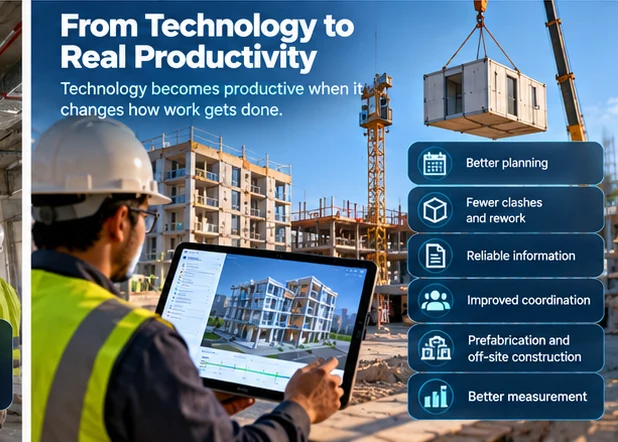
That could mean better planning.
Better training.
Earlier decision-making.
More reliable information.
Standardised processes where standardisation makes sense.
Greater use of prefabrication.
Better measurement.
And technology that genuinely changes the way work is performed rather than simply digitising existing processes.
Some of these changes are already happening. Others remain difficult to scale.
The challenge is that construction productivity cannot be fixed by one software package, one technology or one company.
It requires the industry to rethink how projects are designed, planned, supplied, built and measured as a connected system.
The Problem Is Not That Construction Is Standing Still
Construction has changed enormously.
The industry now has technologies that were barely imaginable a generation ago.
The challenge is turning those individual advances into repeatable improvements in how projects are delivered.
That may be the real productivity gap.
Not a lack of technology.
Not a lack of ideas.
But the difficulty of turning good ideas into everyday construction practice.
And until the industry solves that problem, building faster will remain much harder than simply building with better technology.
Professional BIM Course
Master BIM Course
Structural Design Concepts and BIM
Certified MEPF BIM Master Course
Electrical BIM Professional Program
RenderLab – Master 3D Modeling & Photorealistic Rendering
Multi-Tool Mastery for Architects & Engineers
BIM Coordinator Workflow Program
BIM FastTrack – 30 Day Intensive Training
Global Architectural & Structural BIM Project Program