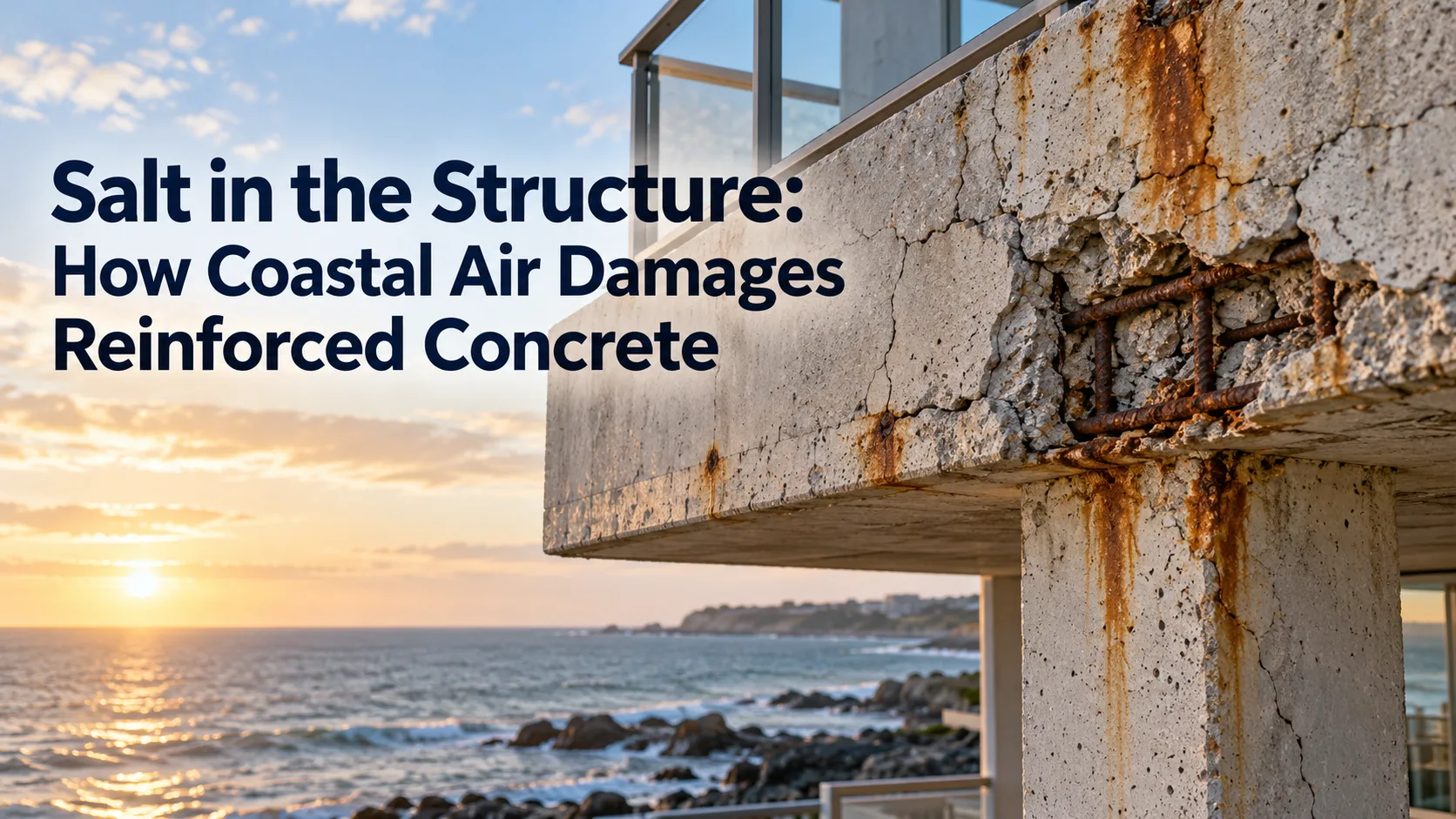
From rust-stained balconies to deteriorating concrete columns, understanding how salt and moisture affect reinforcement can help buildings withstand the challenges of coastal environments.
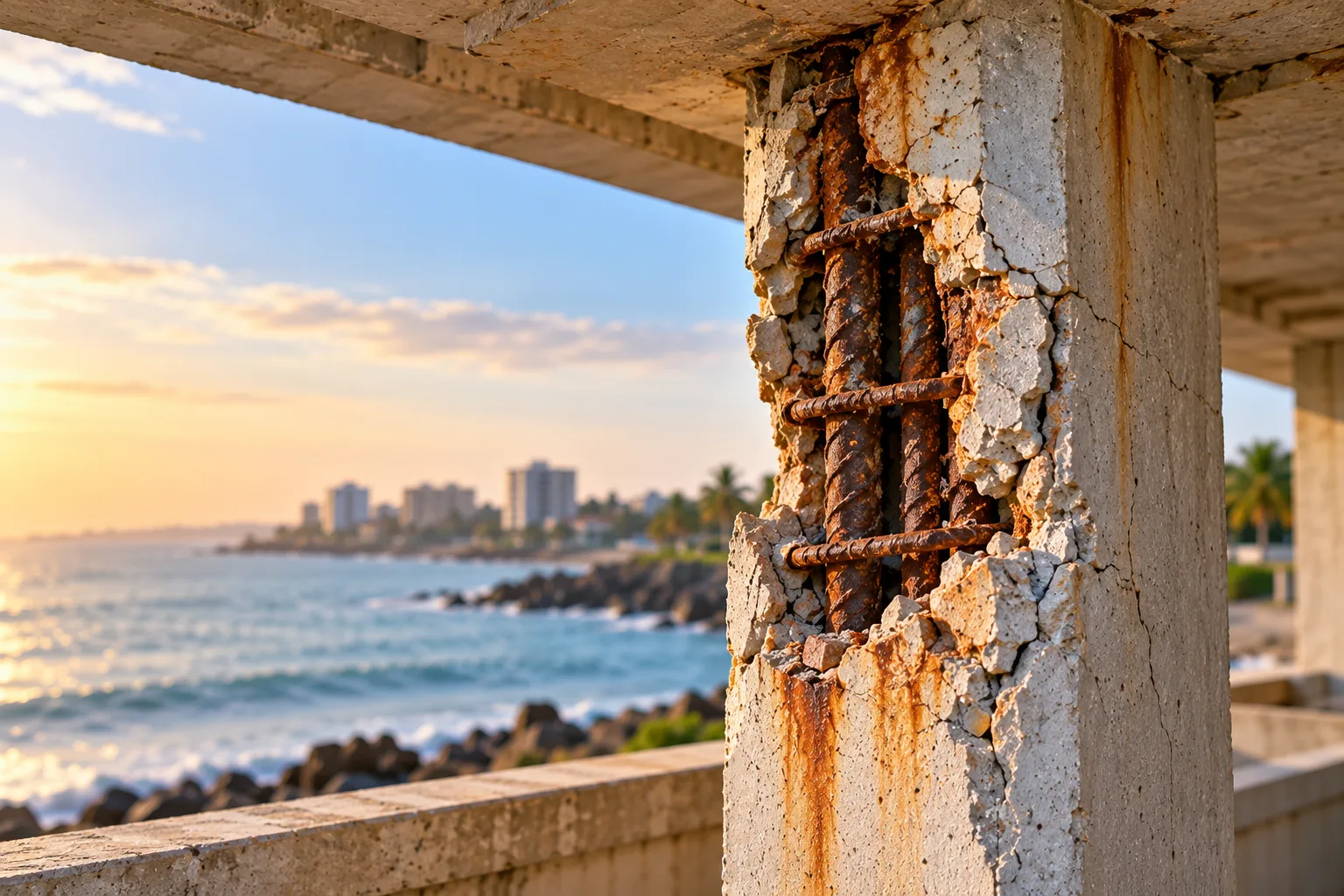
A faint rust-coloured stain appears along the edge of a concrete balcony. At first, it seems like a minor surface defect. Months later, a crack develops in the same area. Eventually, a small piece of concrete breaks away, exposing the steel reinforcement beneath.
What looks like an ordinary maintenance problem may have started years earlier, long before the first stain became visible.
In coastal regions, buildings face environmental conditions that can gradually affect the durability of reinforced concrete. Salt carried by sea air, moisture and repeated wetting and drying can contribute to the corrosion of embedded steel.
The effects are particularly relevant to coastal cities, where residential buildings, bridges, ports and other infrastructure may remain exposed to aggressive environmental conditions throughout their service lives.
Understanding reinforced concrete corrosion begins with a question that is easy to overlook: how does salt reach steel that is completely surrounded by concrete?
Concrete Looks Solid. How Does Salt Reach the Steel?
Reinforced concrete combines two materials with complementary properties. Concrete provides compressive strength, while embedded steel reinforcement helps resist tensile forces.
The concrete surrounding the reinforcement also provides protection against corrosion.
Although hardened concrete appears solid, it contains a network of extremely small pores. Water and dissolved substances can move through these pores, depending on the concrete's composition, quality and exposure conditions.
In coastal environments, salt particles carried by the wind may settle on exposed concrete surfaces. Rainwater and moisture can dissolve these deposits, allowing chloride ions to move into the concrete over time.
Chlorides may also enter through cracks, poorly constructed joints or areas where the concrete is particularly porous.
The movement is generally gradual, but it becomes important when chlorides reach the reinforcement.
Concrete normally provides an alkaline environment that supports a thin protective layer on embedded steel. This layer, known as a passive film, helps prevent corrosion.
When sufficient chloride ions reach the steel, they can locally disrupt this protective film.
With moisture and oxygen available, the conditions for reinforcement corrosion may develop.
What Happens When Reinforcement Starts Corroding?
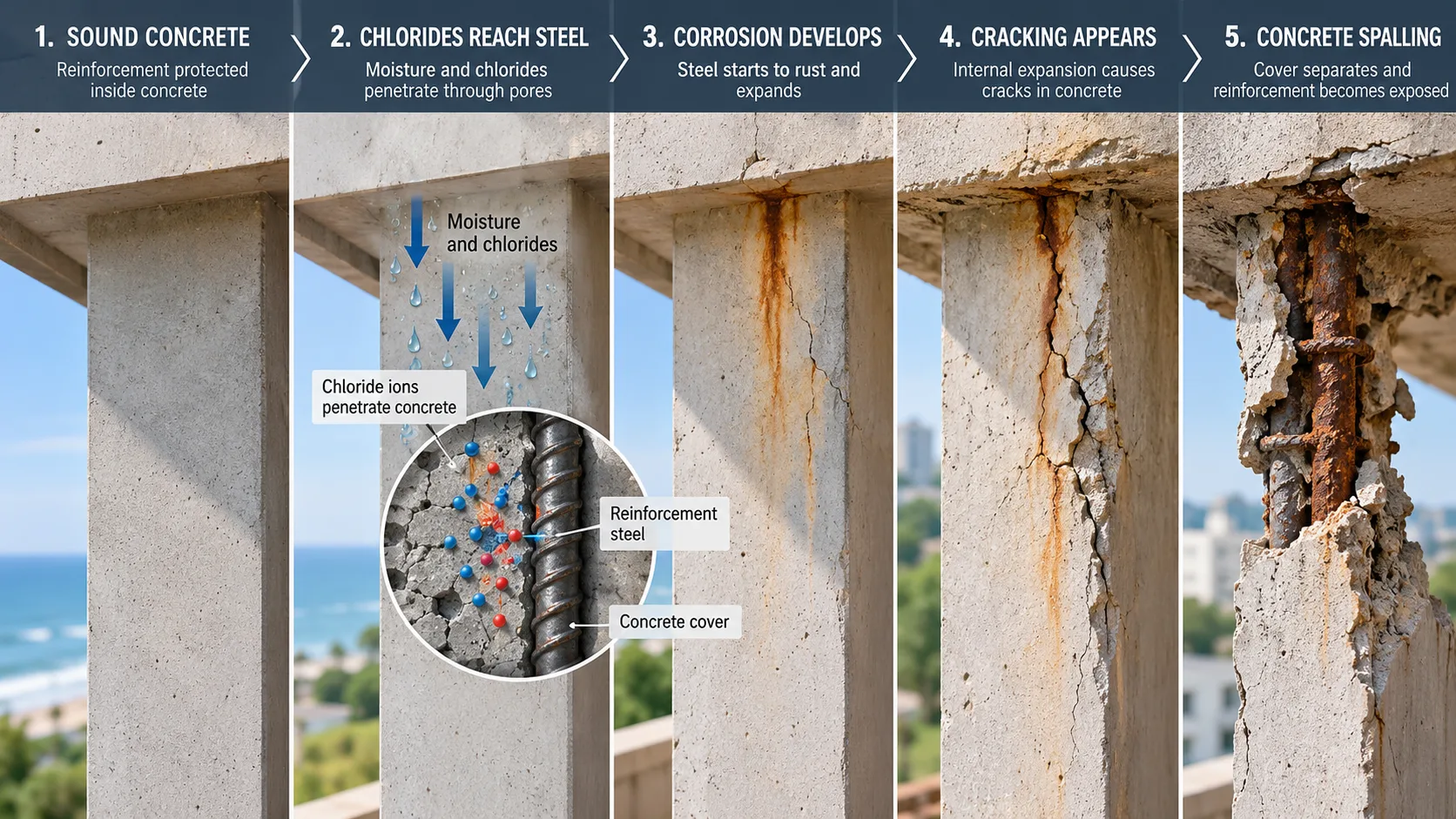
The early stages of steel corrosion may be invisible from outside the structure.
As corrosion progresses, the steel reacts with its environment and forms corrosion products commonly recognised as rust.
These products can occupy more space than the original metal, creating pressure against the surrounding concrete.
Because concrete has limited tensile strength, this internal expansion may eventually cause cracks to form along the reinforcement.
Further deterioration can lead to concrete spalling, where sections of the concrete cover separate or break away.
Once the reinforcement becomes exposed, moisture and chlorides can reach it more easily, potentially accelerating the damage.
Corrosion may also reduce the effective cross-sectional area of the reinforcing steel and affect its bond with the surrounding concrete.
These changes can influence structural performance if deterioration becomes sufficiently advanced.
However, not every crack or rust-coloured stain indicates reinforcement corrosion. Concrete can crack due to shrinkage, thermal movement, loading, settlement or other mechanisms.
Identifying the actual cause requires appropriate inspection and engineering assessment.
Why Coastal Exposure Makes a Difference
Not every building near the sea experiences the same level of corrosion risk.
Exposure depends on factors such as distance from the shoreline, prevailing winds, salt deposition, rainfall, humidity and the frequency of wetting and drying.
A concrete surface directly exposed to sea spray may experience different conditions from a sheltered wall located further inland.
Structures exposed to repeated cycles of wetting and drying can be particularly vulnerable.
During wet periods, moisture can carry dissolved chlorides into concrete. As the surface dries, salt deposits may remain, while oxygen becomes more readily available to support corrosion reactions.
Over many cycles, chloride concentrations within the concrete can increase.
This helps explain why certain exposed parts of coastal structures may deteriorate faster than others.
Balconies, parapets, projecting slabs and external structural members deserve attention because their exposure conditions and construction details can influence moisture entry.
Marine structures also demonstrate how environmental exposure varies. Components in tidal or splash zones may face particularly aggressive conditions, while permanently submerged elements can behave differently because oxygen availability is more limited.
Coastal exposure does not automatically mean a structure will fail prematurely. Properly designed and constructed reinforced concrete can perform reliably in marine environments.
The difference often lies in how effectively the structure has been designed to resist deterioration.
The Construction Details That Determine Durability
Concrete durability is influenced by more than its compressive strength.
A concrete mix may achieve its specified strength while still having characteristics that affect how easily moisture and chlorides can penetrate it.
One important consideration is permeability.
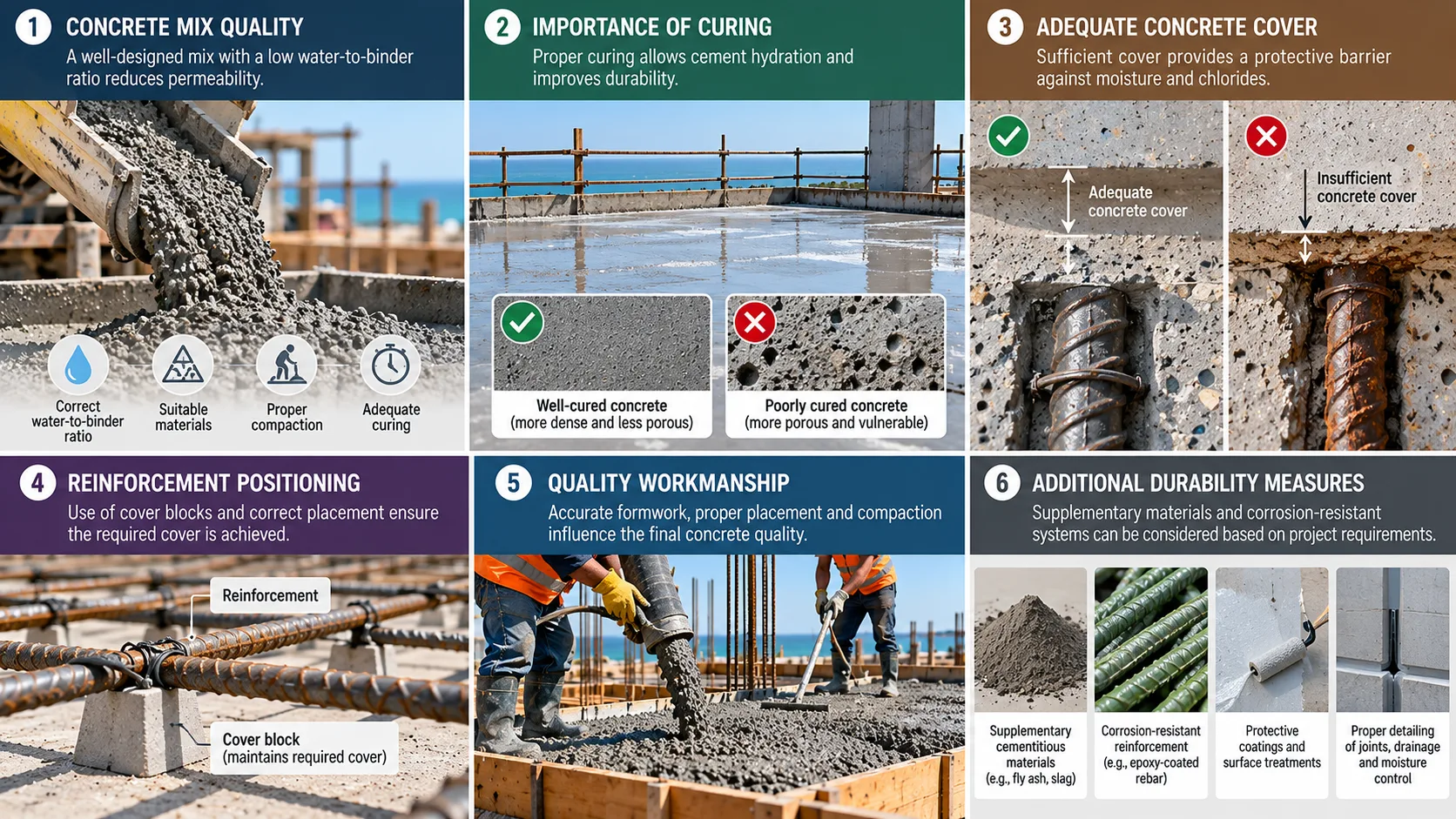
Concrete with a well-designed mix, appropriate water-to-binder ratio, proper compaction and adequate curing can provide greater resistance to the movement of harmful substances.
Curing is particularly important because it allows cement hydration to progress and helps develop the concrete's intended properties.
Poor curing, excessive mixing water and inadequate compaction can compromise the quality of the hardened material.
Another critical factor is concrete cover—the distance between the outer concrete surface and the embedded reinforcement.
Adequate cover provides a protective barrier that chlorides must pass through before reaching the steel.
If reinforcement is placed too close to the surface, this protection may be reduced.
Construction workmanship therefore matters as much as the design specification. Reinforcement positioning, cover blocks, formwork accuracy, concrete placement and proper curing all influence the finished structure.
Depending on project requirements, supplementary cementitious materials and corrosion-resistant reinforcement systems may also be considered to improve durability.
These choices must be evaluated for the intended exposure conditions, structural requirements and applicable standards.
Designing Concrete for Coastal Conditions
Durability should be considered before construction begins.
In India, IS 456:2000, the code of practice for plain and reinforced concrete, classifies environmental exposure conditions and provides corresponding durability requirements.
These include considerations relating to concrete quality, water–cement ratio and nominal cover to reinforcement.
Coastal exposure is specifically recognised, with different levels of severity depending on environmental conditions such as salt-laden air, seawater spray and tidal exposure.
This distinction is important because a sheltered structural element and one exposed to direct marine conditions may not require identical durability provisions.
For design teams, durability planning involves more than choosing a concrete grade.
It includes assessing the exposure environment, specifying appropriate materials, detailing drainage and joints, controlling cracks and ensuring construction quality.
Protective coatings, surface treatments or specialised reinforcement may offer additional protection in suitable applications.
However, no single treatment can compensate for every weakness in material selection, structural detailing or workmanship.
The most reliable approach combines appropriate design decisions with quality control during construction.
Recognising Damage Before It Becomes Serious
Corrosion-related damage often develops gradually, which makes regular inspection valuable.
Rust staining, cracks following reinforcement lines, localised concrete separation and exposed steel can indicate possible deterioration.
Other warning signs may include loose concrete, surface delamination or recurring damage in areas previously repaired.
These symptoms should not be assessed solely by appearance.
A structural engineer may use methods such as concrete-cover measurements, chloride testing, corrosion-potential assessment or other appropriate investigations to understand the condition of the reinforcement.
The choice of investigation depends on the structure, observed damage and purpose of the assessment.
Early identification is important because superficial repairs may not address an underlying corrosion problem.
Painting over a stained surface or patching damaged concrete without investigating the cause can allow deterioration to continue.
Where corrosion is confirmed, suitable repair strategies may involve removing deteriorated material, treating or replacing affected reinforcement where necessary, restoring the concrete and addressing the conditions that contributed to the damage.
Such repairs require professional assessment, particularly when structural members are involved.
Durability Continues After Construction
A coastal building's durability is influenced by how it is maintained throughout its life.
Water accumulation, failed sealants, damaged protective coatings and blocked drainage paths can increase exposure to moisture.
Routine maintenance can help prevent minor defects from developing into more serious problems.
For example, a leaking joint or damaged protective finish may appear insignificant but can create a path for water and chlorides to enter the concrete.
Addressing such defects early may reduce the likelihood of more extensive repairs later.
Building owners and facility managers therefore have a role alongside architects, structural engineers and contractors.
A structure's service life depends not only on how it was designed and constructed, but also on how its condition is monitored and maintained.
Building for the Years Ahead
A newly completed concrete building rarely reveals how it will respond to decades of coastal exposure.
Its long-term performance depends on decisions that are largely hidden after construction: concrete composition, reinforcement cover, curing quality, structural detailing and protection against moisture and chlorides.
These details may receive less attention than visible finishes, yet they help determine how effectively a building withstands its environment.
For coastal regions, durability is not simply a matter of preventing rust stains or repairing damaged concrete.
It is about preserving structural performance, reducing avoidable maintenance and extending the useful life of buildings and infrastructure.
The most effective approach begins with understanding the environmental conditions and designing accordingly, supported by careful construction and regular maintenance.
A building's strength is demonstrated when it is constructed. Its durability is revealed by how well that strength is preserved over time.