Author: Devika R
October 27, 2026
7 min read
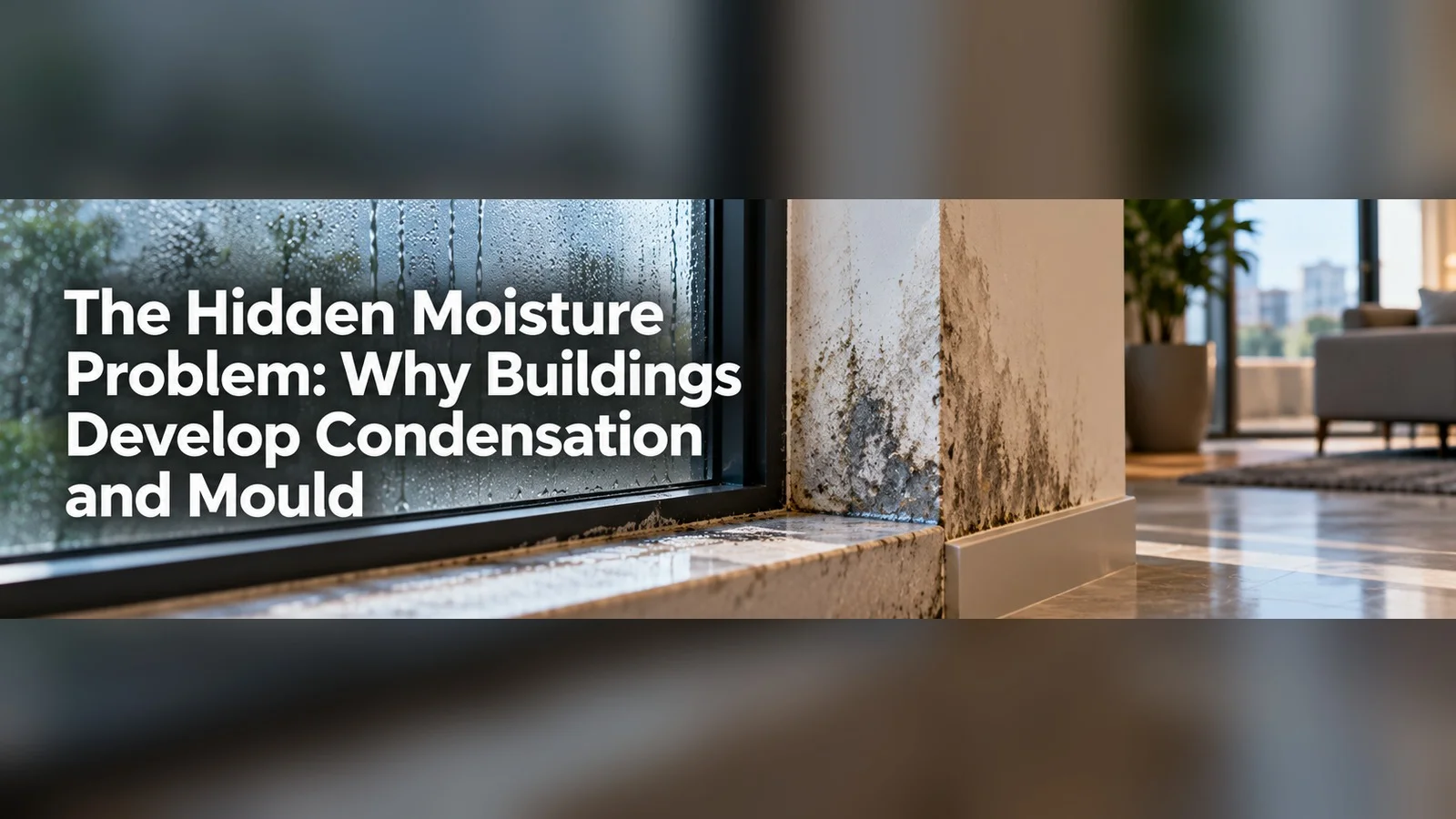
From damp walls and peeling paint to hidden condensation, understanding how moisture moves through buildings can prevent problems that begin long before they become visible.
A newly finished apartment develops dark patches along an external wall. In an office, paint begins peeling near an air-conditioned room. A hospital corridor has a persistent musty smell, even though the floors are regularly cleaned.
The first response is often familiar: repaint the wall, apply a waterproof coating or replace the damaged finish.
But the visible damage may be only the final stage of a problem developing inside the building.
Moisture can enter through leaks, travel with moving air or accumulate when humid air encounters a sufficiently cold surface. It may remain unnoticed within walls, ceilings and insulation before stains or mould appear.
Understanding moisture control in buildings requires looking beyond surface finishes to the relationship between architecture, construction materials, ventilation and temperature.
A Wall Can Be Wet Without a Plumbing Leak
Water does not always enter a building through a broken pipe or an obvious roof leak.
Rainwater can penetrate poorly detailed window joints, roof connections and external walls. Moisture may also rise into porous materials through capillary action where appropriate damp-proofing is absent or ineffective.
Another source is condensation.
Air contains water vapour. The amount it can hold before reaching saturation depends on its temperature. When humid air comes into contact with a surface that is cold enough, some of that vapour can condense into liquid water.
The temperature at which condensation begins is known as the dew point.
It explains why water droplets form on the outside of a chilled glass. A similar process can occur on building surfaces or within construction assemblies when the temperature and moisture conditions allow it.
The challenge is that condensation inside a wall may not be visible until materials have already been affected.
Why Air-Conditioned Buildings Can Develop Moisture Problems
In warm, humid climates, the relationship between indoor cooling and outdoor air deserves particular attention.
Consider a commercial building where the outdoor air is warm and humid, while the interior is maintained at a much lower temperature.
If moist outdoor air enters through unsealed joints, gaps around windows or service penetrations, it may encounter surfaces cooled by the air-conditioning system.
When those surfaces fall below the dew point of the surrounding air, condensation can occur.
The risk depends on several conditions, including outdoor humidity, indoor temperature, surface temperature, air movement and the construction of the wall or ceiling.
This is why a building can experience condensation problems even when there is no visible rainwater leakage.
Air-conditioning systems also have another responsibility: managing indoor humidity.
A system may cool a room adequately without controlling moisture effectively, particularly when equipment selection, operation or ventilation arrangements are unsuitable.
Comfortable temperature alone does not establish that indoor moisture is under control.
The Building Envelope Does More Than Keep Out Rain
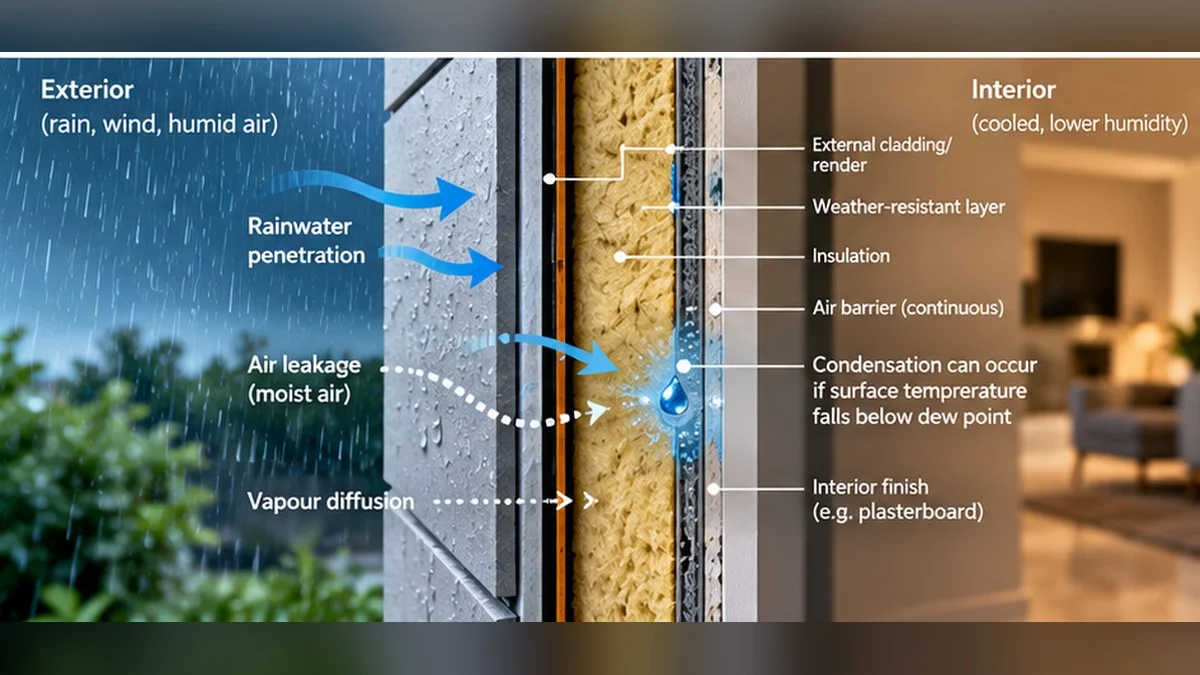
The building envelope includes the walls, roof, windows, doors and other assemblies separating indoor and outdoor environments.
Its performance depends on controlling several forms of moisture movement.
Liquid water can enter through cracks, failed seals, roof defects or poorly detailed connections.
Air leakage can carry water vapour through gaps in the construction, potentially depositing moisture when that air reaches colder surfaces.
Vapour diffusion occurs when water vapour moves through materials because of differences in vapour pressure.
These mechanisms are different and require different approaches.
A waterproof external finish may help resist rain penetration, but it will not necessarily prevent humid air from moving through an unsealed service opening.
Similarly, installing a vapour-resistant layer without considering the entire wall assembly can create difficulties if moisture becomes trapped and cannot dry adequately.
Good building-envelope design must consider how moisture enters, where it may accumulate and how the assembly can safely dry.
Why Materials and Construction Details Matter
Two buildings with similar appearances can perform very differently when exposed to moisture.
The difference may lie in details that are rarely visible after construction.
Window-to-wall connections, roof parapets, expansion joints, façade interfaces and penetrations for pipes or cables all require careful detailing.
Insulation also influences condensation risk because it changes temperature distribution within an assembly.
Poorly coordinated insulation, air barriers and finishes can leave cold surfaces exposed to humid air or create conditions where moisture accumulates inside building materials.
Material selection matters as well. Some materials tolerate occasional wetting better than others, while certain finishes restrict drying.
For example, a low-permeability interior finish may cause difficulties in a humid, air-conditioned building if it prevents moisture within an external wall from drying towards the interior.
This does not mean every building needs the same membrane, coating or insulation arrangement.
The correct solution depends on climate, wall construction, indoor conditions and the intended performance of the assembly.
When Architecture and HVAC Design Must Work Together
Moisture problems are sometimes treated as either an architectural defect or a mechanical engineering issue.
In practice, the two can be closely connected.
An architect may specify the wall assembly and finishes. The mechanical engineer determines cooling, ventilation and humidity-control requirements. Contractors install the systems and seal the interfaces between them.
A weakness in any part of that arrangement can affect the completed building.
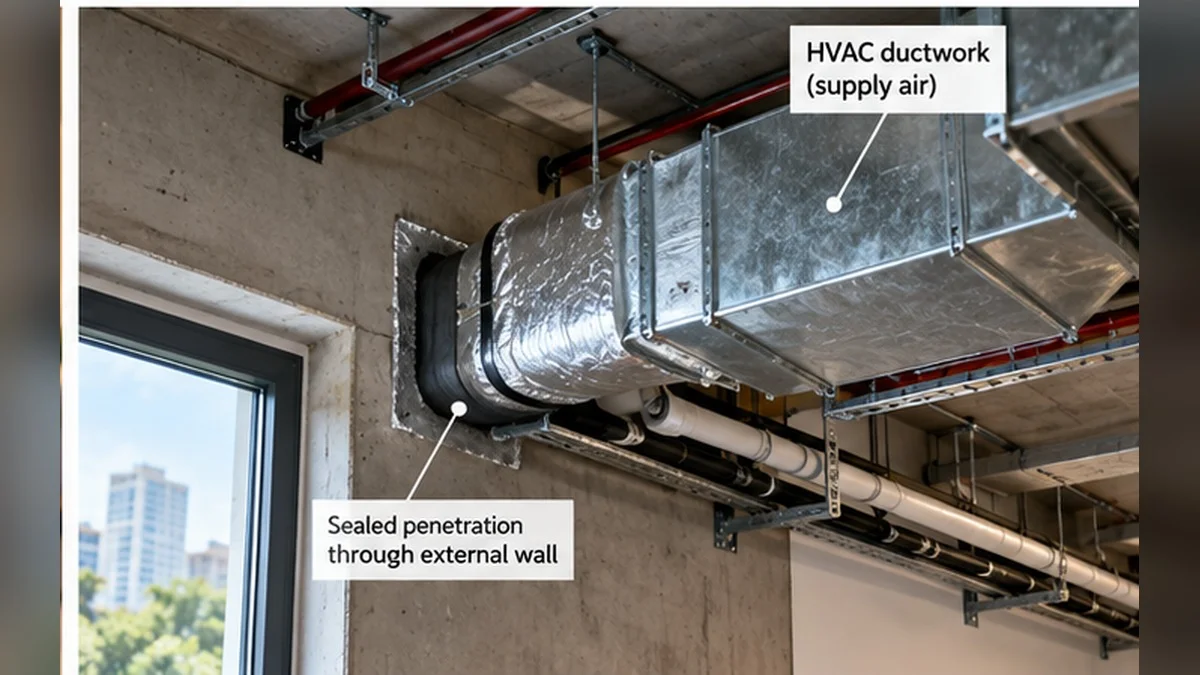
Consider an air-conditioned office with an external wall containing several service penetrations.
If the openings are not adequately sealed, humid outdoor air may enter the wall or ceiling cavity. If the surrounding surfaces are sufficiently cold, moisture can accumulate.
Replacing the stained ceiling panel may improve the appearance temporarily, but it does not resolve the underlying air leakage or condensation condition.
In commercial buildings, maintaining appropriate pressure relationships and controlling the moisture content of supplied air can also be important.
These decisions require coordination between architectural design, building-envelope specialists and HVAC engineers.
Why Moisture Problems Often Appear After Occupancy
A building can appear satisfactory at handover and develop visible moisture problems months later.
One reason is that the conditions during construction may differ from those during normal operation.
An occupied building experiences regular air-conditioning cycles, changing ventilation requirements, additional indoor moisture sources and varying outdoor weather conditions.
Moisture can also remain in construction materials when wet work is enclosed before sufficient drying has occurred.
Concrete, plaster, screeds and other materials may retain construction moisture. Installing moisture-sensitive finishes too early can contribute to subsequent defects.
Small installation gaps can be another source of trouble. A designed air barrier or weather-resistant assembly only performs as intended when its components and connections are installed correctly.
This makes inspection, workmanship and commissioning important parts of moisture control, not simply the final stages of construction.
How Designers Can Prevent Hidden Moisture Problems
Preventing moisture damage begins with understanding the building’s environmental conditions.
In a hot, humid region, designers need to consider how the building envelope and air-conditioning system will behave together. In colder climates, the direction of moisture movement and the surfaces most likely to experience condensation may be different.
Several design decisions deserve early attention.
- Control rainwater entry. Roofs, façades, windows and junctions should have effective weather protection, drainage and properly detailed connections.
- Limit uncontrolled air leakage. Continuous air barriers and correctly sealed penetrations can reduce unwanted movement of humid air through building assemblies.
- Assess condensation risk. Insulation placement, surface temperatures and moisture conditions should be considered when selecting wall and roof constructions.
- Coordinate HVAC performance. Cooling, ventilation, dehumidification and building pressure should be assessed as parts of the same environmental strategy.
- Allow for appropriate drying. Assemblies should be designed with an understanding of how moisture may leave them. Materials and finishes should not be selected solely for appearance or initial cost.
Where the risk is significant, specialist hygrothermal analysis can help assess heat and moisture movement through construction assemblies under different conditions.
Digital building models can support coordination by documenting material layers, identifying service penetrations and making design interfaces easier to review. However, a model cannot independently verify moisture performance or replace appropriate calculations, inspections and testing.
A Dry Building Is a Design Achievement
Moisture damage is often discovered through something small: a stain near a window, a swollen skirting board or paint that begins to bubble.
By the time these signs appear, the underlying cause may have existed for some time.
The solution begins by identifying the source, whether it is rainwater penetration, plumbing leakage, condensation, construction moisture or a combination of factors.
Repainting or replacing finishes without addressing that source risks allowing the problem to return.
For architects, engineers and construction teams, moisture control is a reminder that building performance depends on details that occupants may never see.
A well-designed building must manage more than structural loads, space and appearance. It must also respond to the movement of heat, air and water throughout its life.
The best protection against moisture damage is often the detail that was designed correctly before the first sign of dampness appeared.
Professional BIM Course
Master BIM Course
Structural Design Concepts and BIM
Certified MEPF BIM Master Course
Electrical BIM Professional Program
RenderLab – Master 3D Modeling & Photorealistic Rendering
Multi-Tool Mastery for Architects & Engineers
BIM Coordinator Workflow Program
BIM FastTrack – 30 Day Intensive Training
Global Architectural & Structural BIM Project Program