Author: Devika R
October 10, 2026
7 min read
What happens when a BIM model becomes part of the approval process—not just the design process?
For decades, getting a building approved has followed a familiar pattern.
Drawings are prepared.
Documents are collected.
Applications are submitted.
Officials review them.
Comments come back.
The design team makes corrections.
The process repeats.
The building may already exist as a detailed digital model inside the design office, yet the approval process often still depends heavily on documents prepared for people to read and review.
That is beginning to change.
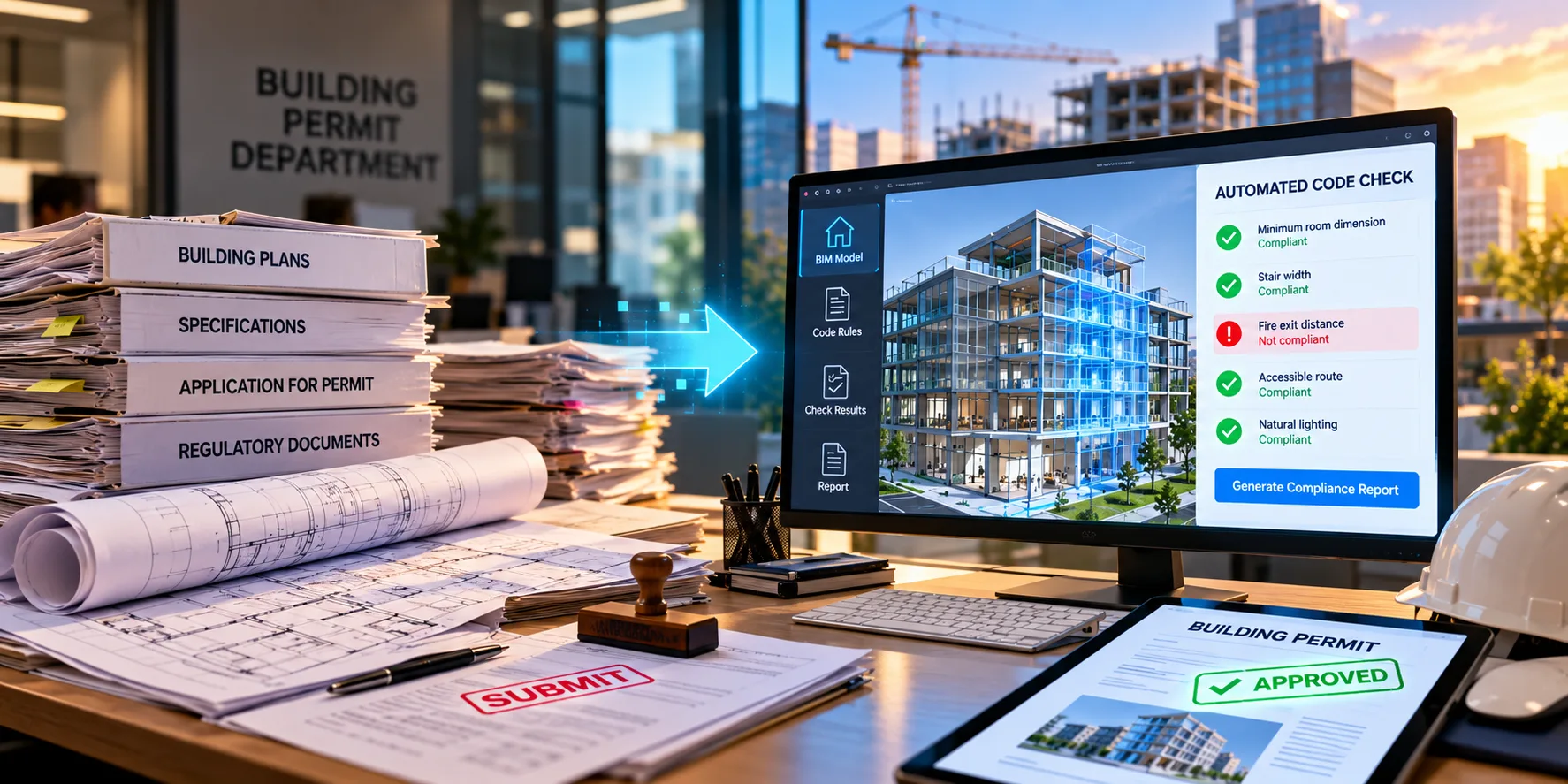
Around the world, digital permitting systems are being developed to work with structured building information, including BIM models. BIM Cafe has previously covered this as an emerging industry development, but the bigger question is what happens when building regulations themselves become readable by software.
From Drawings to Digital Rules
A BIM model contains information about a building’s geometry and elements.
A building code contains rules.
Traditionally, a professional sits between the two.
They look at the design, interpret the relevant regulations and determine whether the proposal satisfies them.
The emerging idea is to make at least some of those rules machine-readable.
Instead of:
- Building Code
- Human Interpretation
- Drawing Review
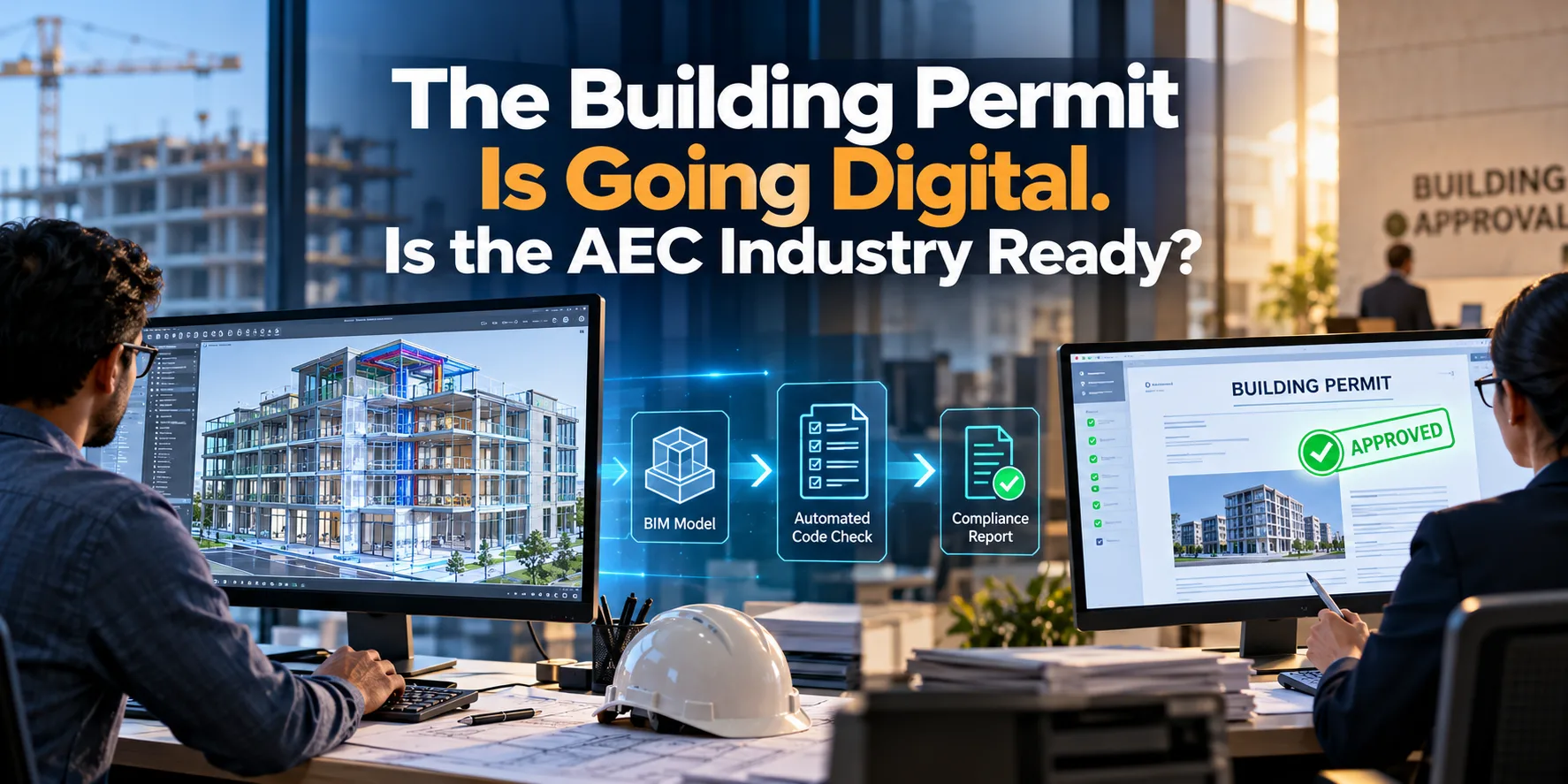
the process could move towards:
- Digital Building Code
- Automated Rule Check
- BIM Model
- Compliance Report
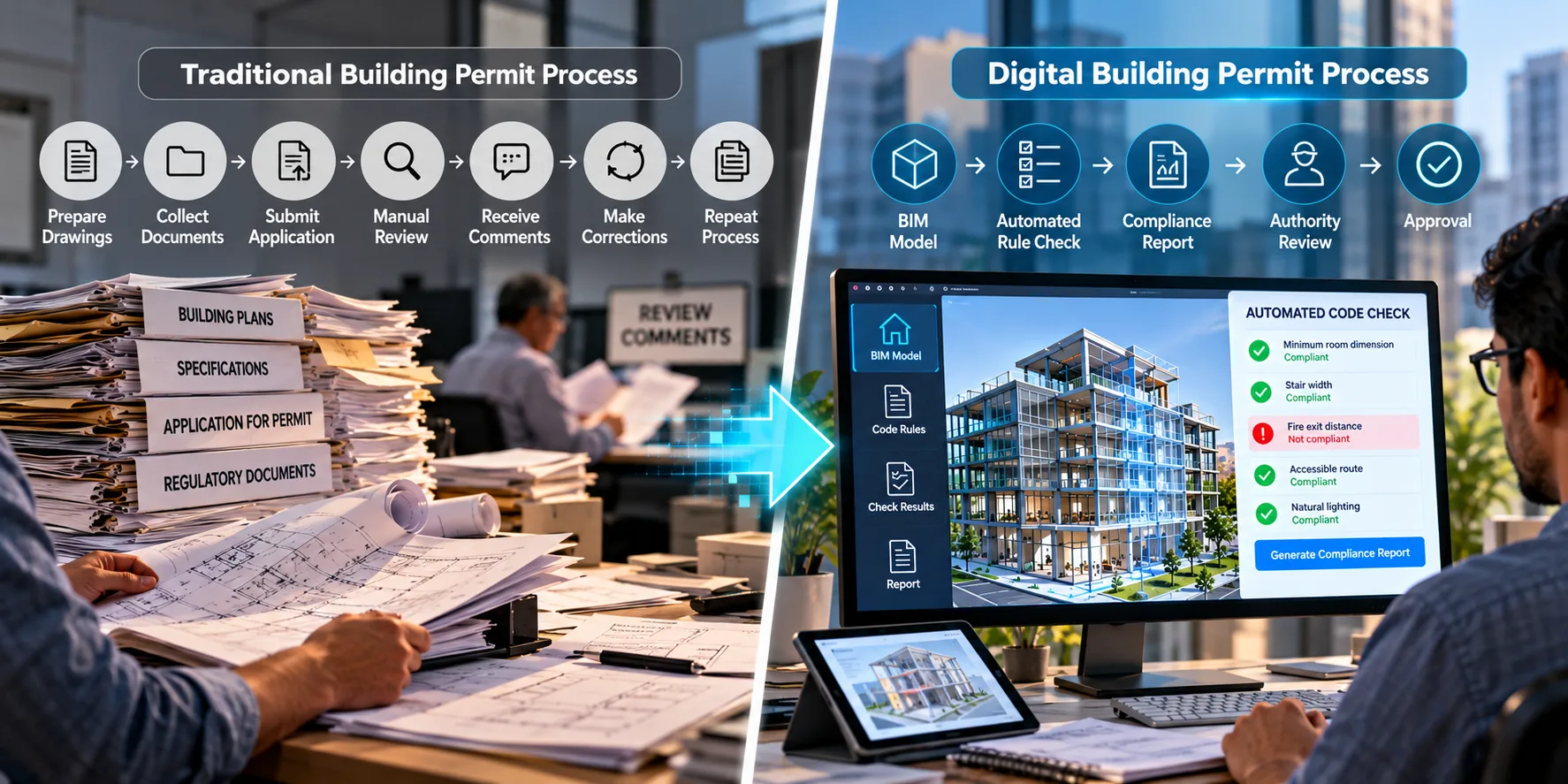
Recent research is already exploring frameworks that translate regulatory requirements into computer-interpretable rules and apply them directly to BIM models.
That sounds simple.
It isn’t.
A Building Code Wasn’t Written for a Computer
Consider a basic requirement such as a minimum room dimension.
A person can read the regulation, understand which room it applies to, identify the relevant dimensions and make a judgement.
A computer needs something much more precise.
It needs to know:
- What counts as a room?
- Which building types does the rule apply to?
- Which dimension should be measured?
- Where should the measurement begin and end?
- Are there exceptions?
- Which version of the regulation applies?
- What happens when another regulation modifies the requirement?
This is one of the biggest challenges in automated compliance checking.
The difficult part isn’t simply giving software access to a BIM model.
The difficult part is teaching software how to interpret the rules that govern the building.
Not Every Rule Can Be Automated
This is where expectations need to remain realistic.
Some requirements are relatively straightforward to express digitally.
A system could potentially check whether:
- a minimum dimension has been met
- a required number of spaces exists
- certain elements are present
- specified distances are maintained
- particular model properties satisfy predefined conditions
But regulations aren’t made entirely of simple numbers.
Some requirements depend on context, professional judgement or interpretation.
A computer might identify that a particular condition has not been met.
It may not be able to determine why a design was made that way or whether an unusual situation deserves an exception.
Recent work on digital permitting therefore points towards automation as decision support, rather than simply replacing building professionals and authorities.
The BIM Model Could Become More Than a Design Deliverable
This changes the role of the model.
Today, a BIM model may support design, coordination, documentation and construction workflows.
In a digitally connected approval process, it could also become part of the regulatory conversation.
Imagine submitting a building proposal where the authority receives a structured model rather than relying entirely on a collection of drawings.
The system could perform preliminary checks.
Instead of receiving a general comment such as:
“Please revise and resubmit.”
the design team could receive structured information showing which requirement failed, where it failed and what model information triggered the issue.
That could make the approval process more transparent.
It could also allow designers to identify certain problems before submitting the application.
But There Is a Bigger Problem
There is an important question hiding underneath all of this:
Whose interpretation of the rule does the software use?
Building regulations change.
Different jurisdictions have different requirements.
Local authorities may interpret provisions differently.
A model may also contain incomplete or incorrectly structured information.
So an automated checker can only be as reliable as the rules, data and assumptions behind it.
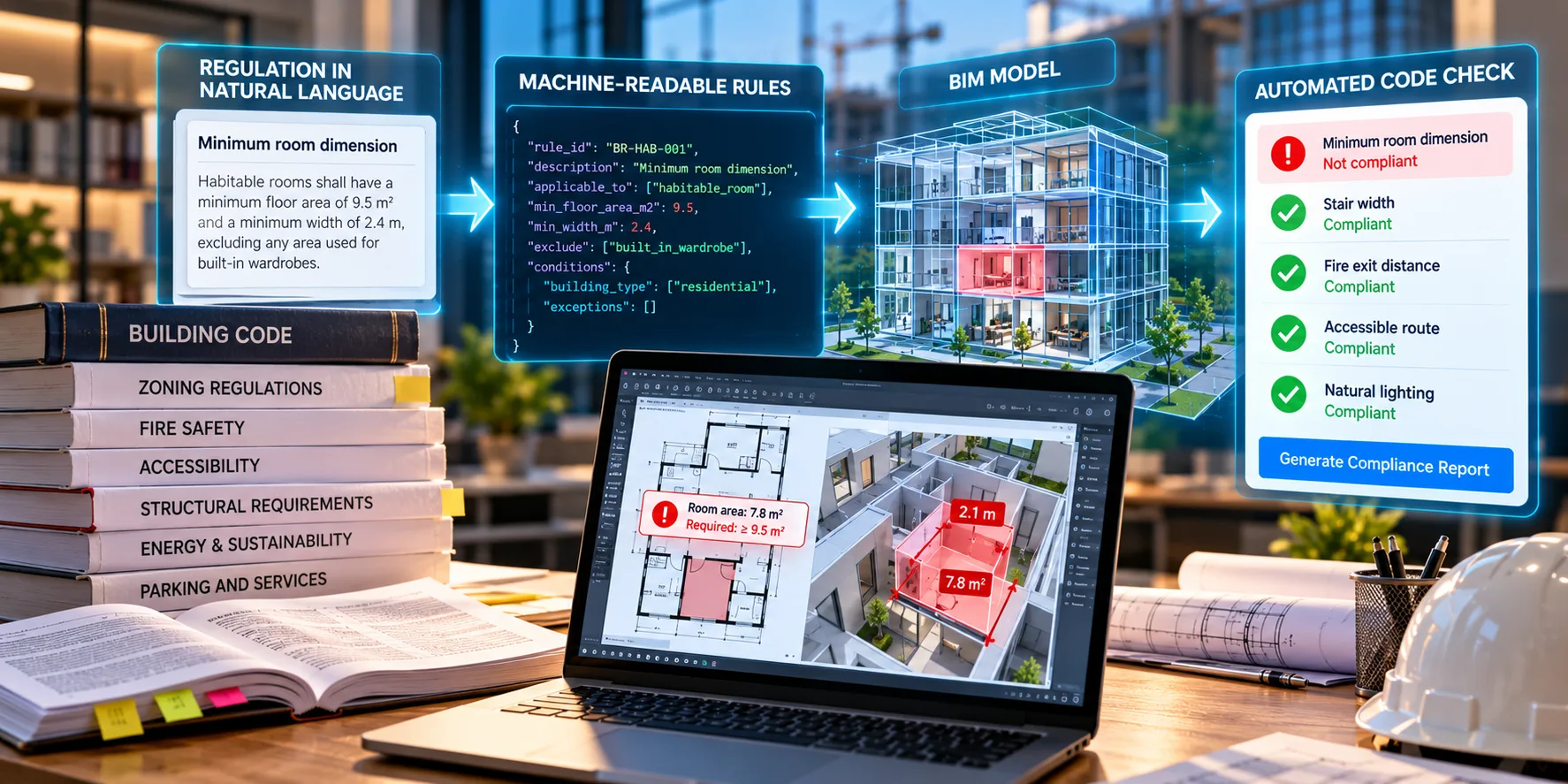
This means digital permitting isn’t simply a software project.
It involves regulations, data standards, government systems, BIM workflows and professional responsibility working together.
Research into digital building permits highlights exactly this challenge: regulations written in natural language must be translated into computer-interpretable rules while still respecting legal and technical requirements.
What Changes for Architects and Engineers?
The arrival of automated checking doesn’t make professional knowledge less important.
It may change where that knowledge is used.
Instead of spending as much time manually checking repetitive requirements, professionals could spend more time on:
- interpreting complex regulations
- resolving exceptions
- making design decisions
- validating automated results
- dealing with unusual project conditions
- explaining decisions to clients and authorities
The ability to understand both the building and the information inside the model could become increasingly valuable.
For BIM professionals, this also introduces another layer of responsibility.
A model isn’t useful for automated checking simply because it looks correct.
Its information needs to be structured, consistent, and suitable for the intended purpose.
What Could the Future Approval Process Look Like?
A future workflow could look something like this:
- Design
- BIM Model
- Automated Pre-Check
- Corrections
- Digital Submission
- Authority Review
- Professional Approval
The computer handles what can reasonably be checked.
The professional handles what requires interpretation.
The authority remains responsible for the regulatory decision.
That division may be more realistic than the idea of completely automated building approvals.
And it could reduce one of the most frustrating parts of construction projects: discovering a regulatory problem late in the process.
The Real Shift
Digital permitting is not simply about replacing paper with PDFs.
It represents a much larger change.
The industry is moving towards a situation where building information, regulations and approval systems can communicate with each other.
The BIM model could eventually become something that software can test against digital rules before a human reviewer makes the final decision.
The technology is developing, but the transition will take more than better BIM software.
It will require regulations that can be interpreted digitally, reliable information standards, capable approval systems and professionals who understand how all of these pieces connect.
The future building permit may not look like a document at all.
It may look more like a digital conversation between the building, the rules and the people responsible for approving it.
And that could change how buildings are designed long before anyone reaches the construction site.
Frequently Asked Questions
What is a digital building permit?
A digital building permit process uses digital systems to submit, review and manage building approval information instead of relying entirely on traditional document-based workflows.
Can BIM models be used for building approval?
Yes. BIM-based approval workflows are being researched and developed, including systems that can use structured model information for automated compliance checks.
Can software automatically check building codes?
Some regulatory requirements can potentially be converted into machine-readable rules and checked automatically. More complex requirements may still require professional judgement.
Will automated code checking replace architects and engineers?
Not necessarily. The more realistic direction is to use automated checking for repetitive and deterministic requirements while professionals handle interpretation, design decisions and exceptions.
Why is BIM important for digital permitting?
A structured BIM model can provide machine-readable information about building elements, geometry, and properties, creating a potential foundation for automated regulatory checks.
The interesting future of BIM may not be another smarter model. It may be what happens when the model, the building code and the approval system can finally understand each other.
Professional BIM Course
Master BIM Course
Structural Design Concepts and BIM
Certified MEPF BIM Master Course
Electrical BIM Professional Program
RenderLab – Master 3D Modeling & Photorealistic Rendering
Multi-Tool Mastery for Architects & Engineers
BIM Coordinator Workflow Program
BIM FastTrack – 30 Day Intensive Training
Global Architectural & Structural BIM Project Program