Author: Devika R
September 26, 2026
8 min read
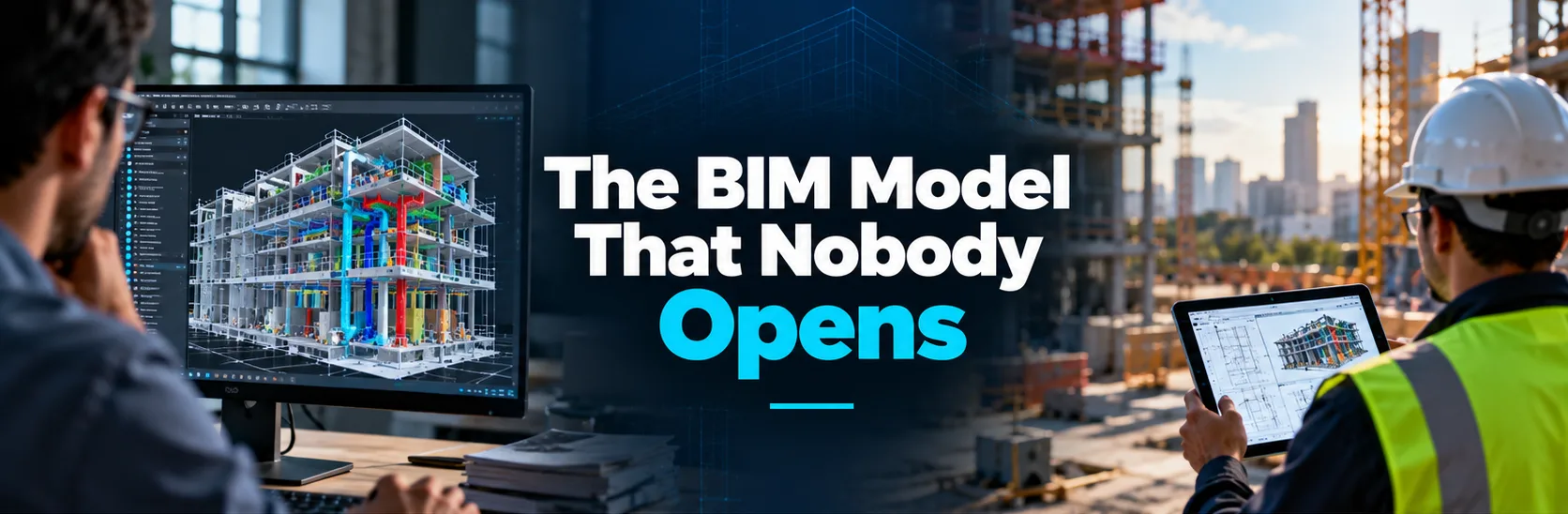
What changes when a BIM model is no longer just a reference, but becomes part of the contractual project information?
For years, BIM models have often existed alongside drawings.
The model helps teams design and coordinate. The drawings communicate what needs to be built. The contract defines what everyone is expected to deliver.
But what happens when the BIM model itself becomes part of the contract?
That changes the conversation.
A model is no longer simply something the project team uses to understand the building. People may begin relying on it to price work, coordinate systems, procure components or build the project.
And once people rely on it, some important questions follow:
Which model is the contract? Which version controls? Who can change it? And who is responsible when something goes wrong?
These are no longer purely theoretical questions. Hong Kong’s Development Bureau has introduced requirements under which specified portions of design BIM models form part of tender information and are contractually binding for relevant capital-works projects.
A BIM Model Does Not Automatically Become a Contract Document
Using BIM on a project does not, by itself, mean that every model is contractually binding.
There can be a significant difference between a model used for:
- design development,
- coordination,
- visualisation,
- quantity information,
- tendering, or
- construction.
The project’s contractual and information arrangements need to establish what the model is actually being used for.
This distinction matters because reliance creates responsibility.
If a contractor is expected to rely on a particular model when pricing or building, that is very different from being given a model simply as a coordination reference.
Current construction-industry guidance is increasingly highlighting the need to define the model’s status, permitted uses, and level of reliance clearly rather than leaving these questions open to interpretation.
Which Version Is the Contract?
This may be one of the biggest challenges.
A BIM model is not like a printed drawing sitting in a folder.
It can change frequently.
A design team may issue an updated model.
A contractor may add information.
A specialist subcontractor may develop its portion.
Another revision may follow after coordination.
Now imagine a disagreement several months later.
The contractor says:
“We built it according to the model.”
The designer says:
“That was an earlier version.”
The question becomes:
Which model was actually authoritative at that point?
This is why identifying specific model versions can become important when a model has contractual status. AIA’s E201 BIM exhibit, for example, provides for specific model versions to be identified as contract documents rather than treating every evolving model as automatically contractual.
The lesson is simple:
“The latest model” is not necessarily a sufficient contractual definition.
What Happens When the Model and Drawing Disagree?
This becomes even more interesting when a project still uses both.
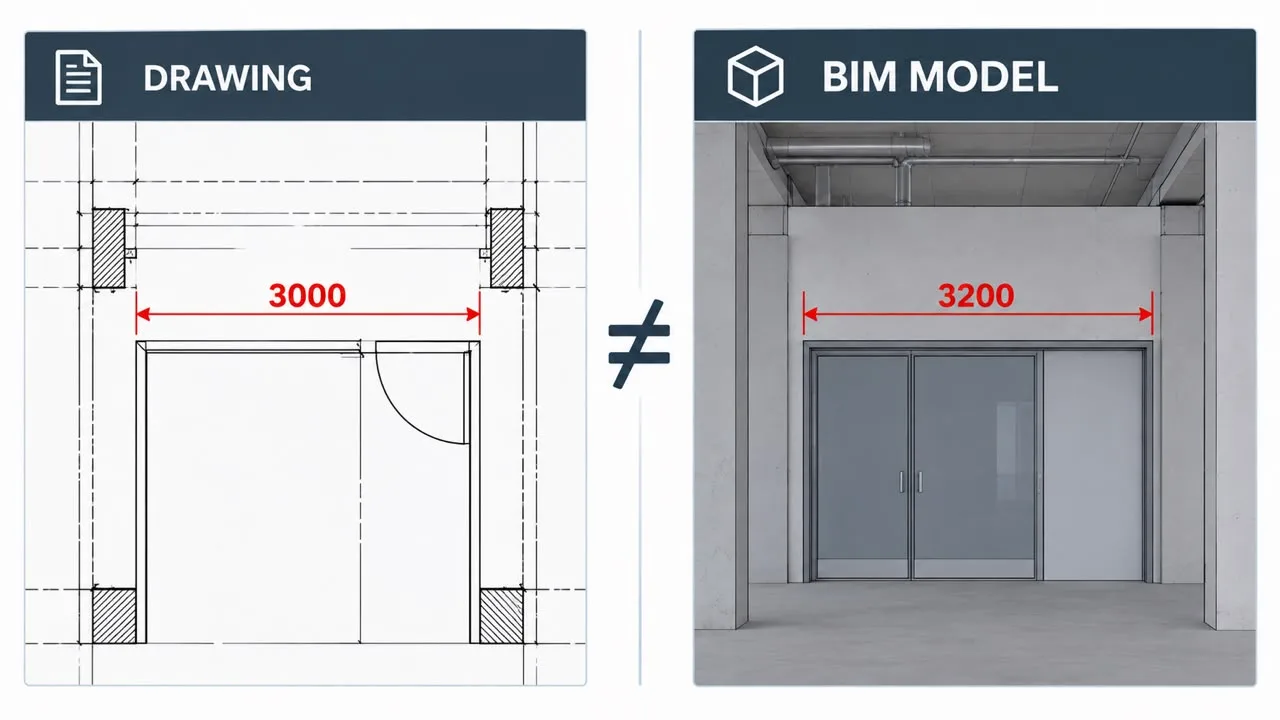
Imagine the drawing shows one dimension while the corresponding model contains another.
The site team finds the discrepancy.
Which one should they follow?
There is no universal answer that can simply be assumed.
The project’s contractual documents and information procedures need to establish which information has authority and how discrepancies are resolved.
This is one reason the transition toward model-based construction needs to be handled carefully.
Moving from:
Model + drawings
to:
Model as contractual information
is not just a software change.
It changes how project teams define, issue and rely on information.
Who Is Allowed to Change the Model?
A shared BIM environment can contain contributions from many parties.
Architects.
Structural engineers.
MEP consultants.
Contractors.
Specialist subcontractors.
Fabricators.
That collaboration is one of BIM’s strengths.
But when a model has contractual significance, unrestricted editing becomes a different matter.
The project needs to be clear about:
Who can create information?
Who can modify it?
Who can approve it?
Who can issue it for reliance?
How are those changes recorded?
This does not mean every BIM edit needs a complicated approval process.
It means that important contractual information needs a clear route from creation to approval to issue.
What If the Model Contains an Error?
A model can contain an error just as a drawing can.
But BIM can make the situation more complicated because several parties may contribute information to the same digital environment.
Suppose a structural element is incorrectly positioned.
Was the error introduced during design?
During coordination?
During model development by another party?
Was it later modified?
Was the version actually approved?
And did someone have a reasonable basis for relying on it?
The answer cannot simply be:
“The BIM team made a mistake.”
Responsibility depends on the project’s defined roles, information status, approval process and contractual arrangements.
That is why current discussions around BIM-related disputes increasingly focus on reliance, verification, version control and responsibility, rather than simply asking whether the model contained an error.
This Changes the Role of the BIM Team
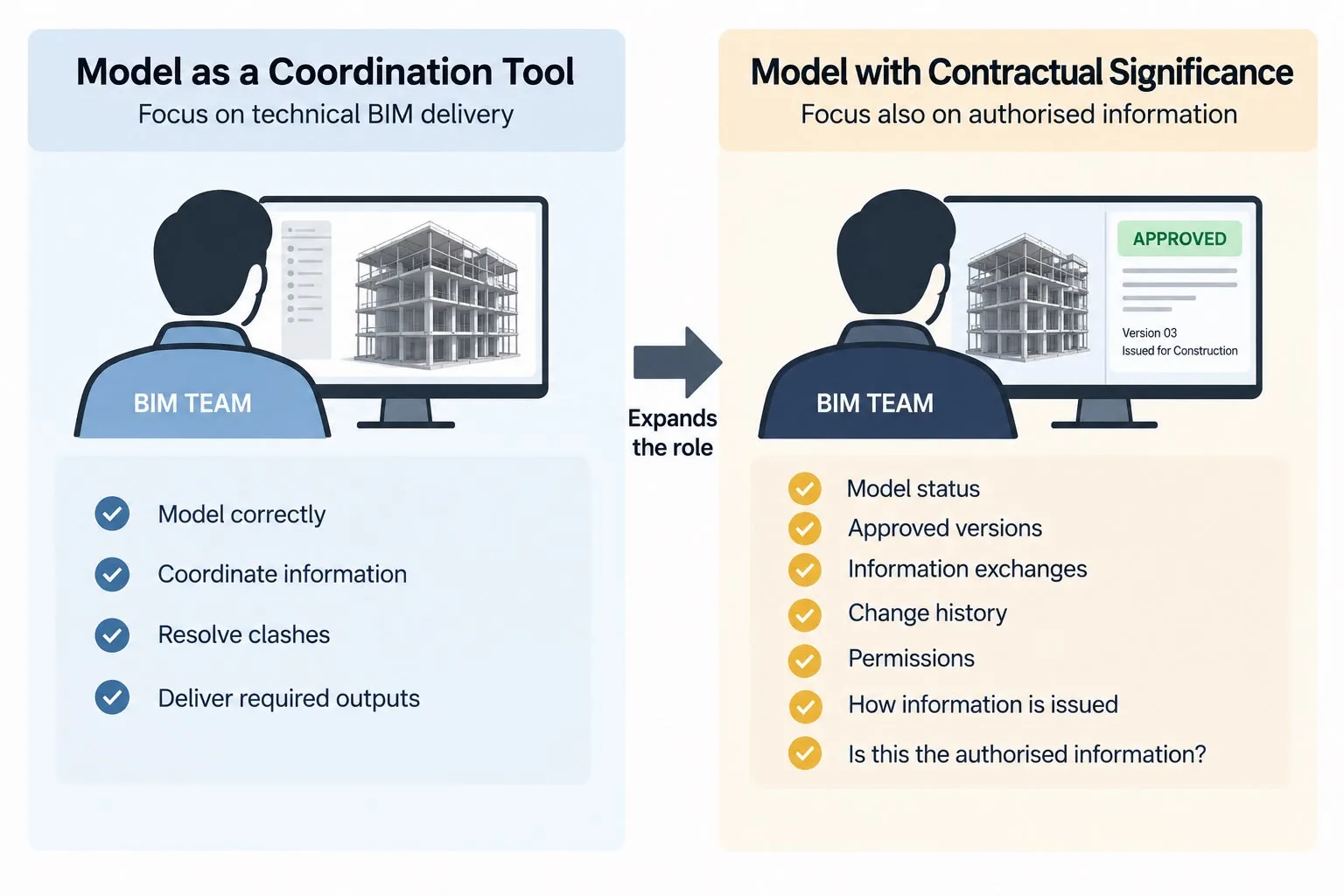
When the model is only a coordination tool, the BIM team can primarily focus on whether information is properly modelled, coordinated and delivered.
When the model has contractual significance, another question becomes important:
Is this the authorised information?
That makes model governance more important.
BIM coordinators and managers may need to pay closer attention to:
- model status,
- approved versions,
- information exchanges,
- change history,
- permissions,
- and how information is issued.
This does not turn the BIM coordinator into a lawyer.
It simply means that technical BIM processes and contractual information processes become more closely connected.
What Should Be Clear Before the Project Starts?
Before a project expects people to rely on a BIM model, a few questions should have clear answers.
What is the model being used for?
Coordination, tendering, construction, handover—or something else?
Which model or model version has authority?
Avoid relying on vague terms such as “latest model.”
Who can modify and approve it?
Define responsibilities before problems arise.
How are changes communicated?
A change to important project information should not depend on someone simply noticing a new file.
What happens when information conflicts?
The project should have a defined process for resolving discrepancies.
These questions are more important than simply saying:
“The project is BIM-enabled.”
BIM Is Becoming More Than a Coordination Tool
This is perhaps the larger shift.
As BIM moves closer to tendering, fabrication and construction, the model becomes increasingly important to project decisions.
That does not mean every model should become a contract document.
In fact, there are good reasons to be selective.
A model changes continuously. Different parts may be developed to different levels. Some information may be intended for reference rather than reliance.
The important point is that the project’s expectations should match the model’s contractual status.
Where a model is intended to be relied upon, that reliance needs to be deliberate.
The Model May Become Contractual. The Responsibility Still Belongs to People.
BIM can make information more connected.
It can make coordination faster.
It can give different project participants access to the same digital environment.
But technology does not remove responsibility.
When a BIM model becomes part of the contractual information, the project needs to know:
what the model represents, which version matters, who can change it, who approves it and who is entitled to rely on it.
That is not about making BIM complicated.
It is about making expectations clear.
Final Thoughts
The BIM model used to be something people looked at.
Increasingly, it is becoming something people work from, make decisions from and potentially contract against.
That is a significant change.
The next stage of BIM maturity may therefore not be about creating increasingly detailed models.
It may be about becoming much clearer about what authority those models actually have.
Because once the model becomes part of the contract, the question is no longer simply:
“Is the model correct?”
It becomes:
“Is this the information we agreed to rely on—and does everyone understand what that means?”
That is where BIM stops being just a modelling workflow and becomes part of the commercial and contractual structure of the project.
Professional BIM Course
Master BIM Course
Structural Design Concepts and BIM
Certified MEPF BIM Master Course
Electrical BIM Professional Program
RenderLab – Master 3D Modeling & Photorealistic Rendering
Multi-Tool Mastery for Architects & Engineers
BIM Coordinator Workflow Program
BIM FastTrack – 30 Day Intensive Training
Global Architectural & Structural BIM Project Program