Author: Devika R
April 21, 2026
10 min read
If you work in BIM today, you have probably felt this shift: the tools keep changing, but the workflow behind them is changing faster. A few years ago, conversations centered on BIM 360. Then Autodesk Construction Cloud (ACC) became the default for many teams. Now Autodesk Forma is part of the story for 2026—and the questions pile up:
- Is BIM 360 outdated?
- Is ACC still “the” platform?
- Is Forma the future—or a side tool?
The honest answer: this is usually not about replacement. It is about a more connected BIM ecosystem where data and decisions are not trapped in isolated silos—similar to why workflow discipline matters more than software logos on large programmes.
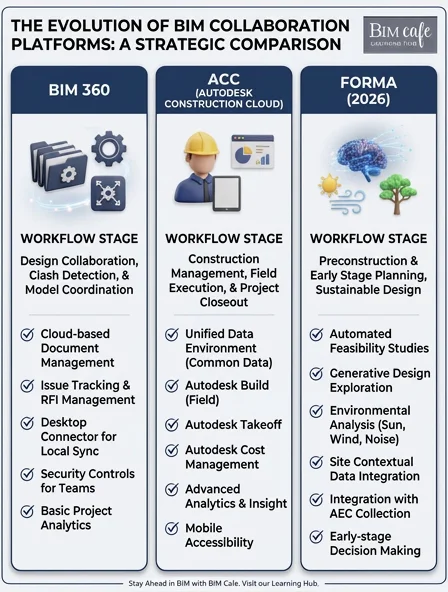
The evolution of Autodesk BIM platforms (why the shift happened)
BIM 360 — where cloud collaboration started to make sense
BIM 360 helped teams share models, track progress, and coordinate across disciplines in the cloud. In many large residential and commercial projects in India (for example Bangalore and Hyderabad), BIM 360 was often used for document sharing, basic coordination, and issue tracking—while day-to-day communication still leaned on email. That gap highlighted a recurring issue: tools existed, but workflows stayed fragmented.
Autodesk Construction Cloud (ACC) — making BIM execution practical
ACC addressed fragmentation by structuring delivery: centralized documentation (Docs), field workflows (Build), coordination (including model coordination), and quantification (Takeoff), among other capabilities.
On UAE and Qatar projects, weekly clash cycles through ACC plus Navisworks-style coordination are common—models from architecture, structure, and MEP are federated centrally, and reporting ties back to the BIM Execution Plan. For a practical walkthrough of professional clash workflows, see our Navisworks clash detection guide for 2026. In that environment, ACC is not a “nice add-on”—it becomes part of delivery.
The shift to Autodesk Forma (2026)
Forma is not trying to “replace construction coordination.” It targets an earlier problem: decision quality before detailed BIM work scales.
Forma emphasizes site intelligence, environmental analysis, AI-assisted inputs, and early planning—useful in large masterplans and township-scale work where sunlight, wind, density, or noise matter before you commit to a direction. That can reduce expensive rework later in Revit and coordination—especially when teams already struggle with reactive changes, as we discussed in why BIM fails when workflows break.
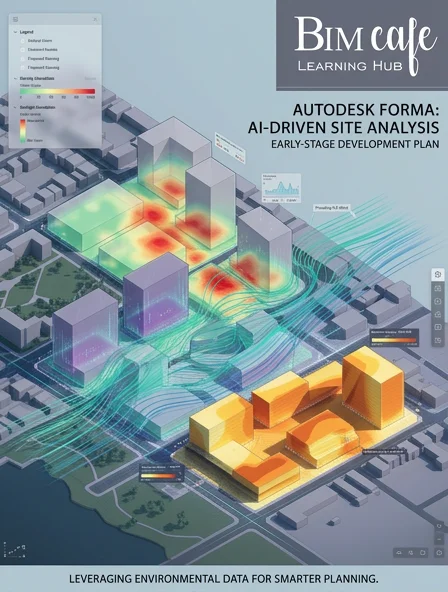
Is Forma replacing ACC?
Short answer: no. Autodesk is converging workflows more than deleting categories. ACC continues to anchor construction coordination and project delivery; Revit continues to carry detailed modeling; Forma becomes a stronger upstream planning layer. Over time, more capabilities may feel “joined,” but the mental model is still: different stages, one continuous lifecycle.
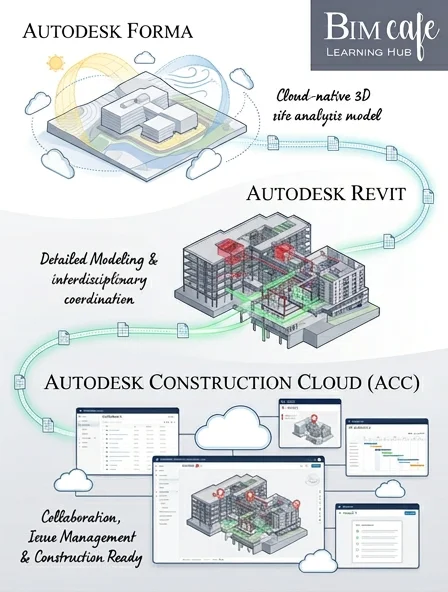
If you only train “one button path,” you will struggle as interfaces merge. The durable skill is knowing what stage you are in—planning, authoring, or field execution—and what data must be true at handoff.
What is really changing in BIM (2026)
For years, BIM debates sounded like: “How do we model better?” The shift now includes: “How do we decide better before modeling becomes expensive?” That mindset change pairs with platform literacy—also why AI in BIM is about assistance and validation, not magic fixes, and why coordinators still need a clear map of tools—see our BIM software list for coordinators in 2026.
Regional reality: Gulf vs India (practical)
Gulf projects often show strong dependency on coordination tooling and strict BEP discipline—BIM can feel execution-driven. Indian projects increasingly adopt ACC-style cloud workflows and structured coordination, with a fast move away from pure 2D + manual habits—though maturity still varies by client and contract.
Where Forma tends to appear first is often large-scale planning—smart-city style programmes, townships, and high-end architecture—anywhere early decisions change cost and sustainability downstream.
Key differences (at a glance)
| Feature | BIM 360 | ACC | Forma (2026) |
|---|---|---|---|
| Focus | Document + coordination | Full construction workflow | Planning + lifecycle intelligence |
| Typical stage | Mid to late | Execution | Pre-design / early decisions |
| Intelligence | Lower | Moderate | High (AI-assisted inputs) |
| Future role | Legacy footprint | Core delivery system for many owners | Upstream entry point + analysis |
Common misunderstandings
- “Forma will replace Revit.” No—Forma supports early decisions; Revit remains the detailed authoring environment for most BIM production workflows.
- “ACC will disappear.” No—ACC remains central for construction coordination and delivery in modern project setups.
- “Learning one tool is enough.” Platforms will keep merging surfaces—what lasts is end-to-end workflow literacy.
The bigger shift: BIM as decision + data infrastructure
BIM is becoming more than modeling—it is part of a continuous data story across planning, design, construction, and operations. That is the foundation behind digital twins and smarter infrastructure—connected systems rather than disconnected files.
BIM Cafe perspective
Interfaces will change and product names will evolve—but in real projects, growth comes from understanding how BIM workflows connect across stages: when the model must be authoritative, how coordination is run, and how approvals and site reality feed back into the dataset.
Final thoughts
BIM 360, ACC, and Forma are better read as stages of the same evolution: collaboration matured, execution became structured, and planning is gaining intelligence. The future of BIM in 2026 is less about picking a single tool—and more about how well you understand the system behind them.
Frequently Asked Questions
What is Autodesk Forma (2026)?
A cloud platform focused on early-stage planning, site analysis, and AI-assisted design exploration—before detailed Revit production work.
Is BIM 360 still used?
Yes in legacy contexts, but many teams have moved workflows toward ACC for modern cloud delivery.
Is ACC still relevant in 2026?
Yes—ACC remains essential for many construction workflows, coordination, and document-centric delivery.
Will Forma replace Revit?
No—Forma supports upstream decisions; Revit remains the core authoring tool for detailed BIM modeling in most workflows.
What is the future of BIM platforms?
More connected ecosystems: planning, design, construction, and operations linked through continuous data—not isolated file exchanges.
Professional BIM Course
Master BIM Course
Structural Design Concepts and BIM
Certified MEPF BIM Master Course
Electrical BIM Professional Program
RenderLab – Master 3D Modeling & Photorealistic Rendering
Multi-Tool Mastery for Architects & Engineers
BIM Coordinator Workflow Program
BIM FastTrack – 30 Day Intensive Training
Global Architectural & Structural BIM Project Program