Author: Devika R
July 7, 2026
8 min read
1. Why Is Everyone Suddenly Talking About Autodesk Forma?
If you've been working in the BIM industry over the past few years, you've probably come across names like BIM 360, Autodesk Construction Cloud (ACC), Spacemaker, and now Autodesk Forma.
With Autodesk continuously evolving its cloud ecosystem, it's natural to wonder:
- Is Autodesk Forma a completely new software?
- Has Autodesk Construction Cloud (ACC) been replaced?
- What happened to BIM 360?
- Where does Revit fit into all of this?
The frequent product name changes have left many students and professionals confused. However, once you understand Autodesk's long-term strategy, the evolution becomes much easier to follow.
Rather than launching completely different products every few years, Autodesk has been gradually building a connected digital ecosystem for the Architecture, Engineering, Construction, and Operations (AECO) industry.
Let's explore how Autodesk's BIM ecosystem has evolved—and what it means for the future of cloud-based BIM collaboration.
Where It All Started: BIM 360
Before Autodesk Forma entered the picture, BIM 360 was Autodesk's flagship cloud collaboration platform for the Architecture, Engineering, and Construction (AEC) industry.
It enabled project teams to:
- Store project documents securely in the cloud
- Collaborate on Revit models
- Perform clash coordination
- Track RFIs and project issues
- Manage construction workflows across distributed teams
For many years, BIM 360 became the industry standard for cloud-based BIM collaboration, allowing architects, engineers, contractors, and consultants to work from a centralized digital environment instead of relying on disconnected files, emails, and multiple project versions.
At the time, this represented a major step toward digital project delivery.
2. The Evolution to Autodesk Construction Cloud (ACC)
As Autodesk expanded its digital construction portfolio by acquiring companies such as PlanGrid, BuildingConnected, and Assemble, it became clear that BIM 360 alone could no longer support the entire construction lifecycle.
This led to the launch of Autodesk Construction Cloud (ACC).
Instead of introducing a completely new workflow, ACC unified several Autodesk solutions into one connected ecosystem, including:
- Autodesk Docs
- BIM Collaborate
- BIM Collaborate Pro
- Build
- Takeoff
- Estimate
Compared to BIM 360, ACC introduced several important improvements.
✅ A more intuitive user experience
✅ A centralized Common Data Environment (CDE)
✅ Better document and permission management
✅ Improved collaboration between design and construction teams
✅ Stronger integration across the entire project lifecycle
A simple way to understand this transition is:
BIM 360 introduced cloud collaboration. Autodesk Construction Cloud expanded it into a connected construction management platform.
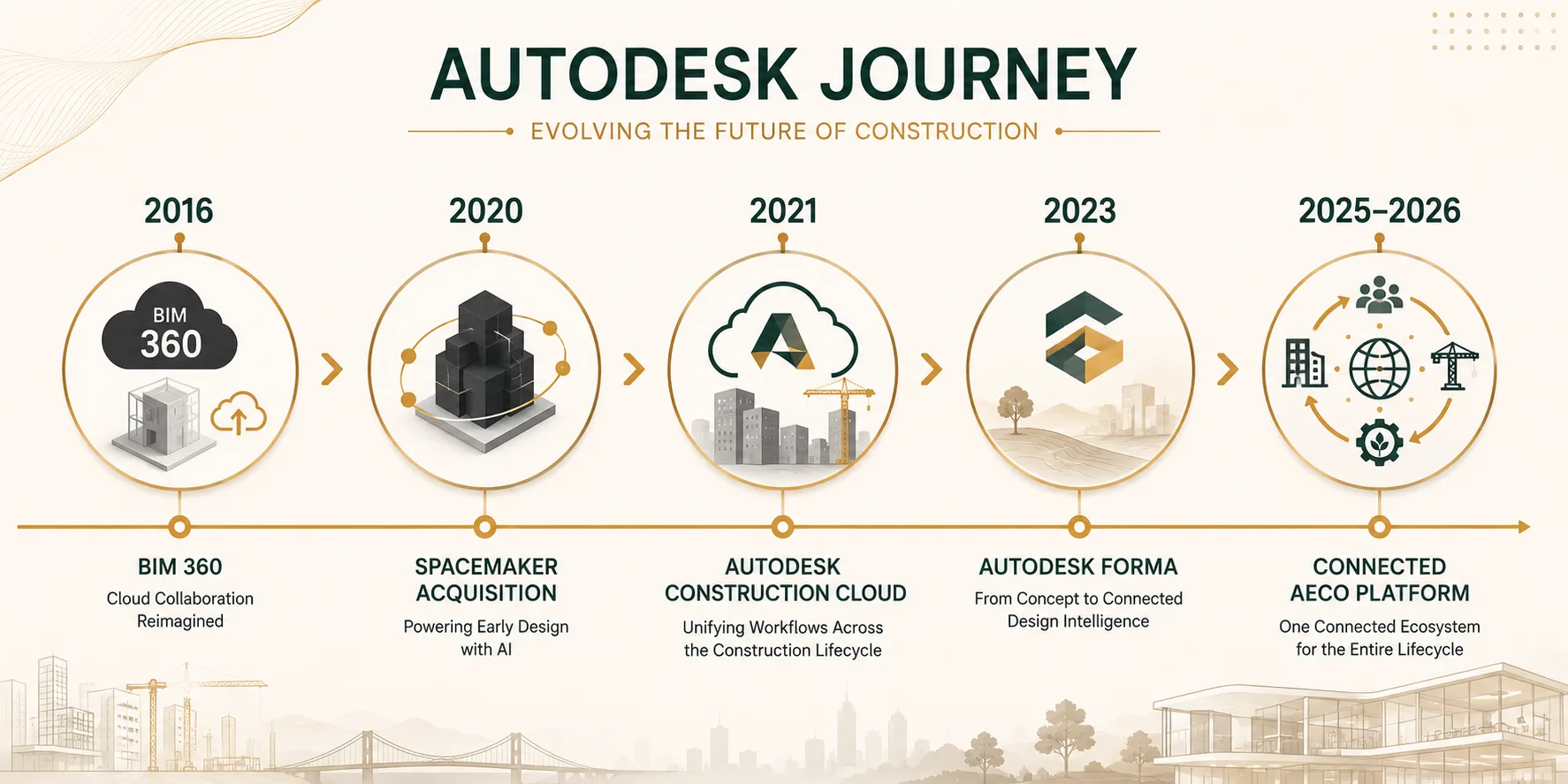
3. Autodesk Timeline at a Glance
Looking at the timeline, one thing becomes clear:
Autodesk isn't replacing one platform after another.
It's continuously expanding a connected digital ecosystem.
4. From Spacemaker AI to Autodesk Forma
While ACC was transforming construction collaboration, Autodesk was also investing in the earliest stages of project design.
In 2020, Autodesk acquired Spacemaker AI, an innovative startup known for its AI-powered approach to site planning and conceptual design.
Spacemaker enabled architects and planners to evaluate:
- Building massing studies
- Site layouts
- Daylight performance
- Wind simulations
- Noise analysis
- Early-stage feasibility studies
Instead of waiting until detailed BIM modeling began, designers could make informed planning decisions much earlier in the project lifecycle.
In 2023, Autodesk officially rebranded Spacemaker as Autodesk Forma.
Initially, Forma focused primarily on site analysis and conceptual design, helping architects optimise projects before opening Revit.
A typical workflow looked like this:
5. Autodesk's Vision for a Connected AECO Platform
This is where many professionals become confused.
Autodesk Forma is not simply the new name for Spacemaker.
Autodesk has gradually expanded Forma into something much larger.
Today, Forma is evolving into a connected platform that brings together planning, design, collaboration, construction, and operations within a single digital ecosystem.
In other words, Autodesk's goal is no longer to provide isolated software products for different project stages.
Instead, it aims to keep information connected throughout the entire building lifecycle.
6. How Autodesk's BIM Ecosystem Has Evolved
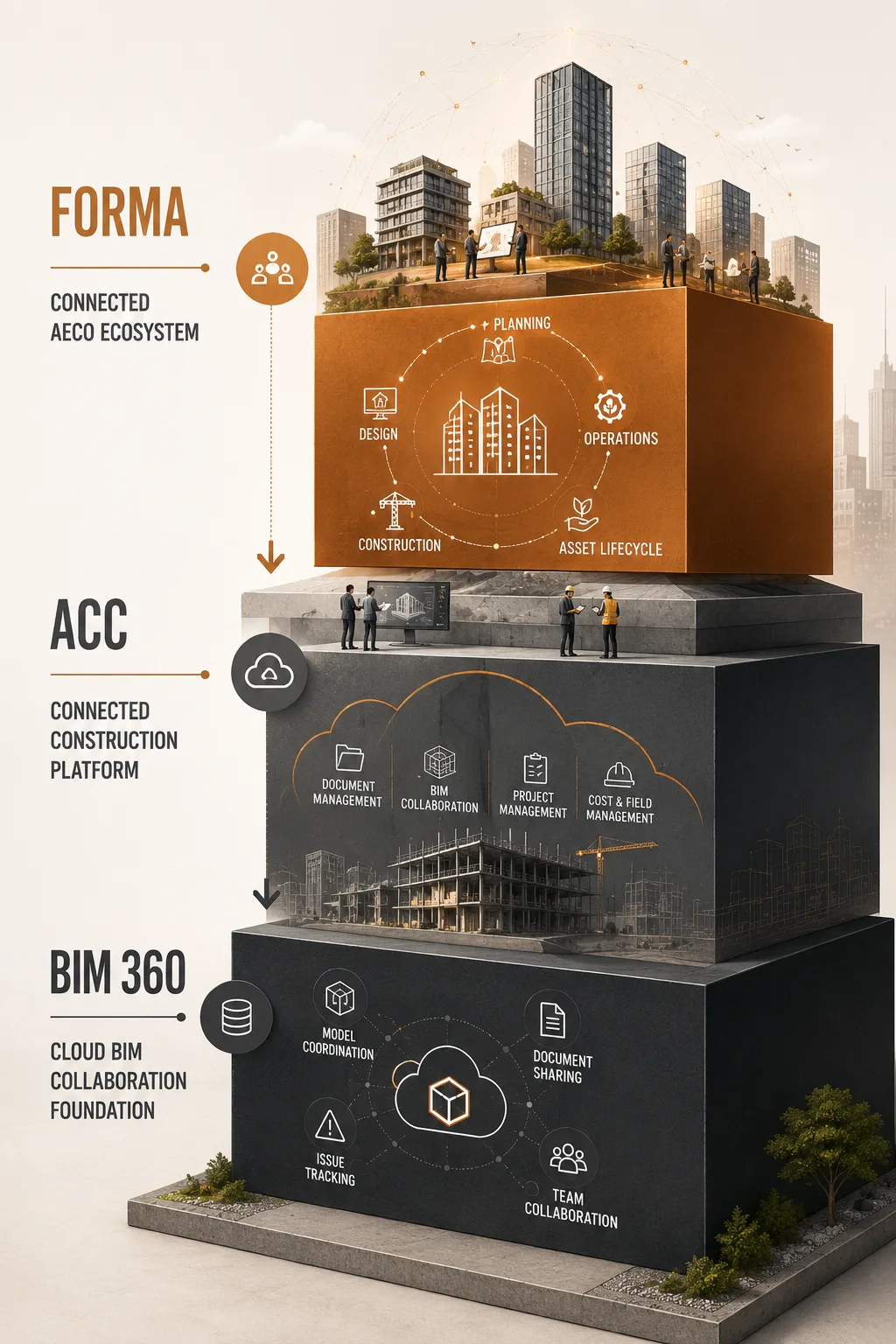
Instead of thinking of BIM 360, Autodesk Construction Cloud, and Autodesk Forma as separate software platforms, it's easier to see them as different stages of Autodesk's long-term strategy.
In simple terms:
- BIM 360 introduced cloud-based BIM collaboration.
- Autodesk Construction Cloud unified collaboration and construction management.
- Autodesk Forma is expanding that ecosystem by connecting planning, design, collaboration, construction, and operations.
Rather than replacing previous products, Autodesk has continued building a more connected digital construction platform.
7. Reality Check
Many professionals believe they need to learn an entirely new software every time Autodesk introduces a new name.
The reality is different.
The software continues to evolve—but the core BIM principles remain the same.
Understanding how information flows between different project stages is often far more valuable than memorising product names.
8. How Product Names Have Evolved
As Autodesk continues integrating its ecosystem, several familiar products are gradually being aligned under the Forma platform.
It's important to note that these changes are largely related to branding and platform integration. Existing projects, workflows, data, and licenses continue to function as before.
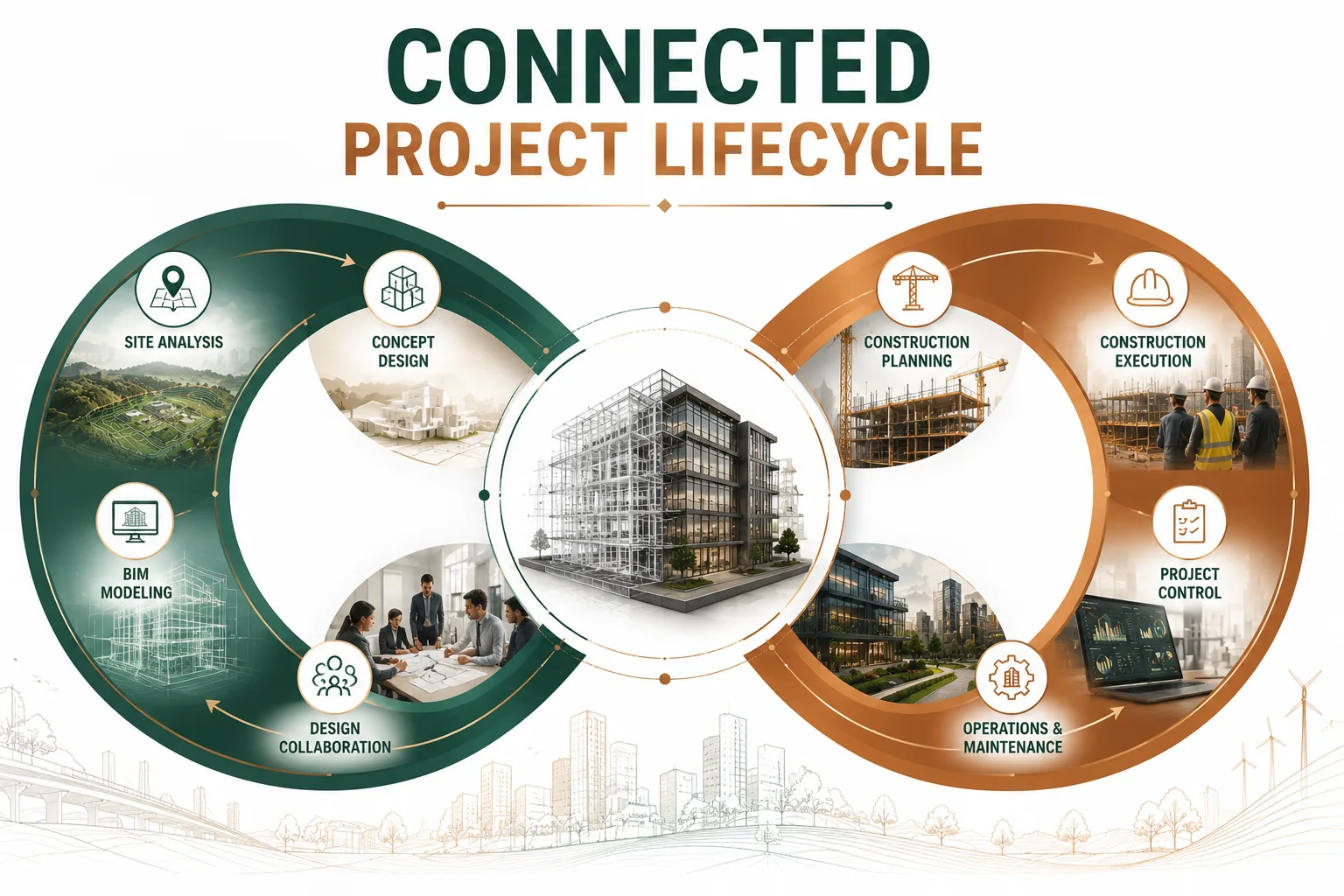
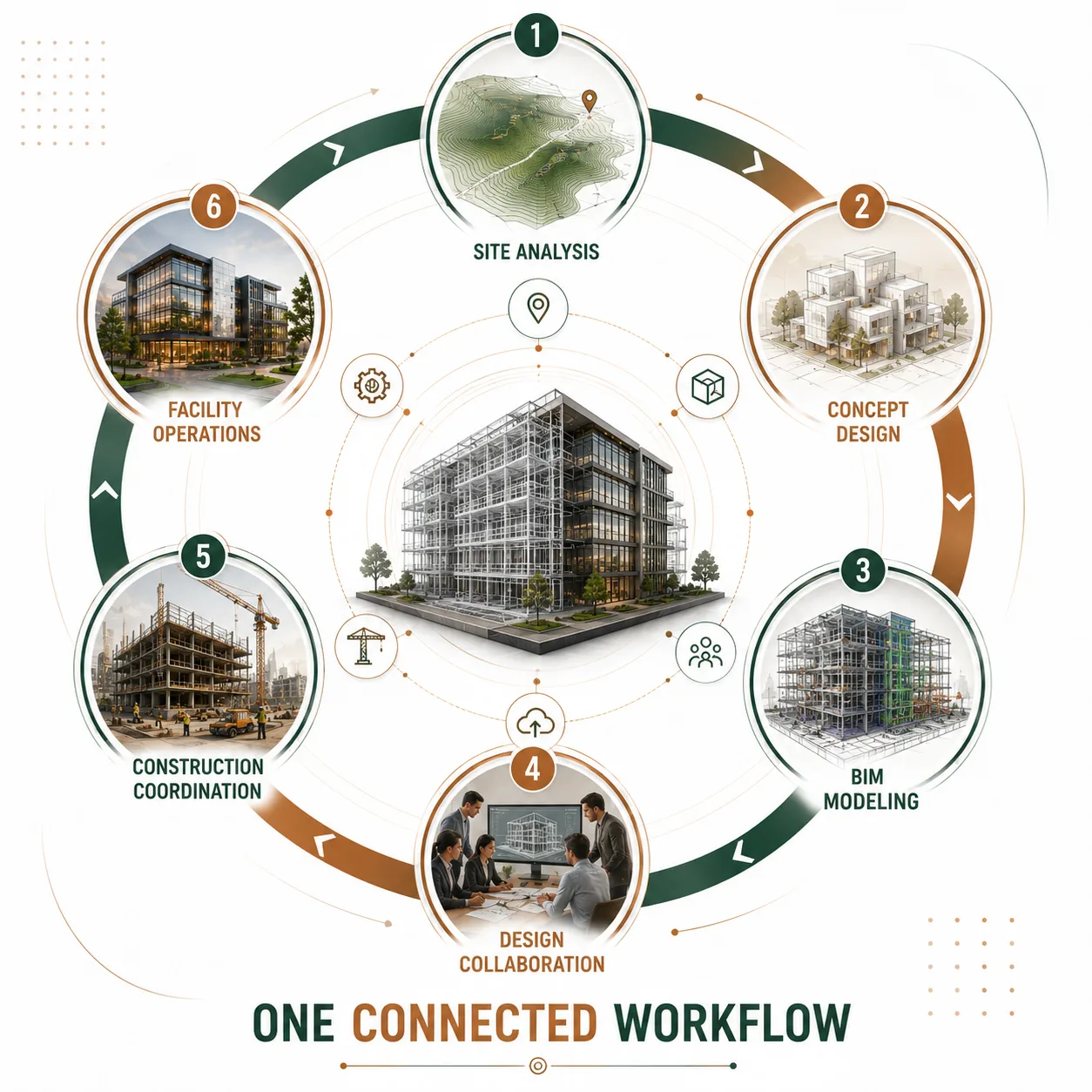
9. How Autodesk Connects the Entire Project Lifecycle
Autodesk's long-term vision is to create one continuous digital workflow that supports every phase of a construction project.
Rather than relying on isolated software applications, project information now flows through a connected cloud ecosystem.
This connected approach helps reduce information loss between project stages while improving collaboration across architecture, engineering, construction, and operations.
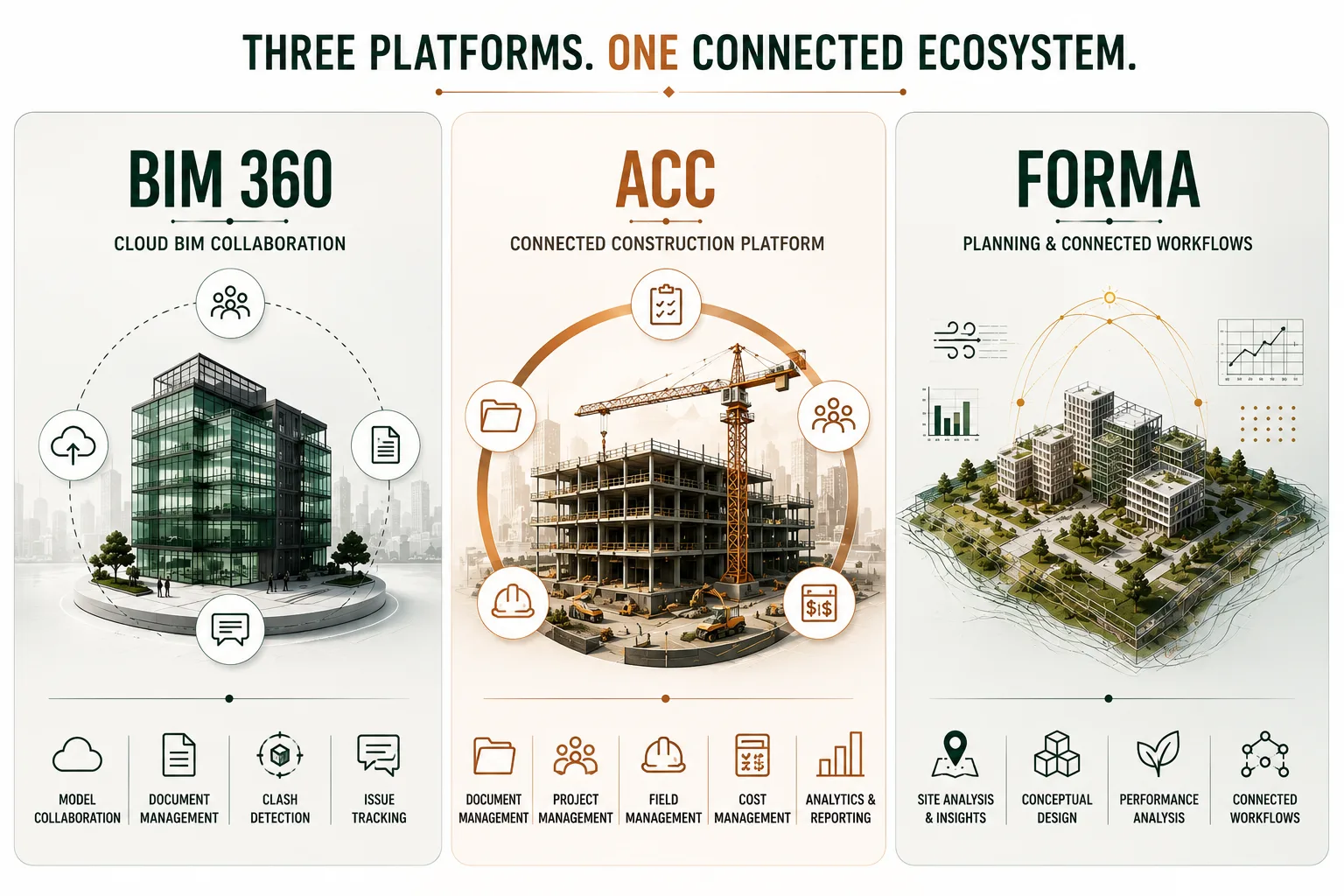
10. BIM 360 vs Autodesk Construction Cloud vs Autodesk Forma
Although these platforms are closely connected, each represents a different stage in Autodesk's digital transformation journey.
The key takeaway is simple: Autodesk isn't replacing one platform with another. Instead, it's connecting every stage of the project lifecycle into a unified digital ecosystem.
11. Why This Matters Beyond Software
For many years, BIM professionals mainly focused on creating coordinated Revit models.
Today, the industry expects much more.
Modern BIM projects increasingly depend on:
- Cloud-based collaboration
- Common Data Environments (CDEs)
- Real-time model coordination
- Digital document management
- Issue tracking
- Connected project information
This means BIM professionals are no longer working only inside a modeling environment—they're contributing to a connected digital delivery process that begins with site planning and continues through construction and facility management.
12. The Industry Shift Is Bigger Than Software
Many people assume Autodesk Forma is simply another application they need to learn.
The bigger transformation is actually happening in how construction projects are delivered.
Instead of exchanging files between different teams, project information is becoming continuously connected across disciplines.
This shift improves:
- Collaboration
- Information accuracy
- Version control
- Design coordination
- Decision-making
- Project transparency
As digital construction continues to evolve, connected workflows are becoming just as important as technical modeling skills.
13. Autodesk Ecosystem at a Glance
Rather than treating these as separate software applications, Autodesk is gradually creating one continuous workflow where project information moves seamlessly from one stage to the next.
One of the biggest misconceptions among students is believing they need to master every new Autodesk product as soon as it's released.
In reality, the underlying BIM principles remain the same.
Whether a project uses BIM 360, Autodesk Construction Cloud, or Autodesk Forma, successful BIM professionals still rely on:
- Strong BIM standards
- Effective collaboration
- Structured information management
- Coordinated workflows
- Clear communication between disciplines
Technology will continue to evolve.
However, professionals who understand how information flows throughout a project lifecycle will always have an advantage over those who focus only on learning individual software tools.
14. Related Learning
If you're new to Autodesk's BIM ecosystem, these articles can help you build a stronger understanding of connected workflows:
- Complete BIM Workflow: From Design to Construction
- BIM is Not Just Revit: Understanding the Difference Between Design and BIM
- Revit 2027: New Features Every BIM Professional Should Know
- MEP Coordination in BIM: The Part Most BIM Learners Never Fully Understand
Together, these topics explain how BIM modeling, coordination, cloud collaboration, and digital project delivery fit into a modern construction workflow.
Final Thoughts
The evolution from BIM 360 to Autodesk Construction Cloud (ACC) and now Autodesk Forma represents much more than a change in product names.
It reflects Autodesk's long-term vision of creating a connected digital ecosystem where information flows seamlessly from site planning and conceptual design to BIM modeling, construction coordination, and facility management.
For BIM professionals, students, and organizations, understanding this evolution isn't simply about keeping up with Autodesk's latest branding.
It's about understanding where the construction industry is heading.
As cloud-based collaboration becomes the standard across global AEC projects, professionals who understand connected BIM workflows, Common Data Environments (CDEs), and digital project delivery will be better prepared for the future of the industry.
Frequently Asked Questions
Is Autodesk Forma replacing Autodesk Construction Cloud (ACC)?
No. Autodesk Forma is not replacing ACC. Instead, Autodesk is expanding Forma into a broader AECO platform that connects planning, design, collaboration, construction, and operations. Many ACC services are gradually being aligned within the Forma ecosystem.
What is the difference between BIM 360 and Autodesk Construction Cloud?
BIM 360 was Autodesk's first cloud collaboration platform focused on document management, model sharing, and coordination. Autodesk Construction Cloud (ACC) expands those capabilities by integrating design collaboration, construction management, issue tracking, and project delivery into one connected platform.
What happened to Spacemaker AI?
Autodesk acquired Spacemaker AI in 2020 and rebranded it as Autodesk Forma in 2023. While it initially focused on AI-powered site planning and conceptual design, Autodesk has expanded Forma into a broader connected platform for the AECO industry.
Does Autodesk Forma replace Revit?
No. Revit remains Autodesk's primary BIM authoring software. Autodesk Forma complements Revit by supporting site analysis, conceptual planning, and cloud-connected workflows before detailed BIM modeling begins.
Should BIM professionals learn Autodesk Forma?
Yes. As more projects adopt cloud-based BIM workflows, understanding Autodesk Forma, Autodesk Construction Cloud, and connected digital collaboration will become increasingly valuable for BIM professionals working on modern AEC projects.
What is a Common Data Environment (CDE) in BIM?
A Common Data Environment (CDE) is a centralized digital platform where project documents, BIM models, drawings, and communication are stored and managed. It ensures all project stakeholders work with the latest information, improving collaboration while reducing errors and duplication.
Professional BIM Course
Master BIM Course
Structural Design Concepts and BIM
Certified MEPF BIM Master Course
Electrical BIM Professional Program
RenderLab – Master 3D Modeling & Photorealistic Rendering
Multi-Tool Mastery for Architects & Engineers
BIM Coordinator Workflow Program
BIM FastTrack – 30 Day Intensive Training
Global Architectural & Structural BIM Project Program