Author: Devika R
April 26, 2026
10 min read
Building Information Modeling (BIM) has reshaped architecture, engineering, and construction. Platforms like Autodesk Revit make it easier to design, coordinate, and document complex work—yet many large projects still hit coordination issues, repeated design revisions, and delays.
If you have seen flagship developments struggle despite strong visuals, our article on vision vs reality in large-scale BIM connects the same pattern: big ambition without delivery systems breaks down under pressure.
So what is going wrong? In most cases, the problem is not BIM software—it is how teams use it, and whether they treat BIM as a shared workflow or as solo drafting in 3D.
The real problem: lack of BIM awareness
On large international projects, BIM failures rarely come from a missing toolbar. They come from workflow gaps—unclear ownership, weak coordination rituals, and contributors who understand design but not model-based delivery.
During coordination for an interior BIM scope on a major hospitality project in Dubai, one issue stood out: the challenge was not only the building—it was BIM awareness across a distributed team.
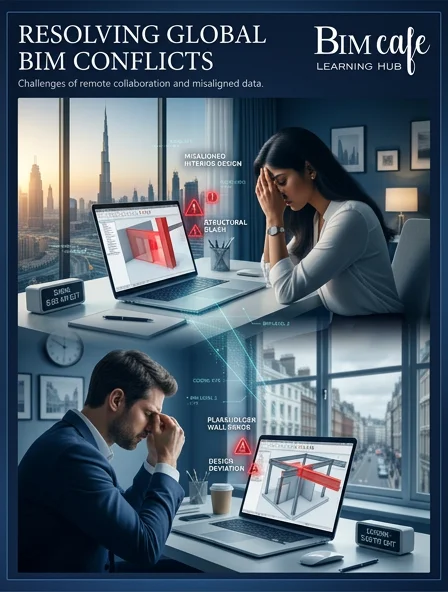
Designers joined from Europe, the UK, South Africa, and other regions—often as freelancers producing hotel interior proposals. Visually, many options looked strong. Practically, they frequently drifted from architectural models, ignored local requirements, and triggered round after round of rework during coordination.
When designers ignore local regulations
Global collaboration is normal—but without local rule sets, it becomes risky. In this programme, several schemes failed Dubai Municipality expectations. Typical issues included undefined toilet layouts, room sets that did not match approved shells, and interior partitions that fought the base building grid.
These were not “small fixes.” They forced redesign, re-modeling, and new coordination cycles—exactly where clash detection and federated reviews turn reactive if models were never aligned in the first place.
BIM cannot compensate for approvals and code logic that were never embedded in the modeling strategy from the start.
The biggest misconception: “Revit = CAD”
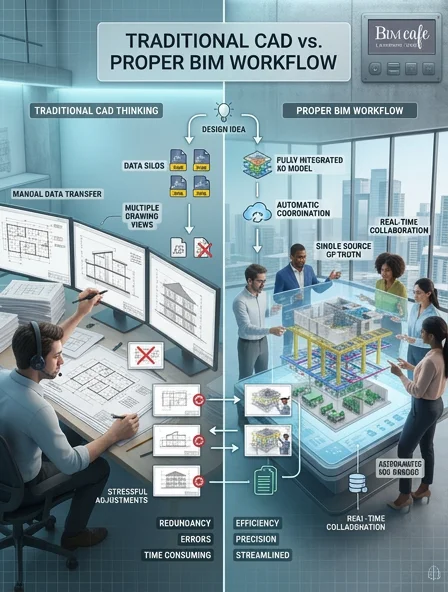
One of the most damaging assumptions is that Revit is just 3D CAD. That mindset encourages draw-first habits in a model-first environment.
- Traditional CAD thinking: draw first, adjust later.
- BIM workflow: coordinate the model first; drawings become views of validated data.
In BIM, the model is meant to integrate architecture, structure, MEP, and interiors. When Revit is used like CAD, models disconnect, coordination breaks, and rework grows—similar to the handoff risks we describe in how a real BIM project works from design to site.
When placeholder modeling breaks coordination
Another failure mode is introducing elements that do not honor the coordinated baseline—placeholder walls that ignore architectural grids, “temporary” geometry that never gets reconciled, or duplicate room logic. In this project, placeholder partitions conflicted with coordinated layouts, pitting interior intent against architectural truth.
Even with shared walkthroughs, teams often optimize for visual storytelling instead of buildable, clash-tested information—a gap that shows up quickly when execution teams ask for dimensions that trace to a single source of truth.
Why hospitality projects amplify BIM risk
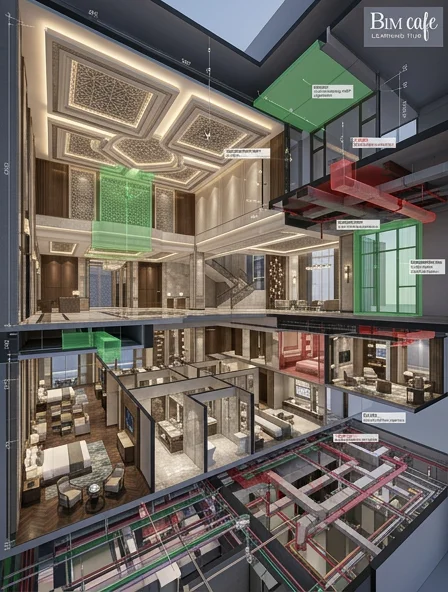
Hospitality compounds complexity: custom room types, intricate bathrooms, decorative ceilings, integrated lighting, and FF&E-driven changes. One local adjustment can ripple into HVAC, plumbing, electrical, and life-safety routing.
Without early alignment—LOD expectations, approval milestones, and shared grids—changes multiply faster than coordination can absorb. That is why employers increasingly screen for workflow maturity, not only software clicks; see what BIM recruiters look for in 2026 and how AI-assisted BIM still depends on human judgment for coordination.
BIM is not a tool — it is a workflow
The takeaway is simple: BIM is not a piece of software; it is a coordinated way of working. Successful programmes define who owns what, how models are shared, how clashes are cleared, and how local regulations are verified before drawings are issued.
Without that foundation, BIM becomes a magnifier—you find problems late, in expensive detail, instead of preventing them while the model is still flexible.
Key lessons for BIM professionals
- BIM is a collaborative process, not a solo modeling exercise.
- Local regulations and authority requirements must be designed into the workflow—not patched after renders look final.
- Missing workflow knowledge creates exponential rework, especially with distributed teams.
- Remote teams need explicit coordination systems (standards, templates, clash cadence, approval gates).
- Model-based thinking has to lead; drawings are outputs of a disciplined model.
Final thoughts
BIM technology is powerful, but it cannot fix broken workflows. When design intent, coordination strategy, and regulatory understanding align from the beginning, projects move faster, rework drops, and collaboration improves. In today’s market, that alignment is often the difference between success and failure.
Frequently Asked Questions
Why do large BIM projects fail?
Most failures trace to workflow issues—weak standards, poor coordination, and treating BIM like drafting—rather than software limitations alone.
Is Revit the same as CAD?
No. CAD is often draw-first; BIM expects a coordinated model-first workflow where drawings are generated from validated model data.
Why does hospitality BIM break more often?
Variability in rooms, bathrooms, ceilings, and services creates many dependencies—small changes can ripple across MEP and fire systems without strict early coordination.
What fixes BIM coordination on international teams?
Clear responsibilities, shared templates, clash routines, approval milestones, and verifying local regulatory requirements before design freezes.
Professional BIM Course
Master BIM Course
Structural Design Concepts and BIM
Certified MEPF BIM Master Course
Electrical BIM Professional Program
RenderLab – Master 3D Modeling & Photorealistic Rendering
Multi-Tool Mastery for Architects & Engineers
BIM Coordinator Workflow Program
BIM FastTrack – 30 Day Intensive Training
Global Architectural & Structural BIM Project Program