Author: Devika R
March 27, 2026
Read time not available
You’ve heard BIM mentioned in every job description, every LinkedIn post, every conversation with seniors who came back from the Gulf.
But here’s what nobody clearly explains: what does an MEP engineer actually do in a BIM project, day to day?
Is it just modelling pipes and ducts in Revit? Is it a designer’s role? Do site engineers even need it?
At BIM Cafe Learning Hub, we work with two groups constantly — fresh engineering graduates trying to break into BIM, and experienced site engineers or Gulf returnees who want to reposition their career. Both groups ask the same question, just from different angles.
This blog gives you a straight answer: what MEP BIM work actually looks like, what skills matter beyond software, how the career ladder works, and where the real opportunities are — both in India and abroad.

MEP in BIM Is Not Just About Modelling
Before getting into roles, it’s important to understand what the work actually is.
In a traditional CAD workflow, MEP engineers produce 2D drawings — floor plans, sections, schematics — and pass them to the site. Clashes are discovered on site, which means delays, rework, and cost overruns.
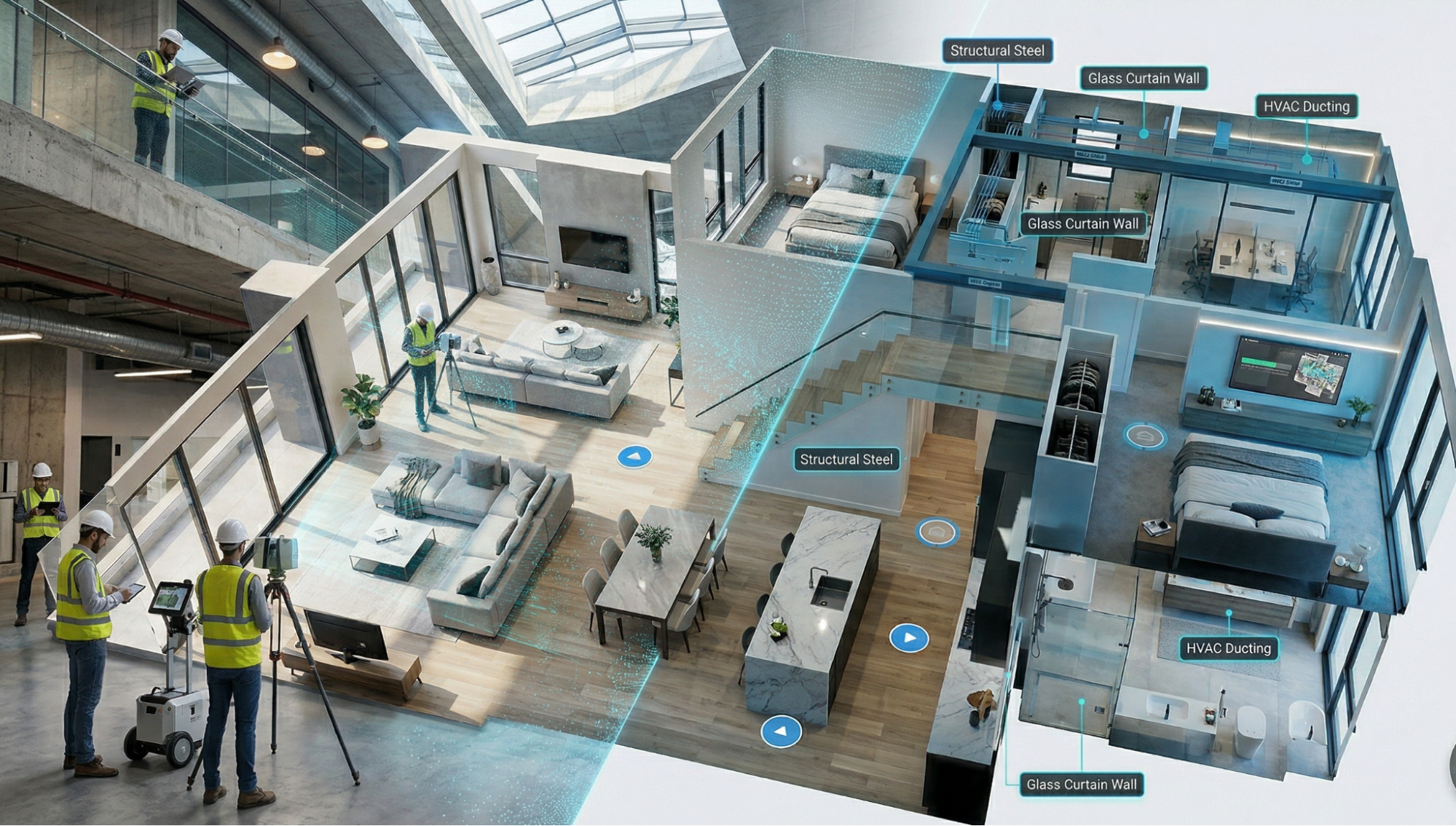
In a BIM workflow, MEP engineers build a 3D intelligent model of all building services — HVAC, plumbing, electrical, and firefighting — and coordinate those services digitally before a single pipe is installed. Every system exists in the same federated model alongside architecture and structure. If a duct passes through a beam, you catch it on screen, not on site.
This is why MEP BIM professionals are so valuable. The work isn’t just drawing — it’s problem-solving before problems become expensive.
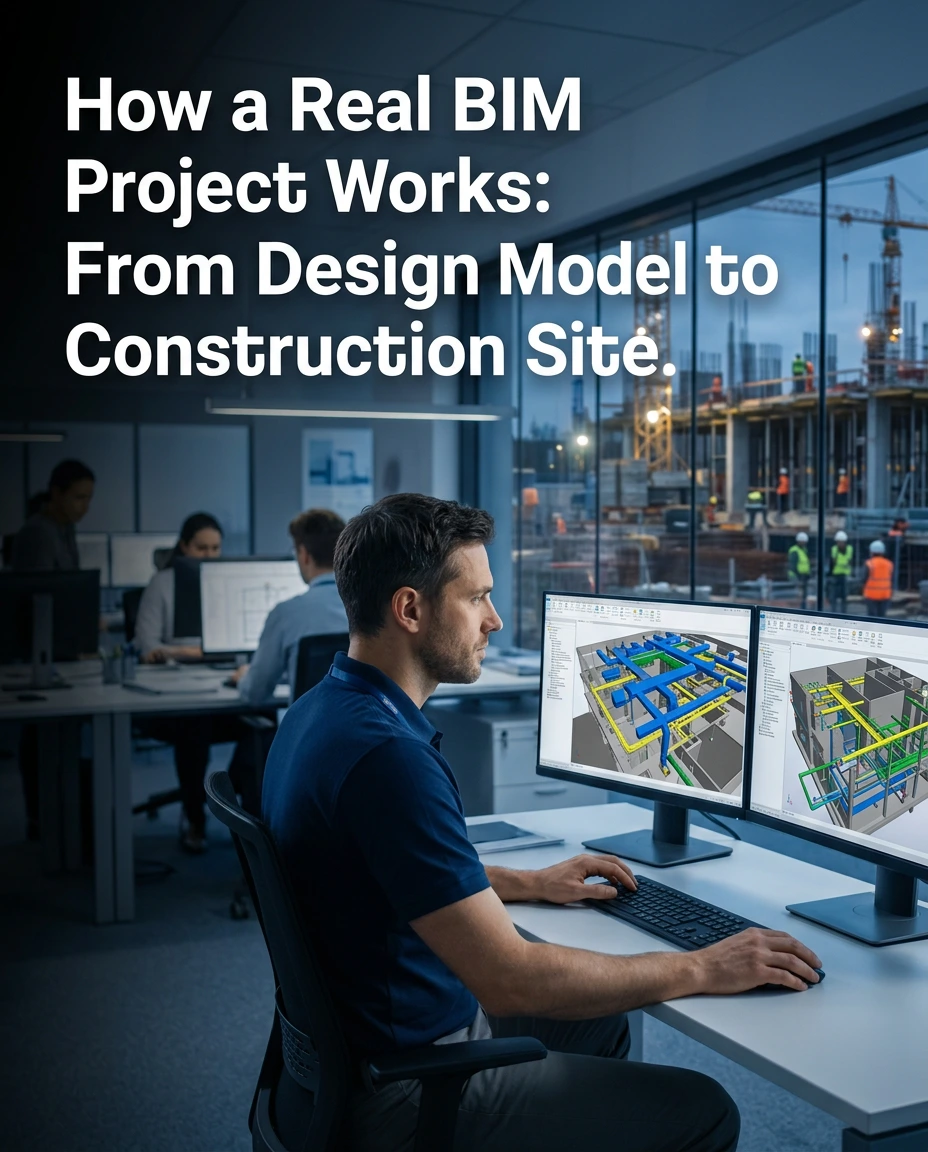
To understand how this fits into the larger project workflow, read: How a Real BIM Project Works: From Design Model to Construction Site
What MEP Engineers Do in BIM — By Discipline
Each MEP discipline has its own specific responsibilities inside a BIM project. Here’s what the work actually looks like:
Electrical BIM Engineer
An Electrical BIM Engineer is responsible for modelling and coordinating all power and lighting systems in the building model.
On a typical working day, this includes:
- Modelling cable trays, conduits, lighting fixtures, switchboards, and panel boards in Revit MEP
- Planning routing paths for electrical systems to avoid structural conflicts
- Coordinating with HVAC teams where ducts and cable trays compete for ceiling space
- Creating load layout drawings and circuit schedules from the model
- Reviewing shop drawings and RFIs (Requests for Information) related to electrical systems
- Participating in coordination meetings and resolving clash reports from Navisworks
If you want to specialise in this area, the Electrical BIM Professional Course covers electrical system modelling, panel layouts, and coordination workflows specifically.
Mechanical (HVAC) BIM Engineer
HVAC is typically the most space-intensive MEP system in any building. Getting the ductwork right — and coordinating it with everything else — is one of the most demanding tasks in a BIM project.
A Mechanical BIM Engineer’s work includes:
- Designing and modelling duct routing, air handling units (AHUs), FCUs, and diffusers
- Ensuring airflow paths are practical and meet design intent
- Coordinating with the structural model to route around beams and slabs
- Producing sections, elevations, and equipment schedules from the model
- Running space analysis to confirm headroom clearances meet building standards
- Flagging and resolving HVAC clashes in coordination reviews
Plumbing BIM Engineer
Plumbing work in BIM requires detailed understanding of slopes, pipe sizing, and system logic — not just modelling.
Daily responsibilities typically include:
- Modelling cold water, hot water, drainage, and sanitary systems
- Calculating and maintaining correct pipe slopes in the model (drainage lines must maintain gravity flow — you can’t just route them flat)
- Coordinating shaft layouts with architectural and structural teams
- Modelling pump rooms and plant rooms in detail
- Producing plumbing schematics and material take-offs from the model
Firefighting BIM Engineer
Fire protection systems follow strict code requirements — and BIM makes compliance verification much more structured.
A Firefighting BIM Engineer’s work involves:
- Designing and modelling sprinkler layouts, fire hydrant networks, and suppression systems
- Verifying coverage areas and spacing against local fire codes (NBC, NFPA, or project-specific standards)
- Coordinating fire protection pipework with HVAC ductwork and electrical cable trays
- Producing fire protection schematics and coordination drawings
For a broader understanding of why MEP codes and compliance matter in BIM projects, read: Why MEP Codes Matter: The Hidden Rules That Keep Buildings Safe
The Most Critical Skill: Coordination
Software knowledge gets you in the door. Coordination skill is what makes you valuable.
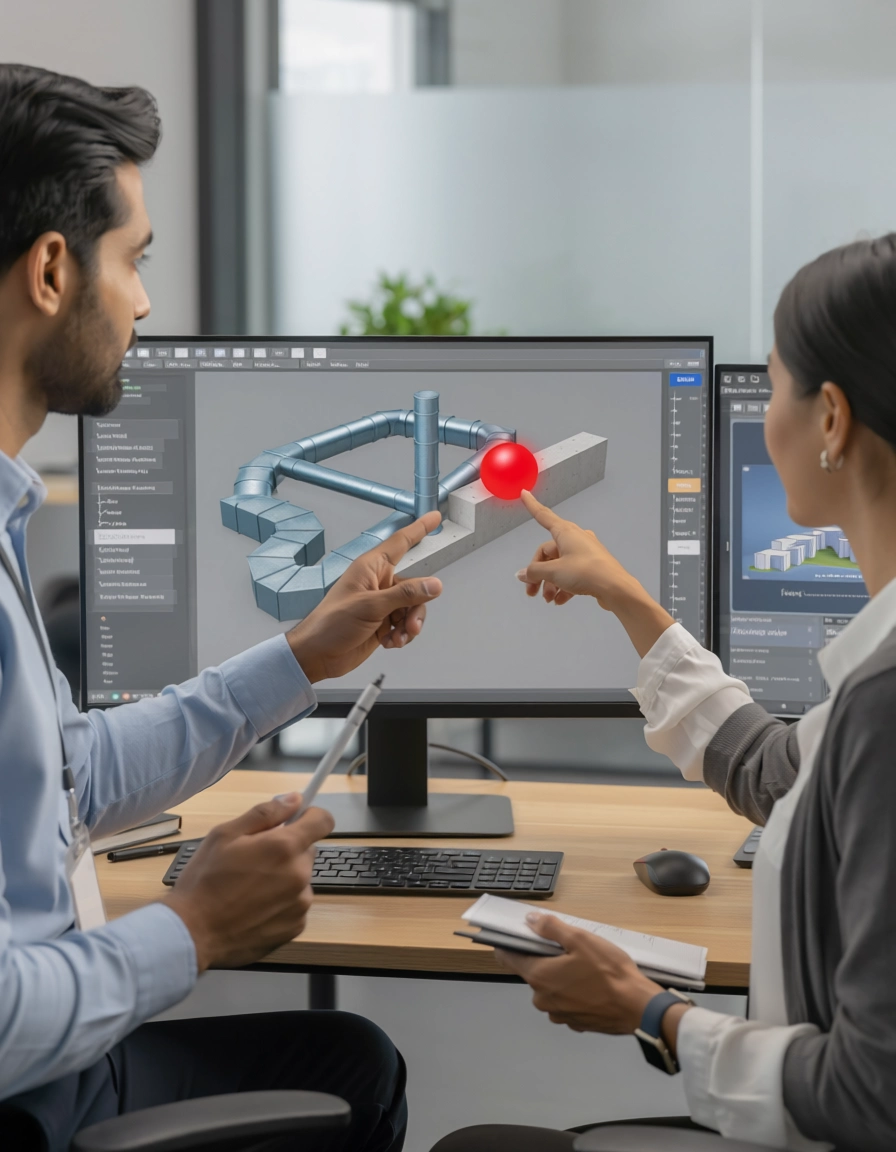
MEP coordination is the process of checking all building systems — architecture, structure, HVAC, plumbing, electrical, firefighting — against each other in a combined federated model, identifying clashes, and resolving them before construction begins.
This is done using tools like Navisworks Manage or BIM 360 / Autodesk Construction Cloud (ACC).
What Real Clashes Look Like on a Project
These aren’t hypothetical examples — they come up in almost every multi-storey project:
- Hard clash: A 600mm wide duct passing directly through a 400mm deep concrete beam. One of them has to move.
- Soft clash: A maintenance access panel for an AHU is blocked by a cable tray routed too close. You can install both, but the AHU can never be serviced.
- Workflow clash: The structural team updated their model with a new beam size, but the MEP model hasn’t been updated to reflect it. The coordination meeting flags it before rework happens on site.
Why This Matters Financially
In large commercial and infrastructure projects, site rework caused by service clashes can cost anywhere from ₹10 lakhs to several crores depending on project scale. MEP BIM engineers who can run coordination workflows, manage clash reports, and facilitate resolution meetings are directly preventing those costs. This is why experienced MEP BIM coordinators command significantly better salaries than modellers.
The MEP BIM Career Ladder
Here’s how a realistic career path looks for an MEP engineer entering the BIM space:
| Role | Typical Experience | Core Responsibility |
|---|---|---|
| MEP BIM Modeller | 0–2 years | Creating and updating BIM models per design intent |
| MEP BIM Engineer | 2–4 years | Modelling + coordination + documentation |
| BIM Coordinator | 3–6 years | Managing multi-discipline clash detection and coordination workflows |
| BIM Manager | 6+ years | Project-level BIM strategy, standards, team management |
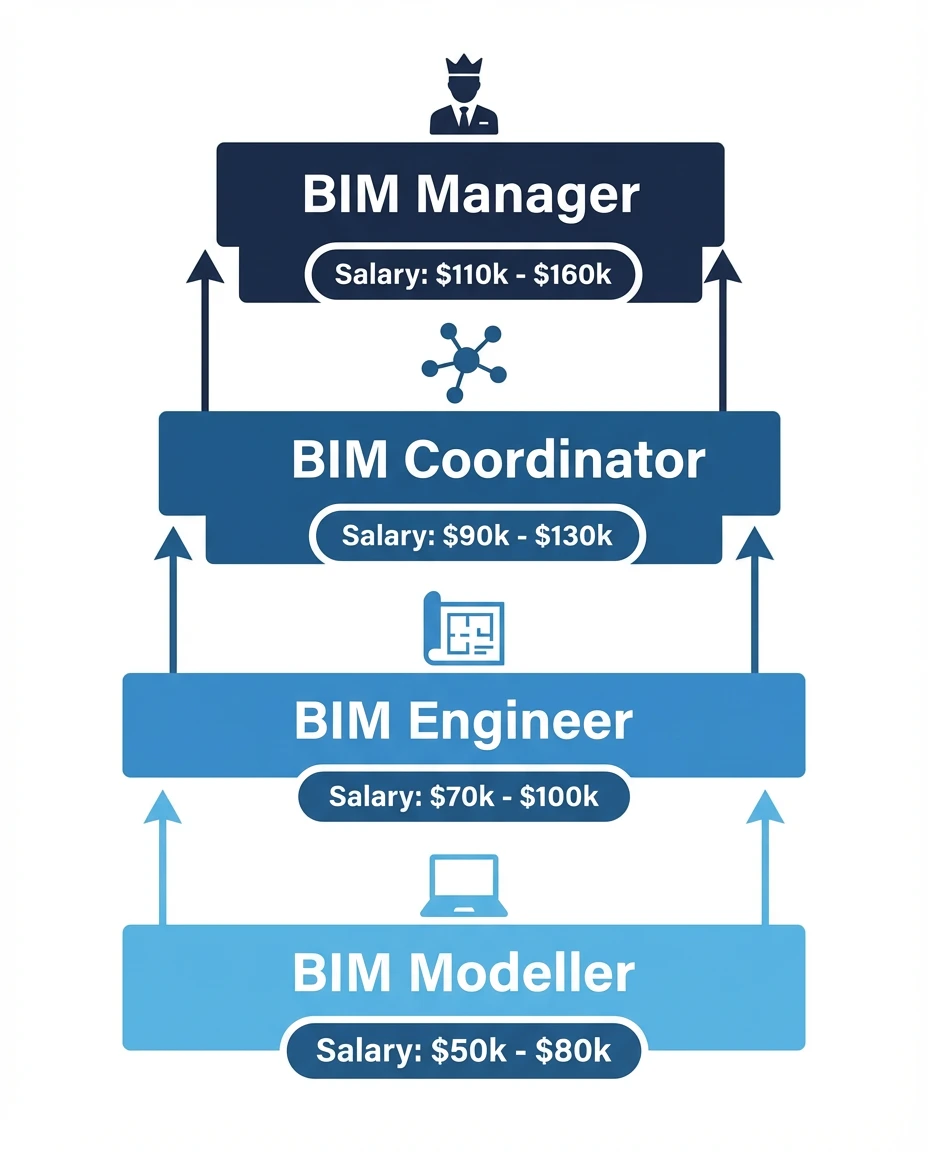
Salary ranges vary significantly between India and Gulf markets:
- India (entry-level modeller): ₹2.5L – ₹4.5L per annum
- India (BIM Coordinator/Engineer): ₹5L – ₹10L per annum
- UAE / Qatar / Saudi (BIM Engineer): AED 5,000 – AED 12,000 per month
- UAE / Qatar (BIM Manager): AED 12,000 – AED 20,000+ per month
The jump from modeller to coordinator — in both responsibility and pay — is significant. And that jump is almost entirely driven by coordination skills, not software hours.
To understand what recruiters are actually looking for when they hire MEP BIM professionals, read: What BIM Recruiters Look For in 2026

Why MEP BIM Demand Is High — Especially in the Gulf
MEP BIM professionals are among the most actively hired AEC roles in UAE, Qatar, Saudi Arabia, and across the GCC. Here’s why:
Scale of projects: Gulf construction projects — airports, hospitals, mixed-use towers, mega infrastructure — are too complex to manage without BIM. Coordinating 40+ floors of services manually in 2D is not viable.
Mandated by clients: Most large project owners (Emaar, Aldar, government infrastructure bodies) now require ISO 19650-compliant BIM delivery. This means MEP subcontractors must have trained BIM resources.
Outsourcing to India: Many UAE-based engineering consultancies outsource their MEP BIM work to India, particularly to Kochi, Hyderabad, and Pune. This creates strong remote and on-site opportunities for trained Indian MEP engineers without relocating.
Skills shortage: The demand for qualified MEP BIM Coordinators is growing faster than the supply of trained professionals. Engineers who understand real project workflows — not just software — have a clear advantage.
Skills That Actually Matter (Beyond Software)
This is where most people get it wrong. They spend months mastering Revit and then struggle in actual jobs because the real work requires more.
What employers consistently look for:
- MEP system understanding — You need to understand how HVAC systems actually function, what pipe slopes are required for drainage, what cable sizing logic looks like. Software can’t compensate for a weak grasp of the engineering.
- Drawing reading skills — You must be able to interpret 2D design drawings and translate them accurately into a 3D BIM model.
- Coordination mindset — Can you anticipate where clashes will occur before running the detection? Can you facilitate a coordination meeting and drive resolution?
- LOD (Level of Development) awareness — Different project stages require different model detail. Understanding LOD 200 vs LOD 350 vs LOD 400 is essential for professional-grade work.
- Documentation — BOQs (Bill of Quantities), shop drawings, RFI logs, as-built models. The model produces these; you need to know how to produce them correctly.
- Communication — Coordination involves architects, structural engineers, contractors, and clients. Clear written and verbal communication is a real job skill.
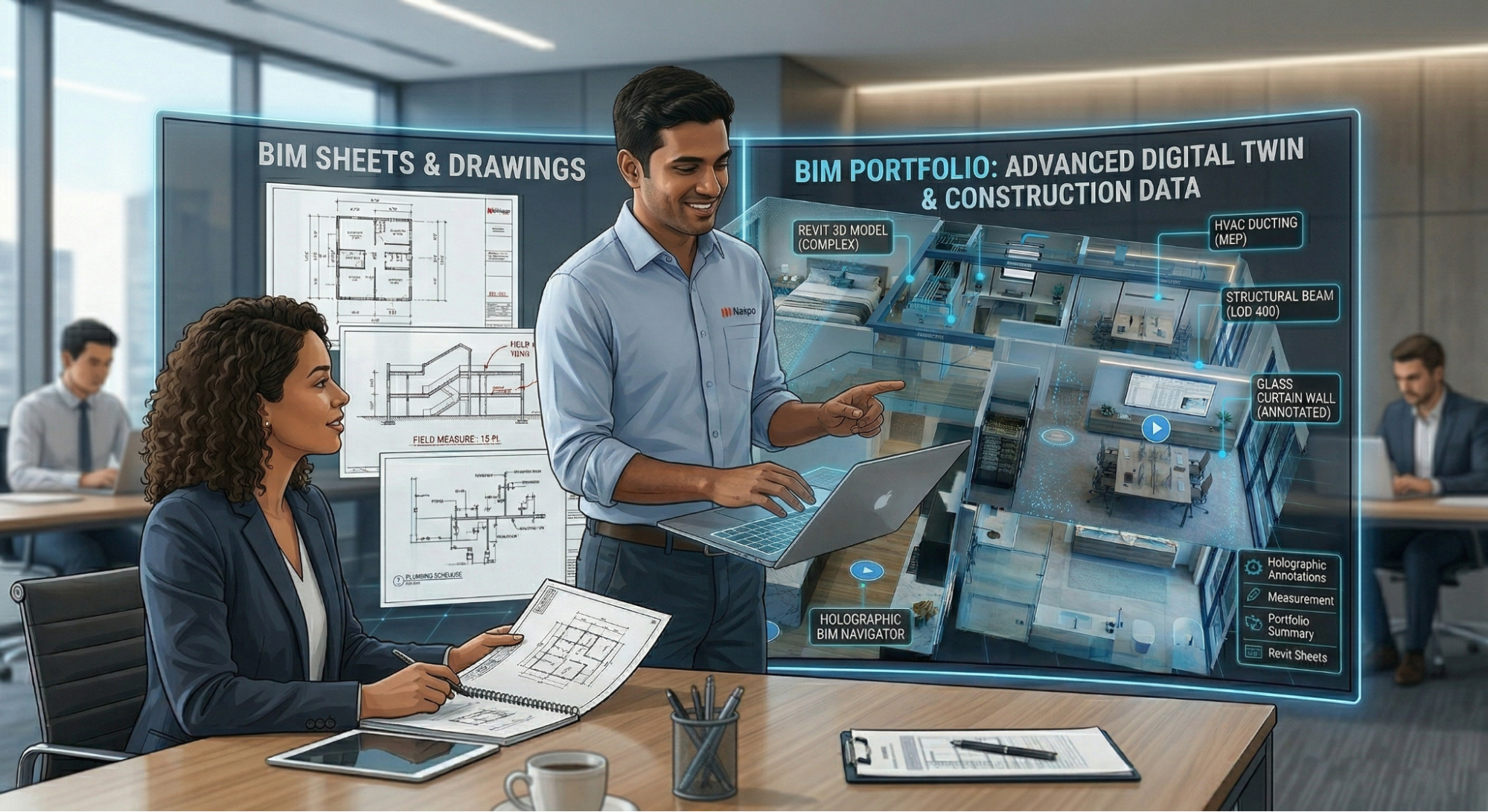
For a detailed look at what a strong BIM portfolio should demonstrate, read: What Should a BIM Portfolio Contain? The 7 Things Recruiters Actually Look For
Common Myths About MEP BIM — Cleared Up
Myth 1: “BIM is only for designers.”
Not even close. BIM is used across design, coordination, construction, and facility management. On most large projects, the MEP contractor’s BIM team does more modelling and coordination work than the design consultant.
Myth 2: “Knowing Revit is enough.”
Revit is the starting point, not the destination. Real projects require Navisworks for clash detection, BIM 360/ACC for collaboration, and increasingly Dynamo for automation. More importantly, the model is only useful if you understand the engineering behind it.
Myth 3: “Site engineers don’t need BIM.”
Site experience is actually a major advantage in BIM. If you’ve seen a pipe clash with a beam on an actual construction site, you understand the coordination process on a completely different level. Site engineers who add BIM skills are genuinely more valuable than pure software trainees.
Myth 4: “BIM is only relevant for large projects.”
While large commercial and infrastructure projects drive the most BIM adoption, mid-sized hospitals, hotels, and institutional buildings increasingly require BIM for MEP coordination. The scope is widening.
Transitioning to BIM from AutoCAD or Site Roles
If you currently work in 2D CAD or on site, the transition to BIM is very doable — but it needs to be structured correctly.
The wrong approach is just buying a Revit course online and working through tutorials. You’ll learn the tool but not the workflow.
The right approach:
- Learn Revit MEP fundamentals — model creation, families, system logic
- Understand how your specific discipline (electrical/HVAC/plumbing) works within a federated model
- Learn clash detection using Navisworks
- Work through real project scenarios — actual project files, coordination exercises, RFI workflows
- Build a portfolio that shows project-based work, not just tutorial outputs
If you’re coming from a 2D CAD background and want to understand the differences in how BIM projects are structured versus traditional 2D workflows, read: MEP Design vs MEP BIM: What’s the Real Difference?
MEP BIM Courses at BIM Cafe Learning Hub
BIM Cafe’s MEP training is designed around real project workflows — not just software training. Here’s how to choose:
MEPF BIM Professional Program (3 Months)
Best for: Freshers or working engineers entering MEP BIM for the first time.
Covers all four systems — HVAC, plumbing, electrical, and firefighting — modelled in Revit MEP with real project logic. Includes coordination fundamentals, quantity take-offs, and documentation.
View MEPF BIM Professional Program →
Certified MEPF BIM Master Course (4 Months)
Best for: Engineers targeting BIM Coordinator or BIM Engineer roles in India or abroad.
Builds on full MEP modelling with advanced coordination workflows — Navisworks clash detection, BIM 360/ACC exposure, LOD management, and real project-based execution aligned with international standards.
View Certified MEPF BIM Master Course →
Electrical BIM Professional Course (2 Months)
Best for: Electrical engineers who want to specialise in Electrical BIM rather than covering all four disciplines.
Focuses specifically on electrical system modelling — lighting, cable trays, panel boards, circuit layouts — and integrates with MEP coordination workflows.
View Electrical BIM Professional Course →
Global MEPF BIM Project Program (1 Month)
Best for: Engineers who have basic Revit knowledge and want real international project exposure.
Live project-based training on actual MEPF BIM projects — the same type of work done for UAE and European clients. Builds portfolio work that is directly relevant to international job applications.
View Global MEPF BIM Project Program →
Not sure which course fits your background? Read: Why BIM Skills Matter More Than Degrees in 2026 Construction Careers
Frequently Asked Questions
What does an MEP BIM engineer do on a daily basis?
Daily work varies by project stage. During design development, you’re modelling systems and running initial coordination checks. During construction documentation, you’re producing shop drawings, resolving RFIs, and updating the model as design changes come in. During construction, you’re supporting the site with clash-free coordinated drawings.
Is MEP BIM only for large construction projects?
No. While large commercial and infrastructure projects are the main adopters, hospitals, hotels, institutional buildings, and increasingly mid-sized commercial developments are requiring BIM MEP coordination. The adoption is widening across project sizes.
What software do MEP BIM engineers use?
Revit MEP is the core modelling tool. Navisworks Manage is used for clash detection and coordination review. Autodesk BIM 360 or Construction Cloud (ACC) is used for model management and collaboration on live projects. Some projects also use AutoCAD for 2D output, and Dynamo for parametric modelling automation.
How long does it take to become job-ready in MEP BIM?
With structured training, 3–4 months is enough to reach entry-level modeller capability. Reaching BIM Coordinator level requires project experience on top of training — typically 1–2 years of actual project work after initial training.
Does site experience help in BIM careers?
Yes, significantly. Engineers who have worked on site understand real installation constraints — where pipes actually go, how access panels work, what a congested ceiling space looks like. This practical knowledge directly improves coordination quality and makes you more valuable than a purely software-trained modeller.
What is the salary of an MEP BIM engineer in UAE?
Entry-level MEP BIM Modellers typically earn AED 4,000–7,000 per month in the UAE. BIM Engineers with 3–5 years experience earn AED 8,000–14,000. BIM Coordinators and Managers can earn AED 15,000–22,000 or more depending on company and project scale.
Can a mechanical or electrical engineer from a non-BIM background switch to MEP BIM?
Yes — and they often have an advantage. A mechanical engineer who understands HVAC systems deeply will learn BIM modelling faster and produce better-coordinated models than someone who learned the software without engineering context. The software is learnable in weeks; the engineering understanding takes years to develop.
What is the difference between a BIM Modeller and a BIM Coordinator?
A BIM Modeller creates and updates the model based on design inputs. A BIM Coordinator manages the coordination process across multiple disciplines — scheduling coordination meetings, running clash detection, tracking clash resolution, and ensuring the federated model stays current. The Coordinator role requires both technical skill and project communication ability.
What Makes BIM Cafe Different
Most BIM training stops at software. BIM Cafe structures training around real project environments — the same type of coordination meetings, project files, and documentation workflows that engineers face in actual jobs.
Placement support and industry partnerships mean students work toward job-ready portfolios, not just certificates.
Explore all MEP courses at BIM Cafe →
Author: Devika R | BIM Cafe Learning Hub
Published: March 2026