Author: Devika R
December 11, 2025
11 min read
The world of Building Information Modelling (BIM) is evolving at an unprecedented pace, and with this transformation comes a tremendous surge in career opportunities. Across regions such as India, the Middle East, Europe, and Southeast Asia, companies are moving away from traditional CAD workflows and embracing BIM-based project delivery. This shift has created a strong demand for specialized BIM professionals who are proficient not only in software tools but also in real-world project workflows.
However, with so many BIM specializations available — including Civil BIM, Structural BIM, MEP & MEPF BIM, Architectural BIM, Interior BIM, BIM Coordination, and more — students and working professionals often face a critical question:
“Which BIM course should I choose to maximize my career growth and global opportunities?”
This guide explores the most in-demand BIM specializations for 2025, detailing the career scope for each, essential skills, recommended courses, and how BIM training can propel your professional journey.
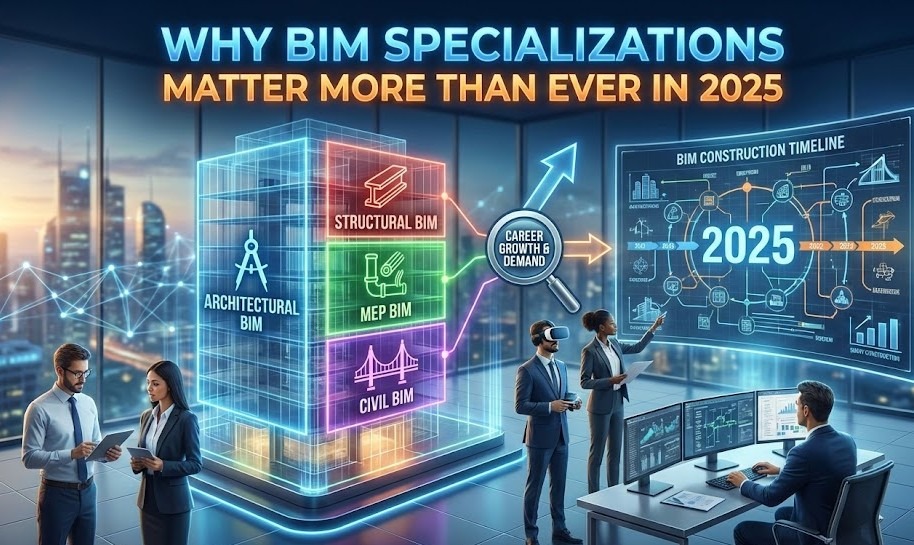
Why BIM Specializations Matter More Than Ever in 2025
In the past, proficiency in Autodesk Revit alone was considered sufficient to secure a BIM-related role. Today, the landscape has significantly changed. Organizations now expect BIM professionals to bring specialized knowledge and real project experience to the table.
Key Expectations from BIM Professionals Today:
- Role-specific BIM expertise: Companies seek individuals trained for particular roles, not general modelers.
- Domain specialization: Civil, MEP, Architectural, or Interior BIM knowledge is crucial.
- Real project experience: Practical exposure to live projects is highly valued.
- Coordination and clash detection skills: The ability to resolve multi-disciplinary conflicts is essential.
- Knowledge of standards: Familiarity with ISO 19650, COBie, LOD/LOI is a must.
- Software proficiency: Hands-on experience with BIM 360, Navisworks, Dynamo, and other industry-standard tools.
Common BIM Roles in Demand:
- BIM Modeler – Civil
- BIM Modeler – MEPF
- Structural BIM Engineer
- BIM Coordinator
- MEP BIM Designer
- Interior BIM Specialist
- Revit Technician – MEP / Civil / Architecture
Insight: In today’s competitive BIM job market, choosing the right specialization is your biggest career advantage. Professionals with targeted skills are preferred over generalists, and their expertise often translates to higher salaries and global opportunities.
BIM for Civil Engineers (High Global Demand)

Civil BIM continues to be one of the fastest-growing specializations worldwide. Civil engineers are the backbone of large-scale infrastructure and building projects, making their skills in BIM modeling and coordination highly sought-after. Over the past three years, demand for Civil BIM professionals has tripled in regions such as the UAE, Qatar, Saudi Arabia, and Europe.
Career Roles for Civil BIM Professionals:
- BIM Modeler – Civil
- BIM Engineer – Infrastructure Projects
- Revit Civil Technician
- Site BIM Coordinator
- BIM Quantity Surveyor (QS)
Core Skills Taught in Civil-Focused BIM Programs:
- Revit for Civil Structures: Foundations, slabs, columns, beams, and grids.
- 3D Modelling & Documentation: Accurate digital models, drawing sets, and schedules.
- Clash Detection: Using Navisworks to identify and resolve conflicts before construction.
- LOD/LOI Understanding: Ensuring designs meet industry standards for Level of Detail (LOD) and Level of Information (LOI).
- Project Coordination Skills: Efficient workflow management for large civil infrastructure projects.
Recommended Courses for Civil BIM Professionals:
- Master BIM Course for Civil Engineers – Comprehensive training with real project exposure.
- Professional BIM Course – Focused on practical modeling, documentation, and coordination skills.
- Premium BIM Course – In-depth specialization including advanced Revit workflows.
- Advanced Diploma in Interior Design & BIM – Integrates civil and interior design applications for versatile career options.
Takeaway: Civil engineers who invest in a Civil BIM specialization gain a strong foothold in the global infrastructure sector, with opportunities in high-paying international markets.
Structural BIM – Precision, Demand & High Salaries
Structural BIM has emerged as one of the fastest-growing BIM specializations worldwide, driven by the increasing complexity of modern infrastructure and high-rise projects. Organizations now rely heavily on skilled structural modelers who can accurately model reinforced concrete (RCC), steel elements, and structural systems while ensuring clash-free coordination with other disciplines.
Why Companies Need Structural BIM Engineers
- Accuracy in RCC & Steel Modelling: Ensures precise digital replication of structural elements, minimizing construction errors.
- Clash-Free Design: Detects and resolves conflicts between structural elements and MEP systems before construction begins.
- Faster Construction Planning: Accurate models streamline sequencing, scheduling, and material management.
- Improved Documentation & Approvals: Detailed BIM models facilitate regulatory approvals, project documentation, and client presentations.
Career Roles in Structural BIM
- Structural BIM Modeler – Creates detailed 3D structural models using Revit.
- Structural Draftsman (BIM) – Prepares precise technical drawings and documentation.
- Revit Structure Specialist – Focuses on advanced modeling, detailing, and software efficiency.
- Structural Coordinator – Oversees structural BIM workflow, coordinating with other disciplines to prevent conflicts.
Essential Skills for Structural BIM Professionals
- Proficiency in Revit Structure
- Strong understanding of structural design principles
- Basics of rebar detailing and steel reinforcement
- Clash detection using Navisworks
- Preparation of BIM documentation and schedules
Recommended Courses
- Structural Design Concepts & BIM – Comprehensive program integrating structural engineering fundamentals with BIM modeling.
- Master BIM – Civil Specialization – Advanced course focusing on real-world projects and coordination workflows.
Insight: Structural BIM professionals are in high demand across infrastructure, commercial, and residential projects, offering competitive global salaries and growth opportunities.
MEP & MEPF BIM – The Highest Paid BIM Specialization
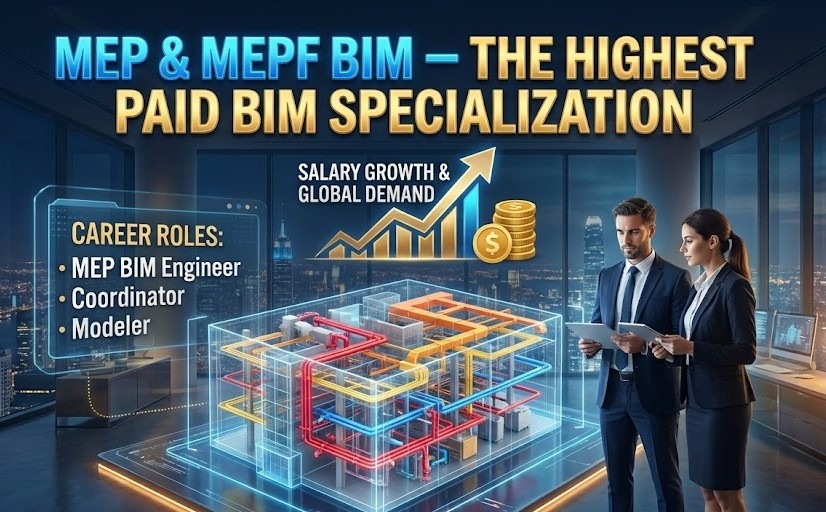
MEP (Mechanical, Electrical, Plumbing) BIM, also known as MEPF (Mechanical, Electrical, Plumbing, Firefighting), is the backbone of any construction project. MEP BIM professionals are consistently among the highest-paid roles due to the complexity and critical importance of MEP systems.
Why MEP & MEPF BIM is in Massive Demand
- All construction projects rely on mechanical, electrical, and plumbing systems for functionality and safety.
- There is a global shortage of skilled MEPF BIM engineers, particularly in the Middle East, where large-scale projects are booming.
- Companies actively recruit from talent hubs like Kerala for international projects.
- Salary growth is faster than most other BIM specializations, reflecting the scarcity and importance of expertise.
Career Roles in MEP & MEPF BIM
- BIM Modeler – Electrical – Designs and models electrical systems digitally.
- BIM Modeler – Mechanical/Plumbing – Handles HVAC, plumbing, and mechanical layouts.
- MEP BIM Engineer – Coordinates all MEP workflows with structural and architectural disciplines.
- Revit MEPF Modeler – Specializes in advanced Revit modeling for MEPF systems.
- BIM Coordinator – MEP – Oversees coordination, clash detection, and project collaboration.
Core Skills Learned in MEP & MEPF BIM Programs
- Revit MEP fundamentals and system modeling
- Electrical, HVAC, and PHE (plumbing, heating, and engineering) modeling
- Cable tray, duct, and pipe routing
- Basic load calculations for mechanical and electrical systems
- Clash detection using Navisworks Manage
- Family creation and annotation standards for MEP systems
Recommended Courses
- Electrical BIM & Designing Course – Focused on electrical system modeling and documentation.
- Revit MEPF Master Course – Advanced program covering all MEP disciplines and coordination workflows.
- MEPF Global Project Training – Hands-on training with international project standards and real-time collaboration.
Insight: Professionals trained in MEP/MEPF BIM enjoy global career opportunities, high salaries, and rapid career advancement, making it the most lucrative specialization in 2025.
Architectural BIM – For Creative Designers & Modellers
Architectural BIM is perfect for architects, interior designers, and graduates looking to combine creativity with digital expertise. It focuses on designing spaces, creating 3D models, and producing BIM documentation for residential, commercial, and institutional projects.
Why Architectural BIM is Important in 2025
- Companies increasingly demand Revit + BIM workflows for architectural projects.
- The interior and residential sectors are growing rapidly, creating more modeling opportunities.
- BIM has become mandatory for government approvals in many countries, driving institutional adoption.
Career Roles in Architectural BIM
- Architectural BIM Modeler – Develops detailed 3D building models.
- Revit Architect – Specializes in Revit for architectural design and documentation.
- BIM Designer – Interiors – Focuses on interior layouts, furniture, and visualization.
- 3D Visualization Assistant – Works with 3ds Max, SketchUp, and other tools for realistic rendering.
Essential Skills for Architectural BIM Professionals
- Modeling floors, walls, roofs, doors, and windows accurately
- Creating BIM documentation sheets and GFC drawings
- Calculating areas and layouts for residential or commercial spaces
- Family creation and component libraries in Revit
- Rendering and visualization basics for client presentations
Recommended Courses
- Architectural BIM & Design Development – Covers 3D modeling, documentation, and architectural workflows.
- Advanced Diploma in Interior Design & BIM – Integrates architectural BIM with interior design applications for versatile skills.
Insight: Architectural BIM professionals are increasingly sought after, especially in firms handling residential, commercial, and interior design projects, offering opportunities for creative digital modeling and design-focused careers.
BIM Coordinator – The Fastest Route to Leadership

In the BIM ecosystem, the BIM Coordinator is considered a senior-level role and often the gateway to leadership positions. While BIM Modelers focus on creating accurate models, BIM Coordinators ensure that all disciplines—Civil, Architectural, and MEP—work together seamlessly without clashes, making multi-disciplinary projects efficient and error-free.
Why Coordination Skills Are Critical
The role of a BIM Coordinator has become increasingly vital due to the complexity of modern construction projects:
- Multi-disciplinary project management: Large-scale projects rely on clash-free design between different disciplines.
- Preference for skilled coordinators: Companies actively seek trained coordinators over general modelers because of their ability to manage teams and streamline workflows.
- High demand globally: BIM Coordinators are especially sought after in UAE, KSA, Oman, and Europe, with opportunities in high-profile infrastructure, commercial, and residential projects.
Key Responsibilities of a BIM Coordinator
A BIM Coordinator oversees both technical and managerial aspects of BIM projects:
- Clash Detection & Resolution – Using tools like Navisworks to identify and resolve design conflicts before construction begins.
- Team Coordination – Collaborating with civil, structural, MEP, and architectural teams to ensure consistent workflow.
- Project & Cloud File Management – Managing project files in BIM 360, Revit Server, or other cloud platforms, ensuring proper version control and accessibility.
- Standards Compliance – Maintaining adherence to ISO 19650, COBie, and LOD/LOI standards for international projects.
Recommended Course for Aspiring BIM Coordinators
- BIM Coordinator Professional Training – Comprehensive program covering multi-disciplinary coordination, project management, clash detection, and cloud workflows. Ideal for mid-level professionals seeking leadership roles in BIM.
Short-Term & Fast-Track BIM Courses – Quick Upskilling Options
For professionals looking to transition into BIM roles quickly, short-term courses are a practical solution. These programs focus on key skills, software proficiency, and real-world project workflows, enabling rapid employability in the BIM industry.
Popular Fast-Track Programs
- BIM FastTrack – 30-Day Intensive Training: Covers essential BIM skills, project-based exercises, and software tools.
- Short-Term Electrical BIM Program: Focused on MEP fundamentals, Revit MEP, and electrical modeling.
- Navisworks Manage Crash Course: Hands-on training in clash detection, project coordination, and workflow optimization.
Tip: These courses are ideal for professionals who want quick entry into the BIM job market, refresh their skills, or shift careers without long-term commitments.
Choosing the Best BIM Specialization for Your Career
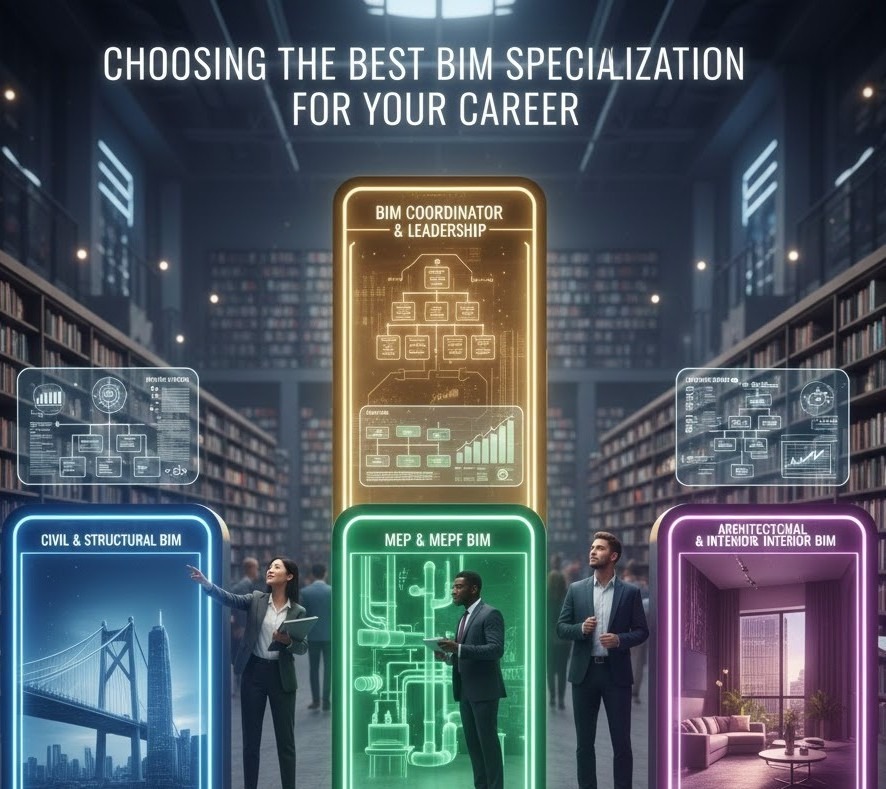
Selecting the right BIM specialization is the most critical decision in shaping your career trajectory. Here’s a simple guide based on your background:
| Background | Recommended BIM Specialization | Career Focus |
| Civil Engineer | Structural or Civil BIM | Infrastructure, concrete structures, site coordination |
| Electrical / Mechanical Engineer | MEP / MEPF BIM | High-paying roles, global opportunities |
| Architect / Designer | Architectural or Interior BIM | Design-focused projects, visualization |
| Mid-level professional aiming for leadership | BIM Coordination | Multi-disciplinary project management, project oversight |
Insight: The right specialization not only ensures job readiness but also accelerates your salary growth and global mobility.
Global BIM Salaries in 2025 (Approx.)
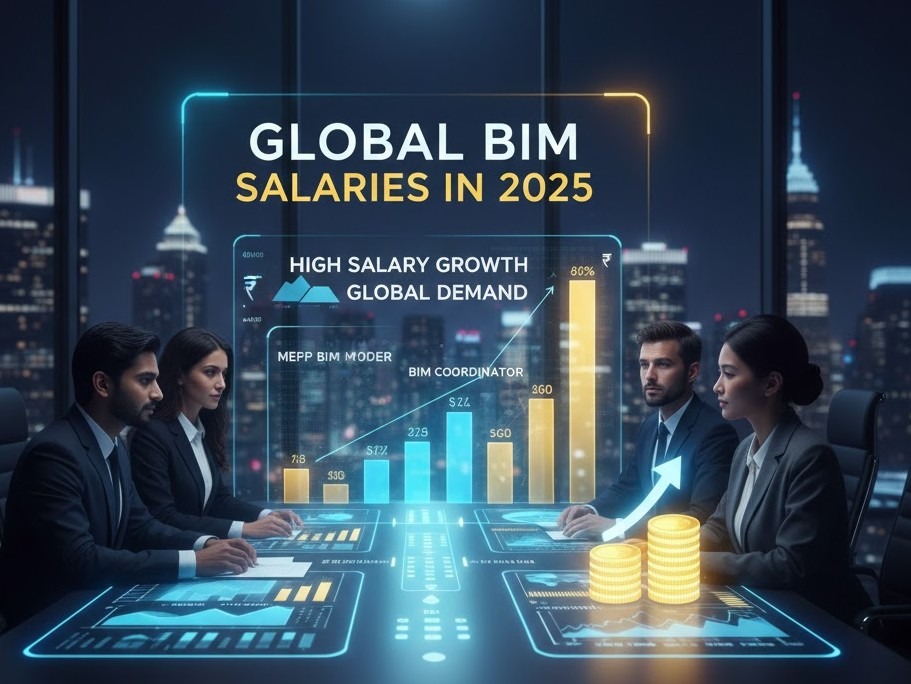
BIM careers offer competitive salaries, especially for specialized roles:
| Role | India (₹) | Middle East (AED) |
| BIM Modeler (Civil/Arch) | 18k–45k | 4,000–6,000 |
| MEPF BIM Modeler | 30k–60k | 5,000–8,500 |
| BIM Coordinator | 50k–90k | 7,000–12,000 |
| Revit Technician | 20k–45k | 3,500–6,000 |
Observation: MEP/MEPF BIM and BIM Coordinator roles are high-paying positions with strong global demand, particularly in the Middle East.
Why BIM Cafe Students Succeed Globally
BIM Cafe Learning Hub equips students with industry-aligned skills and global exposure that make them stand out in competitive BIM markets. Key advantages include:
- Project-oriented training: Hands-on experience with real-world BIM projects.
- Global project exposure: Opportunity to work on projects aligned with international standards.
- Industry-backed experience: Training supported by DDG BIM Services.
- Placement assurance: Guidance and opportunities to enter BIM roles in India and abroad.
- Autodesk Certified Partnership: Ensures globally recognized certification.
- Comprehensive software coverage: Training on Revit, Navisworks, BIM 360, Dynamo, Recap Pro, STAAD, ETABS.
- ISO 19650-aligned curriculum: Kerala’s most detailed BIM course ensuring adherence to international standards.
Choosing Your BIM Career Path in 2025
BIM is no longer an optional skill — it’s the future of the AEC industry. Whether you’re a Civil Engineer, Mechanical Engineer, Architect, or Designer, choosing the right BIM specialization is the most important decision in shaping your career.
If you’re still unsure which BIM course suits your background, BIM Cafe Learning Hub provides free personalized guidance to help you decide the best path.
Contact BIM Cafe today to discuss your career options and find the right BIM course for you