Author: Devika R
March 7, 2026
7 min read
Why the Evolution Of BIM Technology Matters
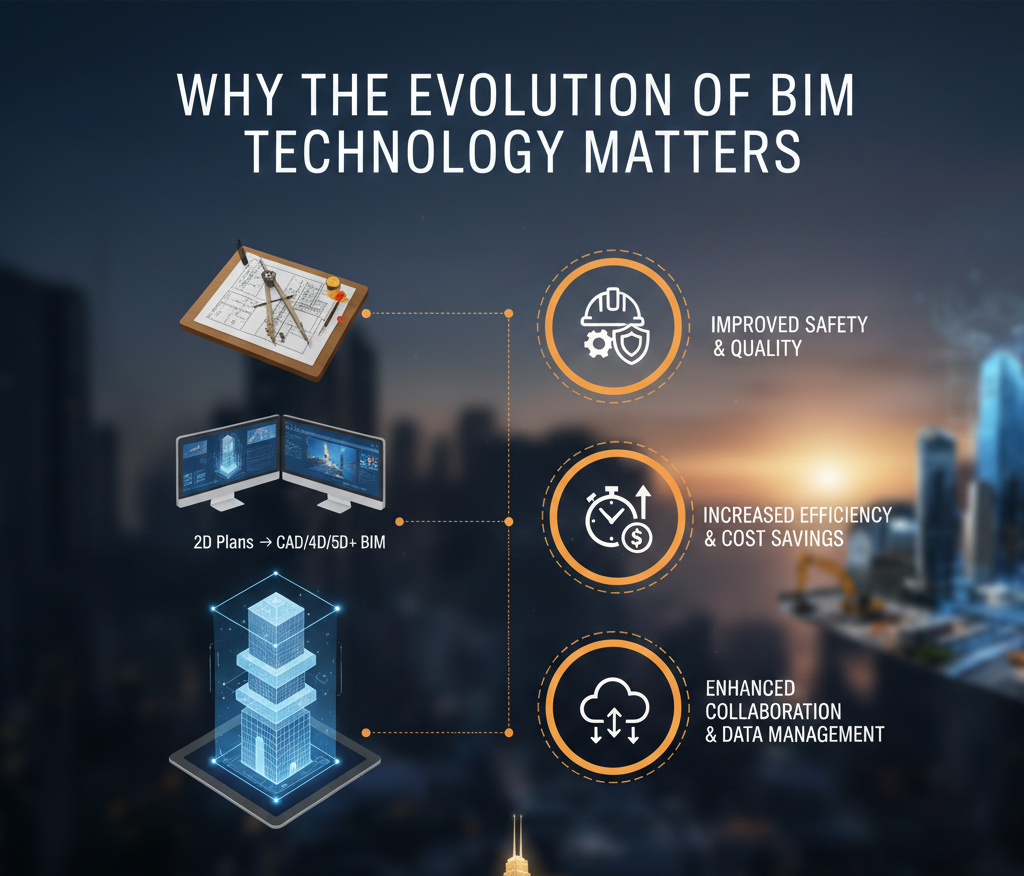
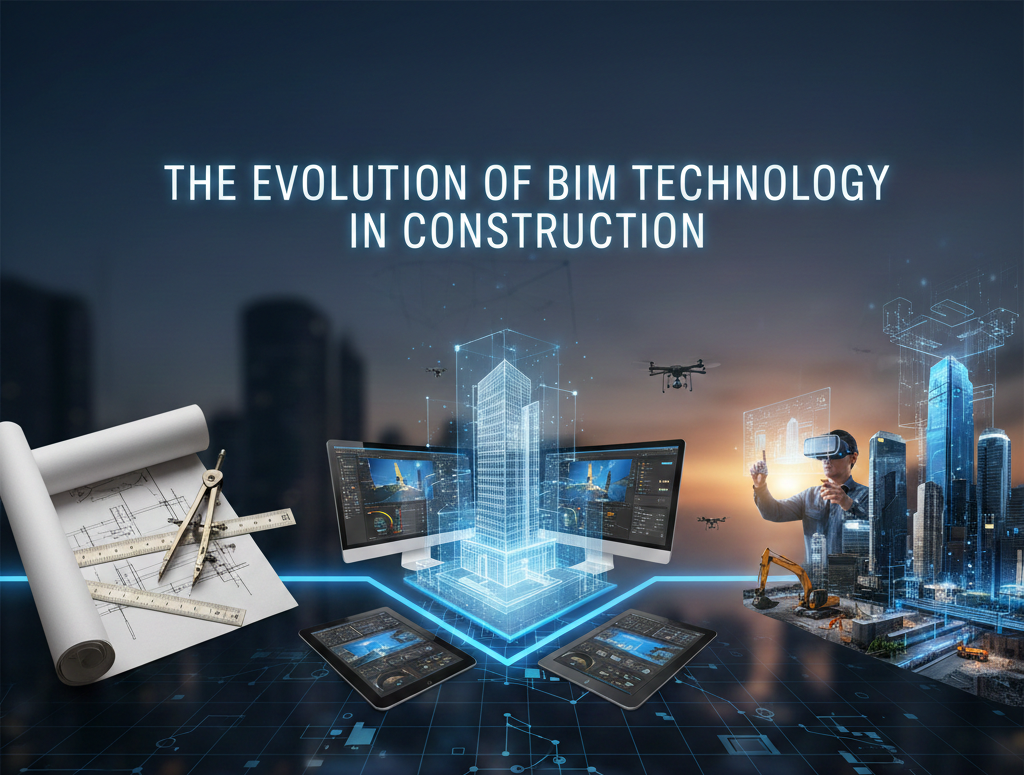
The evolution of BIM technology has transformed the construction industry from fragmented 2D drafting to intelligent, data-driven project delivery. What once relied heavily on manual drawings has now become a highly coordinated digital environment connecting design, construction, and facility management. Understanding this shift is essential for architecture, engineering, and construction (AEC) professionals who want to stay competitive in modern project environments.
Today, the building information modeling evolution reflects more than software progress — it represents a fundamental change in how teams collaborate, manage data, and deliver complex projects with greater predictability and efficiency.
What Is BIM and Why It Changed Construction
Building Information Modeling (BIM) is a process that enables the creation and management of intelligent 3D models enriched with project data.
Key capabilities
- Intelligent object-based modeling
- Centralized project information
- Multi-discipline coordination
- Lifecycle data management
- Improved visualization and analysis
Why BIM was disruptive
- Replaced disconnected 2D workflows
- Reduced documentation inconsistencies
- Enabled real-time collaboration
- Supported digital construction workflows
Unlike traditional CAD, BIM integrates geometry with data, forming the foundation of modern BIM workflow and digital project delivery.
Pre-BIM Era: From Manual Drafting to Early CAD
Before the history of BIM technology began, construction documentation followed a largely manual and fragmented process.
Industry characteristics before BIM
- Hand-drawn technical drawings
- High revision effort
- Limited cross-discipline coordination
- Error-prone documentation workflows
- Slow design iterations
The introduction of CAD in the 1980s improved drafting speed but still lacked intelligence. Teams could draw faster, but coordination challenges remained unresolved, creating the need for the next technological leap.
The Birth of Object-Based Modeling
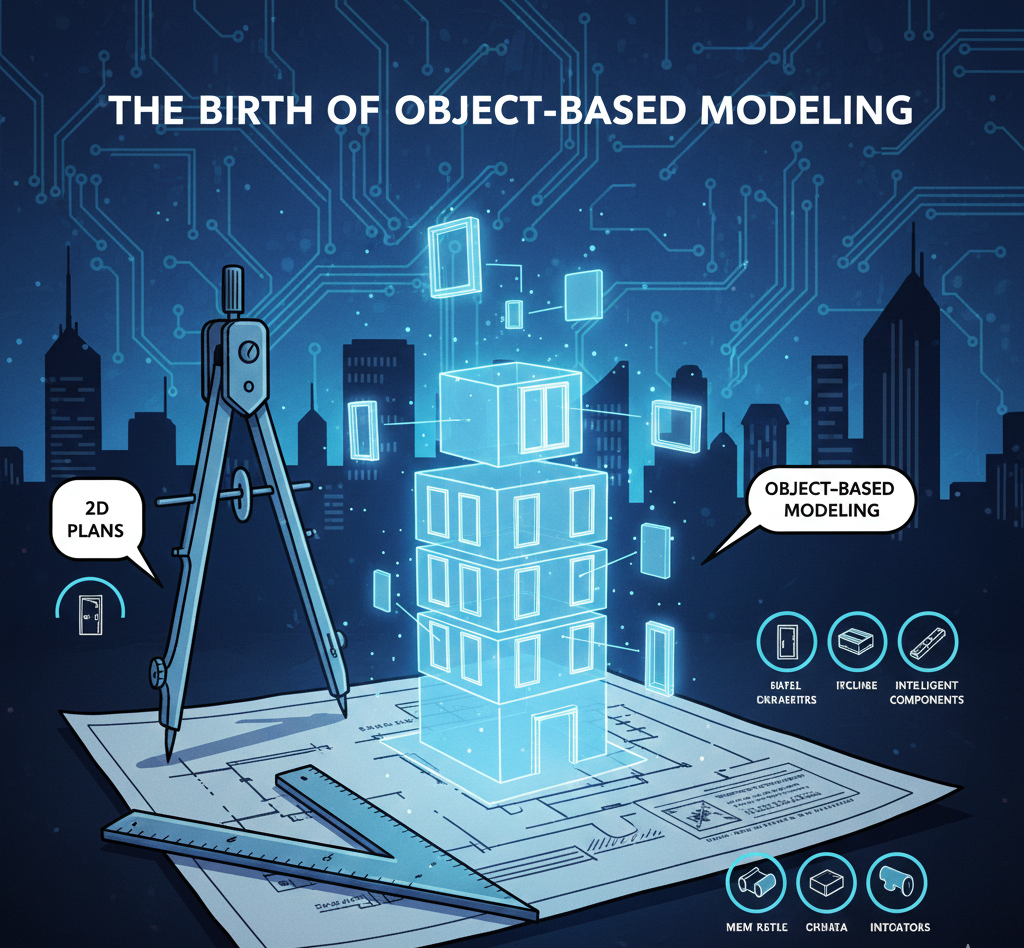
The real building information modeling evolution began when software platforms introduced parametric, object-based modeling in the early 1990s.
What changed technically
- Building elements became data-rich objects
- Models updated automatically with design changes
- Schedules linked directly to model elements
- Early clash detection became possible
Why this was a breakthrough
- Shifted industry from drawing-centric to model-centric workflows
- Enabled early forms of model coordination
- Improved design accuracy and consistency
This phase laid the groundwork for widespread BIM adoption in construction industry workflows.
Major Milestones in the Evolution Of BIM Technology
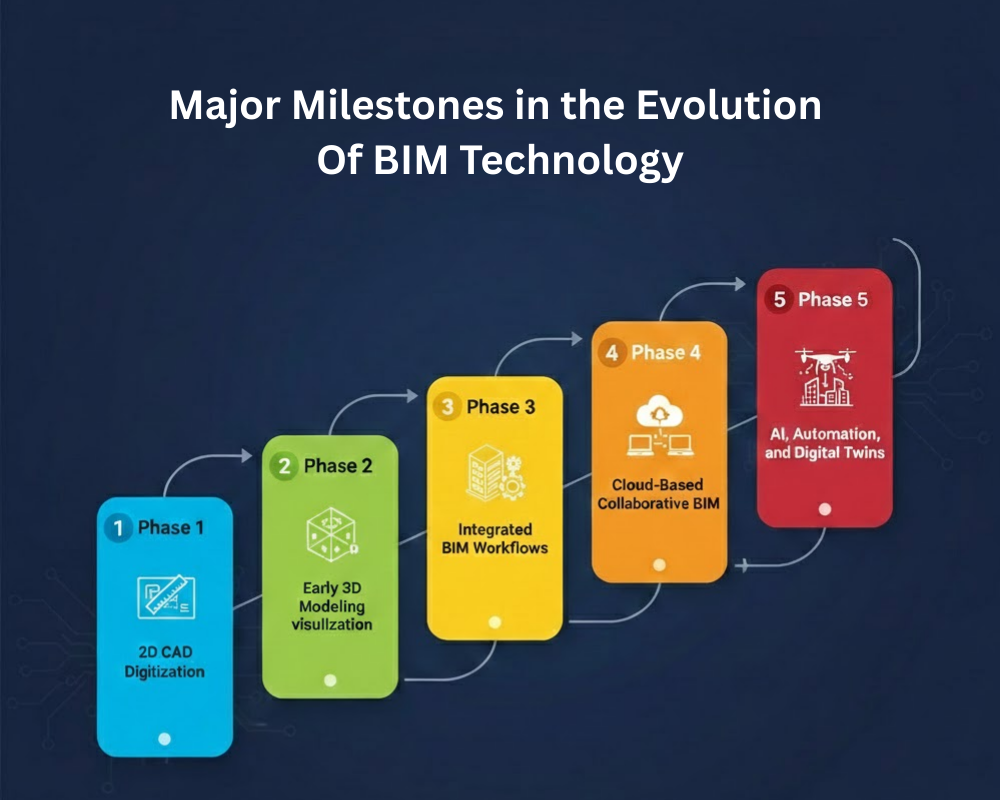
Understanding the evolution of BIM technology requires looking at its major developmental phases.
Phase 1: 2D CAD Digitization
- Focus on drafting efficiency
- Minimal data intelligence
- Limited interoperability
- Discipline silos remained
Impact: Improved speed but not coordination.
Phase 2: Early 3D Modeling
- Basic 3D visualization
- Geometry-focused models
- Limited parametric behavior
- Manual coordination still required
Impact: Better visualization but weak data integration.
Phase 3: Integrated BIM Workflows
- Intelligent parametric components
- Automated clash detection
- Multi-discipline model coordination
- Quantity takeoff automation
- Emergence of Common Data Environment (CDE)
Impact: Major leap in the benefits of BIM in construction.
Phase 4: Cloud-Based Collaborative BIM
- Real-time model sharing
- Remote team collaboration
- Version control improvements
- Improved BIM lifecycle management
- Integration with project management tools
Impact: Enabled truly connected digital construction ecosystems.
Phase 5: AI, Automation, and Digital Twins
- Predictive analytics
- Generative design
- Reality capture integration
- Smart asset monitoring
- Lifecycle intelligence
Impact: Represents the current frontier in BIM technology trends.
Real-World Impact of BIM on Project Delivery
The benefits of BIM in construction become most visible when projects move from design into active coordination and execution. In real project environments, BIM shifts teams from reactive problem-solving to proactive planning, significantly improving cost, time, and quality outcomes.
Measurable project improvements
- Early clash detection reduces site conflicts
- Automated clash detection identifies MEP, structural, and architectural conflicts before construction begins.
- This minimizes costly on-site rework and RFIs (Requests for Information).
- Automated clash detection identifies MEP, structural, and architectural conflicts before construction begins.
- More accurate quantity takeoffs
- Model-based quantities update automatically with design changes.
- Improves procurement planning and reduces material wastage.
- Model-based quantities update automatically with design changes.
- Faster documentation production
- Drawings, schedules, and views are generated directly from the model.
- Reduces manual drafting time and improves consistency across sheets.
- Drawings, schedules, and views are generated directly from the model.
- Improved stakeholder visualization
- 3D and 4D simulations help clients and contractors better understand project intent.
- Enhances decision-making during design reviews.
- 3D and 4D simulations help clients and contractors better understand project intent.
- Better construction sequencing
- 4D BIM links the model with project schedules.
- Helps teams identify sequencing risks and optimize site logistics.
- 4D BIM links the model with project schedules.
- Reduced rework risk
- Coordinated models reduce late-stage design changes.
- Improves cost predictability and project timelines.
- Coordinated models reduce late-stage design changes.
Practical observation
In well-coordinated environments, BIM-driven workflows consistently improve predictability during pre-construction and execution phases. Teams gain earlier visibility into risks, enabling more confident planning and smoother site delivery compared to traditional CAD-based processes. Professionals involved in services coordination can strengthen their capabilities through a specialized Revit MEP course focused on clash detection and intelligent modeling.
Current State of BIM in the AEC Industry
The building information modeling evolution has reached a maturity level where BIM is increasingly viewed as a baseline requirement rather than a premium capability. Across many regions, clients, consultants, and contractors now expect model-based delivery as part of standard project workflows.
Present industry trends
- Government BIM mandates increasing globally
- Many public-sector projects now require BIM compliance.
- Driving wider industry standardization and adoption.
- Many public-sector projects now require BIM compliance.
- Wider adoption among SMEs
- Small and mid-sized firms are gradually integrating BIM into core workflows.
- Cloud tools and scalable licensing have lowered entry barriers.
- Small and mid-sized firms are gradually integrating BIM into core workflows.
- Integration with digital project controls
- BIM models increasingly connect with cost management, scheduling, and project monitoring tools.
- Supports more data-driven decision-making.
- BIM models increasingly connect with cost management, scheduling, and project monitoring tools.
- Growth of cloud collaboration platforms
- Common Data Environments (CDEs) enable distributed teams to work in real time.
- Improves version control and information transparency.
- Common Data Environments (CDEs) enable distributed teams to work in real time.
- Expansion into facility and asset management
- Owners are using BIM data beyond construction into operations and maintenance.
- Supports lifecycle asset intelligence.
- Owners are using BIM data beyond construction into operations and maintenance.
- Strong alignment with digital construction strategies
- BIM now sits at the center of broader digital transformation initiatives in the AEC sector.
- BIM now sits at the center of broader digital transformation initiatives in the AEC sector.
These BIM technology trends clearly indicate that model-based delivery is rapidly becoming standard practice rather than an optional innovation.
Future of BIM Technology: What the Next Decade Will Bring
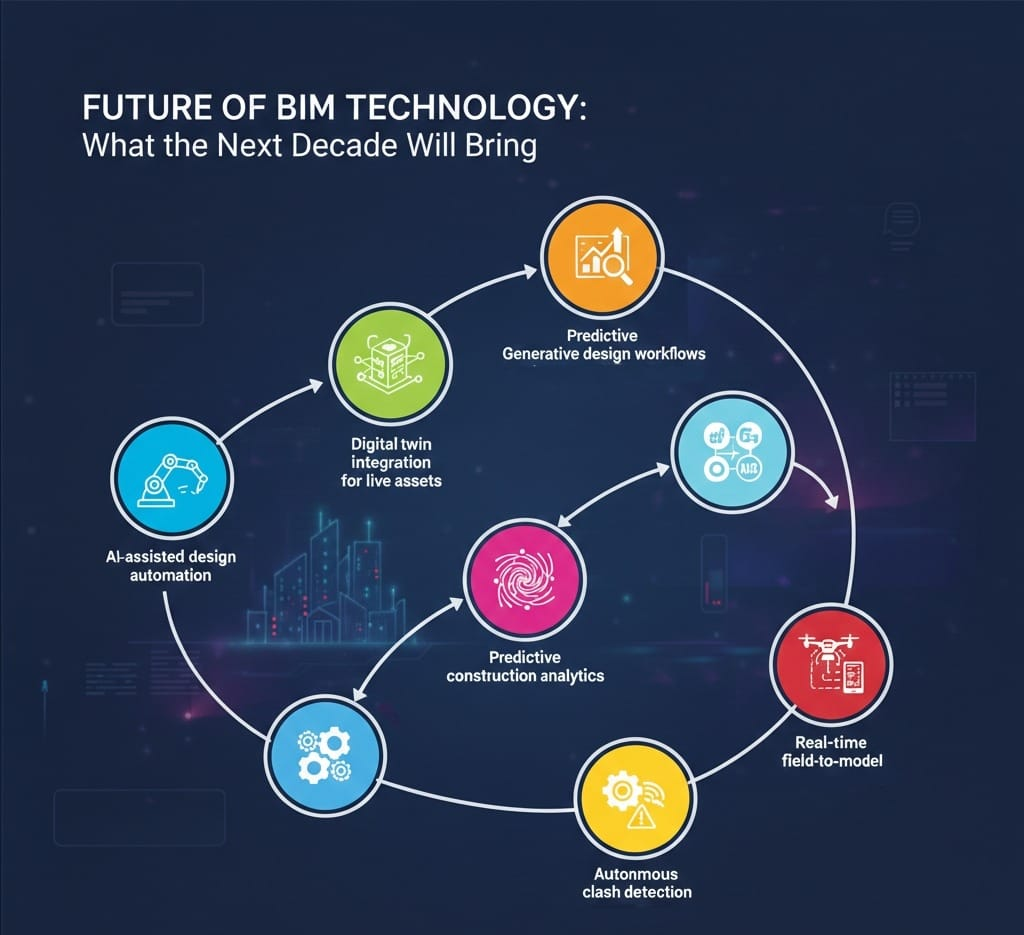
The future of BIM technology is moving toward highly intelligent, automated, and fully connected project ecosystems. The focus is shifting from isolated modeling toward predictive, data-driven infrastructure management.
Emerging directions
- AI-assisted design automation
- Machine learning will support layout optimization and rule-based modeling.
- Designers will spend less time on repetitive tasks.
- Machine learning will support layout optimization and rule-based modeling.
- Digital twin integration for live assets
- BIM models will connect to real-time sensor data from built facilities.
- Enables predictive maintenance and performance monitoring.
- BIM models will connect to real-time sensor data from built facilities.
- Predictive construction analytics
- Advanced data analysis will forecast risks, delays, and cost overruns.
- Supports proactive project control.
- Advanced data analysis will forecast risks, delays, and cost overruns.
- Generative design workflows
- Algorithms will generate and evaluate multiple design options automatically.
- Improves design efficiency and performance optimization.
- Algorithms will generate and evaluate multiple design options automatically.
- Increased OpenBIM adoption
- Greater reliance on interoperable, vendor-neutral workflows.
- Improves collaboration across diverse project teams.
- Greater reliance on interoperable, vendor-neutral workflows.
- Autonomous clash detection
- AI-driven coordination tools will automatically flag and prioritize conflicts.
- Reduces manual model review effort.
- AI-driven coordination tools will automatically flag and prioritize conflicts.
- Real-time field-to-model feedback
- Site data from drones and scanners will continuously update BIM models.
- Creates a live digital representation of project progress.
- Site data from drones and scanners will continuously update BIM models.
Strategic insight
Organizations that prepare early for these developments will gain significant operational advantages. As BIM technology trends continue advancing toward smarter and more connected infrastructure delivery, firms that invest in skills, standards, and digital workflows today will be best positioned for the next generation of construction innovation.
Challenges Still Slowing BIM Maturity
Despite progress in the history of BIM technology, several barriers remain.
Common industry challenges
- Skill gaps in BIM-ready professionals
- Interoperability inconsistencies
- Initial implementation costs
- Resistance to workflow change
- Inconsistent modeling standards
- Hardware performance limitations
Addressing the industry skill gap requires structured learning pathways such as a master BIM course that covers coordination, standards, and advanced project workflows.
How Organizations Can Stay Aligned With BIM Evolution
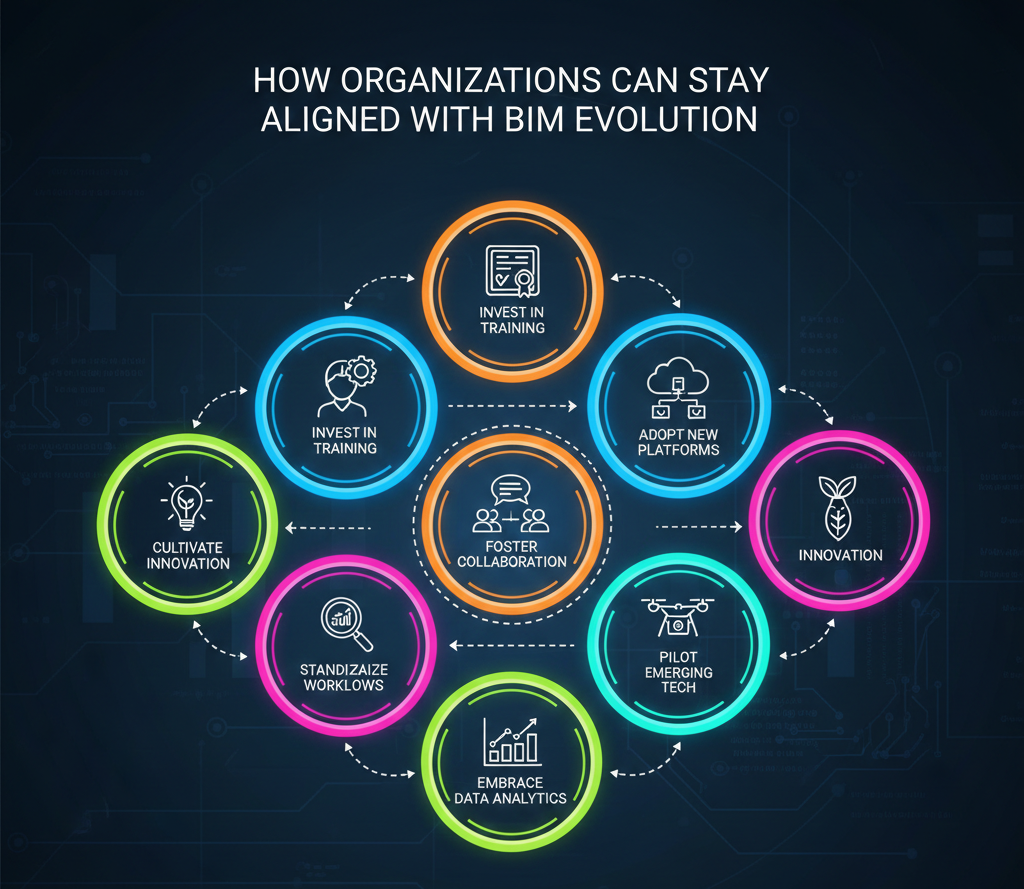
To keep pace with the evolution of BIM technology, firms should adopt a structured improvement strategy.
Recommended actions
- Invest in continuous BIM training
- Develop internal modeling standards
- Strengthen model coordination workflows
- Implement Common Data Environments
- Align processes with ISO 19650
- Upgrade hardware strategically
- Encourage cross-discipline collaboration
Organizations looking to build future-ready teams should consider enrolling their staff in a professional BIM course that focuses on real-world workflows and ISO-aligned practices.
Conclusion
The evolution of BIM technology marks one of the most important digital transformations in the construction industry. From manual drafting and early CAD systems to intelligent digital twins and AI-driven workflows, BIM continues to redefine how projects are designed, coordinated, and delivered.
As the building information modeling evolution progresses, firms that invest in skills, standards, and collaborative technologies will be best prepared for the next era of digital construction. The journey is ongoing, but the direction is clear: smarter, more connected, and increasingly data-driven project delivery.