Author: Devika R
September 3, 2026
8 min read
You Spent Months Creating the Model. What Happens When the Software Changes?
Imagine this.
An architectural team develops a detailed BIM model.
The structural consultant uses another platform.
The MEP team works in a different environment.
The contractor has its own coordination and construction tools.
Then someone asks:
“Can we exchange the model?”
Suddenly, a new question appears:
Will the information actually survive the exchange?
The geometry may transfer.
But what about the parameters?
Classifications?
Relationships?
Properties?
Object information?
This is where BIM interoperability becomes more than a technical issue.
It becomes a project issue.
BIM Was Supposed to Connect the Industry
The promise of BIM has always been bigger than creating 3D models.
Different professionals need to work with information created by others:
- Architects
- Engineers
- Contractors
- Fabricators
- Owners
But these teams don't necessarily use the same software.
That creates a simple problem:
How do you move project information between different systems without losing the information that matters?
This is one reason OpenBIM and open standards have become an important part of the global BIM conversation.
Your BIM Model Is Not the Software
This distinction is easy to miss.
Revit, Archicad, Tekla, Civil 3D, Bentley applications and other platforms are tools.
The BIM model contains project information created and managed using those tools.
So there is a difference between:
The software used to create information
and
The information itself.
That distinction becomes particularly important when a project involves multiple platforms.
A project shouldn't become unusable simply because one team works in a different software environment.
What Is OpenBIM?
OpenBIM is an approach to BIM collaboration based on open standards and interoperability rather than depending entirely on a single software ecosystem.
The objective isn't to eliminate commercial BIM software.
It is to make collaboration and information exchange more open and reliable across different tools.
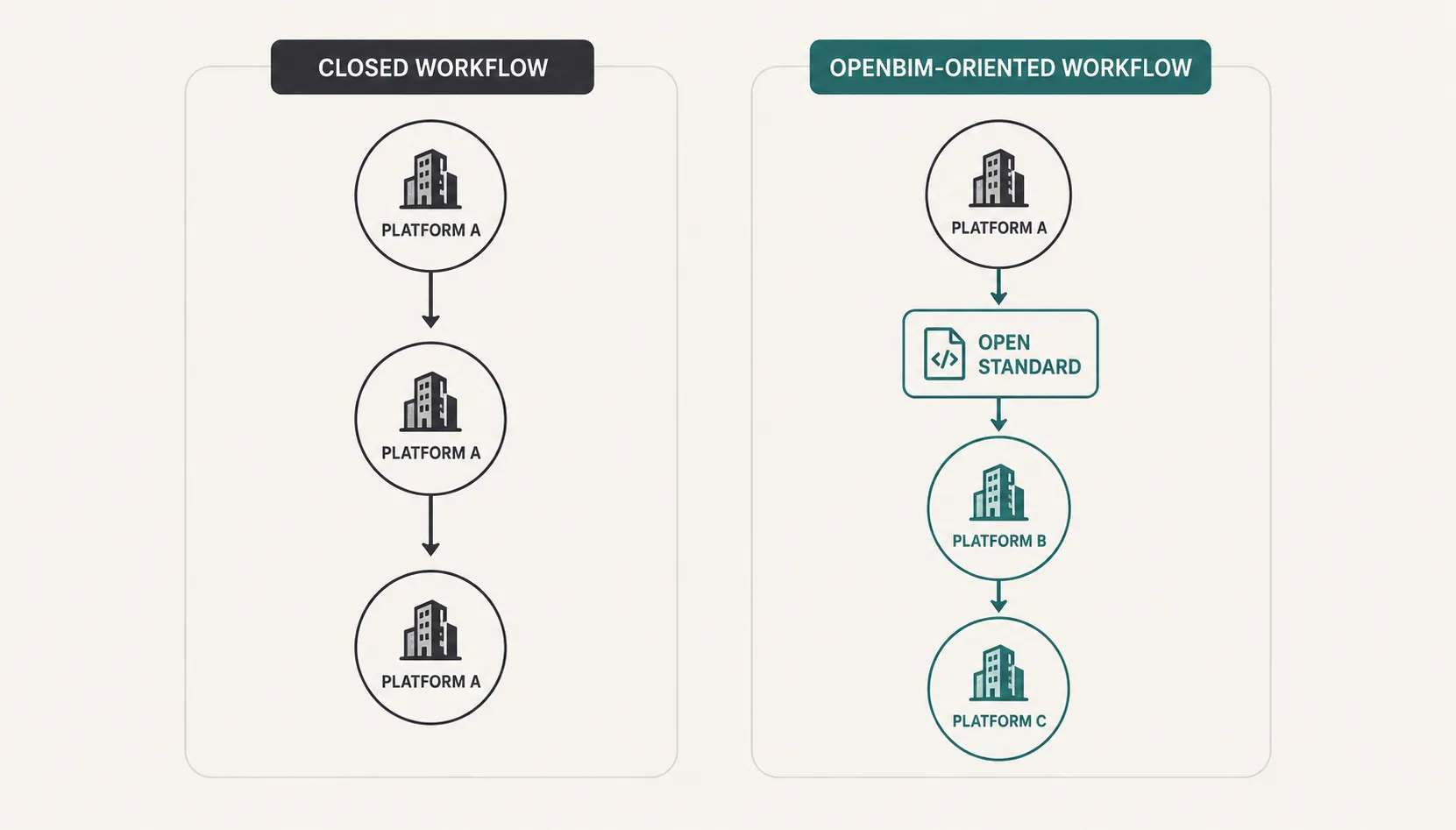
Think of it this way:
Closed workflow
- Platform A
- Platform A
- Platform A
Everything may work smoothly inside one ecosystem.
OpenBIM-oriented workflow
- Platform A
- Open Standard
- Platform B
- Platform C
Different teams can exchange information using agreed standards where appropriate.
buildingSMART identifies IFC, IDS, and other open standards as important components of openBIM workflows and interoperability.
So, What Is IFC?
You will almost certainly encounter IFC if you work with BIM across different platforms.
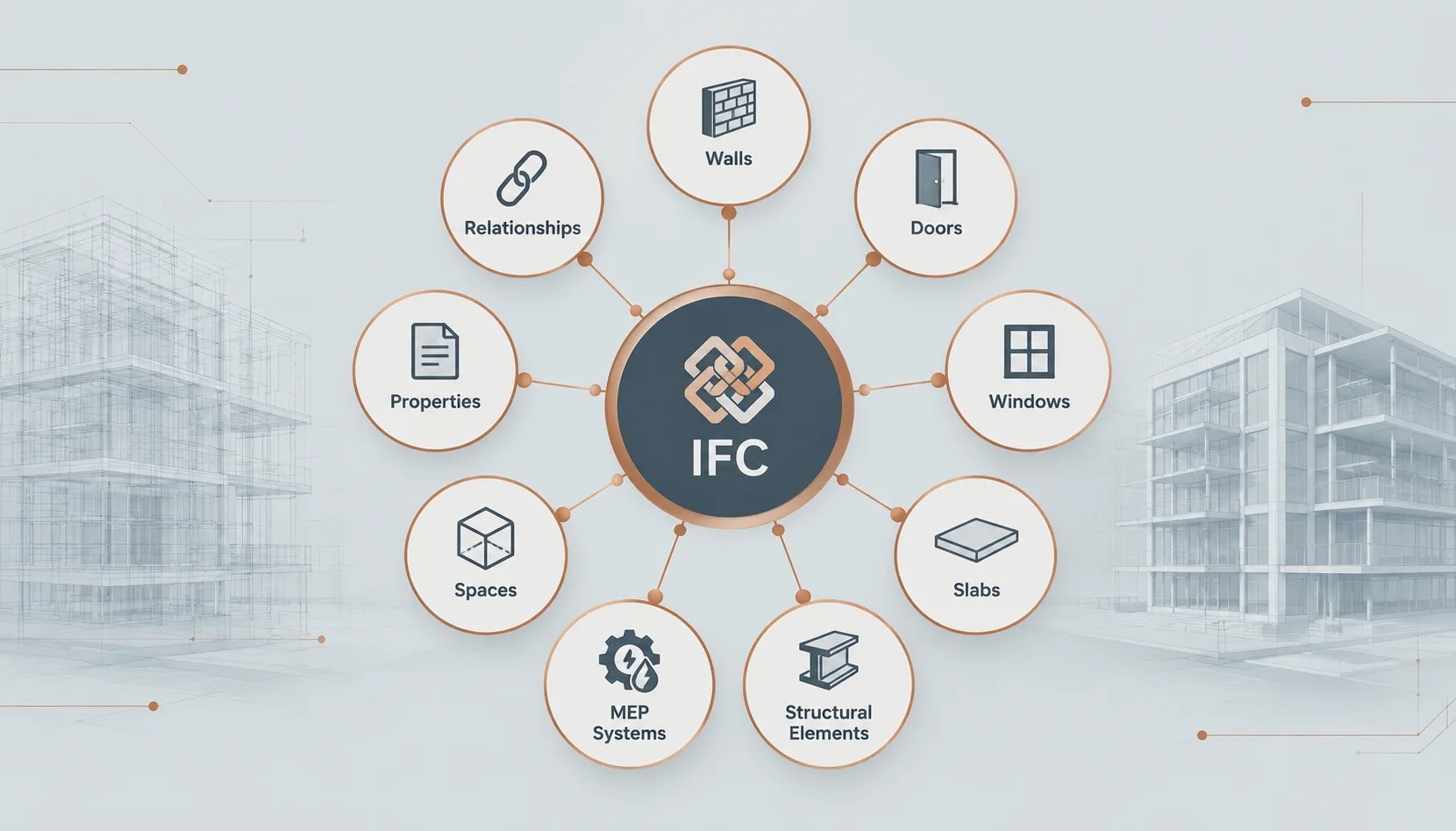
IFC (Industry Foundation Classes) is an open, vendor-neutral data standard developed for sharing BIM information between software applications.
In simple terms:
IFC helps different BIM platforms exchange building information without requiring everyone to use the same authoring software.
It can contain information about elements such as:
- Walls
- Doors
- Windows
- Slabs
- Structural elements
- MEP systems
- Spaces
- Properties
- Relationships
But beginners should understand one important detail.
IFC does not mean “perfect conversion.”
Different software applications may interpret or support information differently.
A successful IFC workflow therefore requires more than simply pressing Export.
The exchange needs to be planned, tested and validated.
The Model Can Transfer. Did the Information Transfer?
Imagine exporting a model to IFC.
The building appears correctly.
Walls are there.
Doors are there.
Equipment is there.
It looks successful.
But then you discover:
Some properties are missing.
Some classifications aren't mapped correctly.
Some relationships aren't preserved as expected.
Some objects behave differently in the receiving application.
This is why BIM interoperability is not simply about asking:
“Can the model open?”
A better question is:
“Can the receiving team use the information for its intended purpose?”
That's a much higher standard.
OpenBIM vs Proprietary Workflows
Neither approach should be reduced to “good” versus “bad.”
The right solution depends on the project.
| Proprietary-Centred Workflow | OpenBIM-Oriented Workflow |
|---|---|
| Strong integration within one ecosystem | Designed for cross-platform exchange |
| Native formats may preserve platform-specific capabilities | Open standards support interoperability |
| Can be efficient within a controlled environment | Useful when multiple platforms are involved |
| Less dependent on external exchange processes | Requires careful exchange and validation |
| Platform-specific features can be valuable | Vendor-neutral information exchange is prioritised |
A project may use proprietary software extensively while still using OpenBIM principles for selected information exchanges.
The two aren't mutually exclusive.
Why Would a Project Need OpenBIM?
Consider a large project with several organisations.
The architect uses one platform.
The structural consultant uses another.
The contractor has its own coordination environment.
Later, the owner wants information that can remain useful for operations.
If every stage depends on one specific software environment, the project can become highly dependent on that ecosystem.
Open standards can help reduce that dependency.
This becomes particularly relevant for:
- Large multidisciplinary projects
- Infrastructure
- Government projects
- Long-life assets
- Multi-consultant environments
- Projects involving different software platforms
- Long-term information management
The Question of Information Ownership
Here's where OpenBIM becomes more than a software discussion.
Imagine a building designed today that will still be operating 20 or 30 years from now.
The software used by the original architect may change.
The contractor may no longer exist.
The owner may appoint a completely different facility management company.
New software platforms may become standard.
But the building information still has value.
So ask:
Should long-term building information depend entirely on the software that created it?
This is one reason open standards and interoperability matter beyond the design stage.
The objective is to protect the usability and exchange of information throughout the asset lifecycle.
OpenBIM Doesn't Mean You Have to Stop Using Revit
This is probably the most important clarification for BIM students.
Learning OpenBIM does not mean abandoning Revit.
Revit can remain an important authoring tool.
The same applies to other professional BIM platforms.
The question is not:
“Which software is better?”
The better question is:
“How will information move between the people and systems involved in this project?”
A BIM professional should understand both sides:
Authoring
and
Information exchange.
What Should a BIM Professional Understand?
You don't need to become an IFC developer to understand interoperability.
But you should know the fundamentals.
Native Formats
Understand what information is retained within your authoring platform.
Open Formats
Know when an open exchange format such as IFC may be appropriate.
Information Requirements
Understand what information the receiving team actually needs.
Mapping
Recognise that properties, classifications and object information may need appropriate mapping during exchange.
Validation
Don't assume an export worked simply because the file opens.
Check whether the required information is actually usable.
Project Standards
Follow the project's agreed information requirements and exchange procedures.
These skills make a BIM professional more useful in multidisciplinary BIM environments.
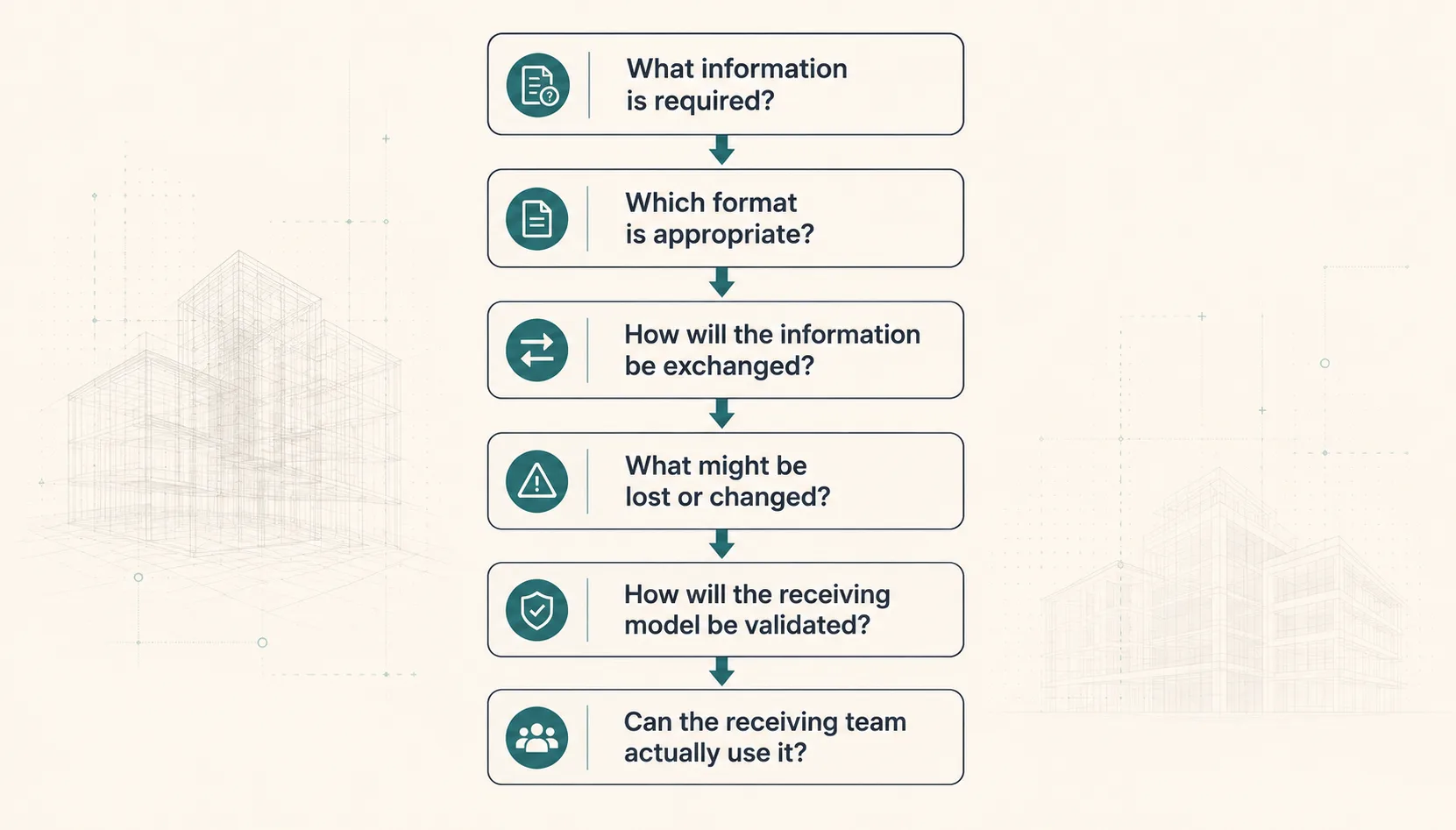
A Better Way to Think About BIM Exchange
Instead of:
- Model
- Export
- Send
Think:
That is professional BIM data exchange.
Why This Matters Beyond Coordination
Interoperability isn't only about resolving clashes.
It can influence the entire project lifecycle.
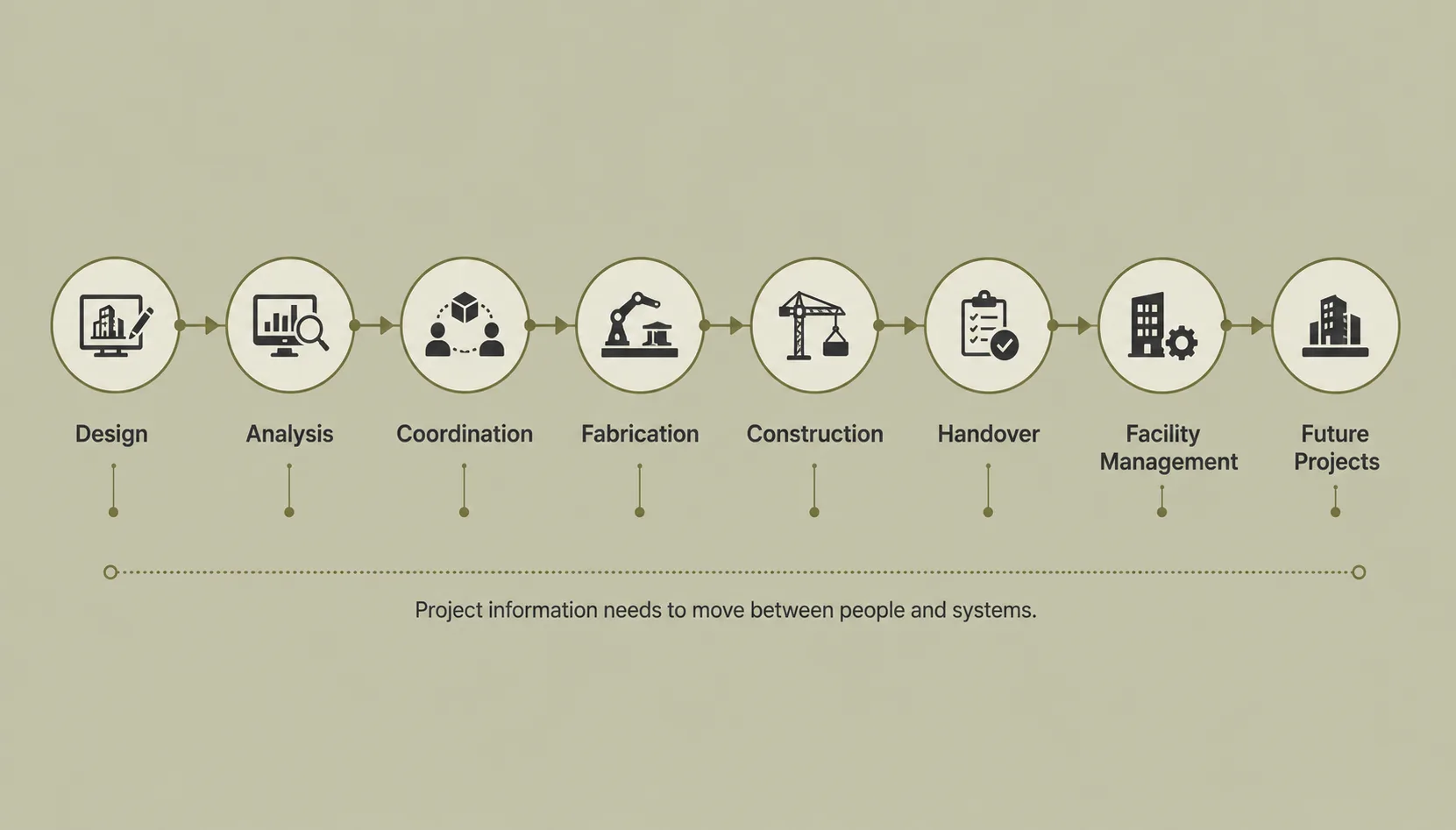
Information may move between:
Design
→ Analysis
→ Coordination
→ Fabrication
→ Construction
→ Handover
→ Facility Management
→ Future Projects
The more organisations and platforms involved, the more important reliable information exchange becomes.
This is especially relevant to infrastructure and large-scale projects where multiple organisations may work across long project lifecycles.
The Future Isn't One Software Platform
AEC technology will continue to change.
New platforms will emerge.
Existing tools will evolve.
Companies will change their technology stacks.
Artificial intelligence will alter many workflows.
But one requirement is unlikely to disappear:
Project information needs to move between people and systems.
That's why interoperability remains an important part of the future of BIM.
The industry discussion isn't really about choosing one winning software.
It's increasingly about building workflows where the right information can move to the right person at the right time.
What Should Students Learn From This?
If you're learning BIM today, don't stop at:
“I know Revit.”
Ask yourself:
- Can I understand project information requirements?
- Do I know why naming and classification matter?
- Do I understand model exchange?
- Have I worked with IFC?
- Do I know how to validate an exported model?
- Can I communicate information requirements to another discipline?
These questions move you from software knowledge toward BIM competency.
And that distinction becomes increasingly important as projects become more multidisciplinary and digitally connected.
Final Thoughts
A BIM model is valuable because of the information it contains and the decisions it supports.
But that value can be reduced if information cannot move reliably between the systems and people who need it.
That's why OpenBIM, IFC, and interoperability deserve attention.
The goal isn't to eliminate Revit, Archicad, Tekla, Civil 3D, Bentley or any other professional platform.
It's to make sure that the information created within those environments can continue to support the project when different teams, tools, and stages become involved.
So the next time someone asks:
“Can you export the BIM model?”
Don't think only about the file.
Ask the more important question:
“What information needs to reach the other side—and will it still be usable when it gets there?”
Because the future of BIM may not be decided by which software creates the best model.
It may depend on how well the industry can make those models—and the information inside them—work together.
Frequently Asked Questions
What is OpenBIM?
OpenBIM is an approach to BIM collaboration that promotes interoperability and the use of open standards so project information can be exchanged across different software environments.
What is IFC in BIM?
IFC, or Industry Foundation Classes, is an open, vendor-neutral standard designed to support the exchange of BIM information between different software applications.
Does OpenBIM replace Revit?
No. OpenBIM and Revit serve different purposes. Revit is a BIM authoring platform, while OpenBIM focuses on interoperable workflows and information exchange.
Why is BIM interoperability important?
Interoperability helps multidisciplinary teams exchange and use project information when they work with different software platforms, organisations, and project systems.
Does IFC guarantee that all BIM information will transfer perfectly?
No. IFC supports standardised information exchange, but the result depends on the exporting and receiving software, model content, mappings, project requirements, and validation processes.
Should BIM students learn IFC?
Yes, at least at a practical level. Understanding IFC and model exchange can help BIM professionals work more effectively in multidisciplinary projects where different platforms are involved.
Professional BIM Course
Master BIM Course
Structural Design Concepts and BIM
Certified MEPF BIM Master Course
Electrical BIM Professional Program
RenderLab – Master 3D Modeling & Photorealistic Rendering
Multi-Tool Mastery for Architects & Engineers
BIM Coordinator Workflow Program
BIM FastTrack – 30 Day Intensive Training
Global Architectural & Structural BIM Project Program