Author: Devika R
January 3, 2026
12 min read
India + Gulf: Skills, Roles & Why Many Revit CVs Get Rejected
If you’re learning BIM in 2026, one reality is unavoidable:
BIM careers are no longer built on “knowing software.”
They are built on being project-ready.
Across India and the Gulf region, BIM hiring is active and growing. Infrastructure projects, large-scale commercial developments, and regulatory mandates continue to push BIM adoption forward. However, alongside this demand is a sharp rise in CV rejections—often at the first screening stage.
And the reason is rarely a lack of certificates.
Most rejected candidates actually know Revit.
Many have completed multiple courses.
Some even hold recognised BIM certifications.
Yet recruiters continue to filter them out because they lack:
- Workflow clarity
- Coordination exposure
- Real project logic
- An understanding of how BIM is applied on live projects
In today’s market, certificates validate learning—but projects validate employability.
This guide breaks down:
- The real BIM career roadmap for 2026, based on hiring patterns in India and GCC countries
- Revit skills recruiters actively reject, despite being commonly listed on CVs
- How hiring expectations differ between India and the Gulf
- How to position yourself professionally and correctly, without exaggeration or over-selling
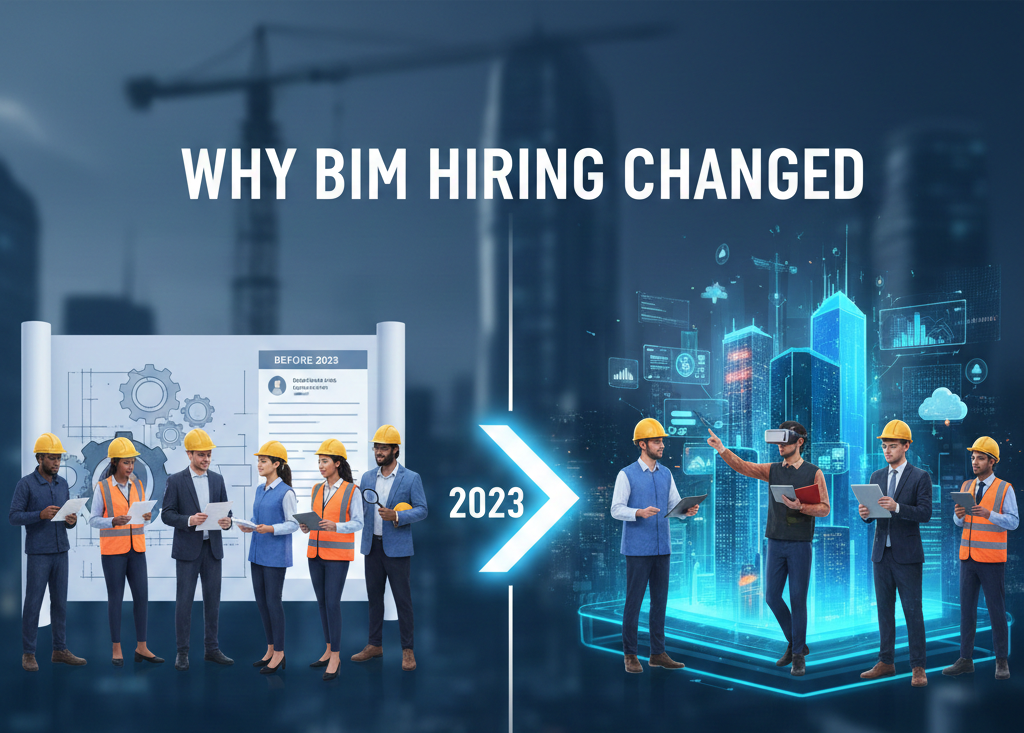
Why BIM Hiring Changed After 2023
Until a few years ago, BIM was still treated as a differentiator.
Simply using BIM tools was enough to stand out.
That phase is over.
After 2023, BIM adoption matured across both Indian and Gulf markets. Clients no longer ask consultants or contractors:
“Do you use BIM?”
Instead, they ask more demanding, outcome-driven questions such as:
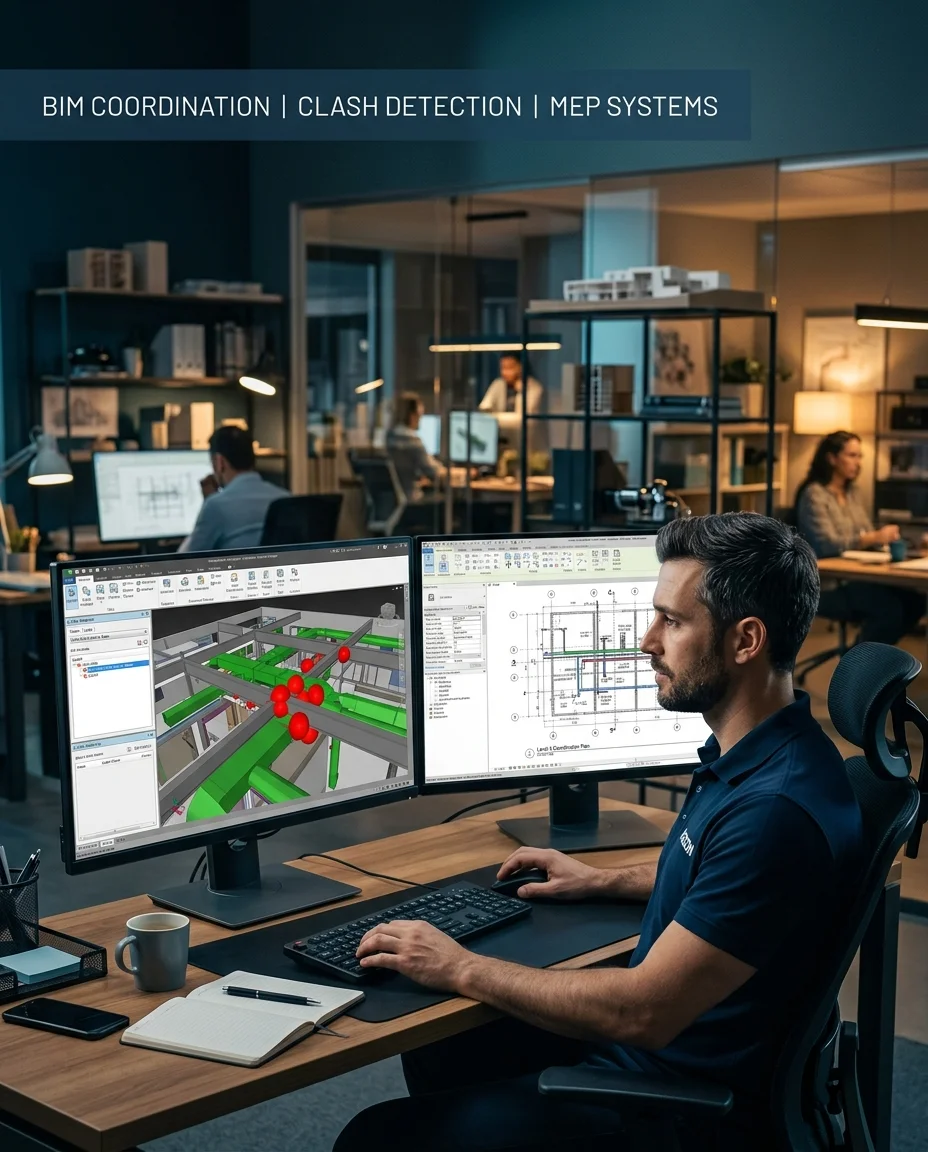
- Can you coordinate effectively across architecture, structure, and MEP?
- Can your models comply with required LOD levels and project standards?
- Can your team work within a Common Data Environment (CDE) without data loss or confusion?
This evolution has fundamentally changed how BIM professionals are evaluated.
Recruiters now assume:
- You know Revit
- You understand basic modelling tools
- You can create drawings
What they actually assess is:
- How you apply BIM within a structured workflow
- Whether you understand coordination responsibilities
- If you can work inside real project environments, not isolated tutorials
In short, tool knowledge is no longer a hiring advantage.
It is the baseline expectation.
What separates shortlisted candidates from rejected ones is their ability to demonstrate:
- Project awareness
- Discipline-specific responsibility
- Coordination logic
- Standards-driven thinking
This is why many Revit-heavy CVs fail—not because the candidates lack skills, but because they fail to show how those skills translate into real project delivery.
BIM Career Roadmap 2026 (India + Gulf)
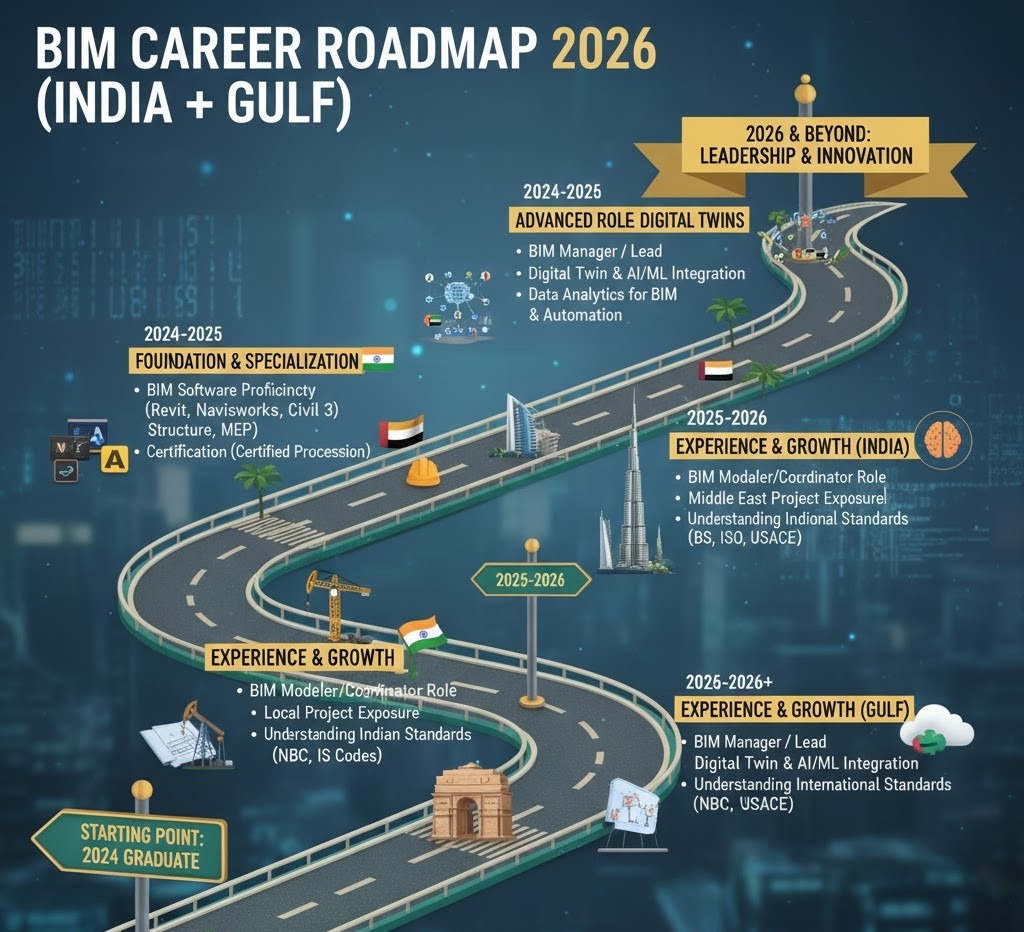
BIM careers in 2026 follow a clear progression. Each stage comes with distinct expectations, and recruiters evaluate candidates differently at every level. Understanding this roadmap early prevents wasted years, repeated rejections, and unfocused learning.
Stage 1: BIM Foundations (0–6 Months)
This stage is about discipline, structure, and modelling logic—not speed.
What Recruiters Expect
At the foundation level, recruiters look for clarity of discipline and clean modelling habits rather than advanced tools.
They expect:
- Discipline-specific modelling
Candidates should clearly belong to Architecture, Structure, or MEP—not attempt everything at once. - Clean, organised Revit models
Models should reflect real project thinking, not tutorial-driven experimentation. - Understanding of core Revit fundamentals
Including views, worksets, sheets, levels, grids, and basic family behaviour.
Recruiters at this stage are checking whether a candidate understands how BIM models are structured, not how many tools they know.
What Recruiters Reject
Common reasons for rejection include:
- CVs listing “Revit – Intermediate” with no project explanation
- Overloaded models with:
- No naming standards
- Poor view organisation
- Uncontrolled categories
- No naming standards
- Families downloaded from the internet without:
- Parameter control
- Naming consistency
- Performance awareness
- Parameter control
📌 Key reality:
At this stage, recruiters do not expect speed or production efficiency.
They expect discipline, structure, and modelling intent.
This is why project-based BIM foundations consistently outperform short crash courses. Well-structured foundation programs focus on why models are built a certain way—not just which command to click.
Stage 2: Job-Ready BIM Modeler (6–18 Months)
This is the most competitive hiring zone in both India and the Gulf.
Most BIM applicants fall into this category—and most rejections happen here.
Required Skills
Recruiters expect candidates to demonstrate:
- LOD 300 discipline-specific modelling
- Model cleanup and drawing-ready documentation
- Basic interdisciplinary coordination awareness
- Introductory Navisworks knowledge (clash viewing and understanding)
- Sheet sets, revisions, exports, and deliverable workflows
At this level, recruiters assume you can model. What they evaluate is whether your output is usable in a live project environment.
Common Rejection Reasons
Candidates are often rejected for:
- Experience limited to academic or sample projects
- No mention of:
- Coordination scope
- Interaction with other disciplines
- Coordination scope
- Zero exposure to:
- BIM standards
- Naming conventions
- Drawing protocols
- BIM standards
💡 Why many professionals get stuck here:
They continue learning tools instead of workflows.
Job-ready BIM professionals are created when learning environments simulate real projects—including deadlines, coordination issues, revisions, and documentation pressure. This is why workflow-driven BIM training produces far better hiring outcomes than tool-focused learning.
Stage 3: BIM Coordinator Track (18–36 Months)
This stage marks the transition from individual contribution to responsibility ownership.
It is highly demanded, particularly in GCC markets.
Expected Competencies
Recruiters expect strong coordination capability, including:
- Clash detection, reporting, and resolution workflows
- Cross-discipline coordination (Architecture–Structure–MEP)
- Model audits and quality checks
- Understanding of ISO-aligned BIM processes
- Clear communication with consultants, contractors, and site teams
At this level, BIM is no longer about modelling—it’s about decision-making and issue resolution.
What Recruiters Scan For
Recruiters closely examine whether you have:
- Actual coordination responsibility, not just participation
- Hands-on experience with Navisworks Manage
- Logical issue tracking and follow-up
- Familiarity with Common Data Environments (CDEs)
🚨 Red-Flag CVs
- “BIM Coordinator” title with no coordination examples
- No mention of:
- Clash reports
- Coordination meetings
- Issue resolution outcomes
- Clash reports
📌 This is where many professionals realise that software upgrades alone are not enough. Structured coordination exposure is essential to progress beyond this stage.
Stage 4: BIM Lead / BIM Manager (3–6 Years)
This is a strategic leadership role, not a production role.
Role Expectations
Recruiters expect proven experience in:
- Team management and task delegation
- BIM standards creation and enforcement
- Model strategy and execution planning
- Client and consultant coordination
- Accountability for BIM delivery outcomes
At this level, success is measured by project performance, not modelling output.
🚫 No shortcuts exist here.
Certifications, tools, or titles cannot replace project maturity, responsibility, and delivery ownership.
Only consistent exposure to complex projects and decision-making leads to this role.
Revit Skills Recruiters Reject CVs For (Very Common)
Let’s be direct.
Most BIM CV rejections are not caused by a lack of Revit knowledge.
They happen because skills are listed without context and experience is presented without credibility.
Recruiters review dozens—sometimes hundreds—of BIM CVs for a single role. They do not read them line by line. They scan for signals of project readiness. When those signals are missing, the CV is rejected within seconds.
Common Reasons Recruiters Reject BIM CVs
❌ Listing every Revit tool without context
CVs that read like a Revit toolbar checklist signal course completion, not project experience. Tools only matter when tied to outcomes.
❌ No LOD mention
If LOD levels are missing, recruiters assume the candidate has never worked to defined BIM deliverables.
❌ No discipline clarity
Candidates who claim experience in Architecture, Structure, and MEP without depth in any discipline are flagged immediately.
❌ Academic projects presented as professional work
Recruiters can easily identify academic models. Presenting them as live projects damages credibility.
❌ Only “Revit” mentioned (no supporting tools)
Modern BIM workflows rarely rely on Revit alone. The absence of tools like Navisworks or CDE platforms suggests limited exposure.
❌ No coordination exposure
Even entry-level BIM roles now expect some awareness of coordination workflows. CVs that ignore this are filtered out.
❌ Poor sheet organisation
Disorganised sheets, missing views, or unclear drawing sets indicate weak delivery standards.
❌ Generic job descriptions copied from Google
Recruiters recognise template descriptions instantly. They signal inexperience and lack of ownership.
📌 Hiring reality:
A focused CV with fewer, real skills always outperforms an overloaded CV filled with unproven claims.
What Recruiters ACTUALLY Want to See

Recruiters are not searching for perfection. They are searching for clarity.
During CV screening, they actively scan for:
✔ Project type
Residential, commercial, mixed-use, infrastructure—context matters.
✔ Your exact role in the project
What you handled, not what the team did.
✔ LOD level managed
This instantly indicates project maturity and responsibility.
✔ Tools used
Revit alongside Navisworks, CDE platforms, or discipline-specific tools.
✔ Coordination exposure
Clash involvement, issue resolution, or coordination support—even at a basic level.
✔ Outputs delivered
Models, drawings, schedules, clash reports, or documentation sets.
These details allow recruiters to map your experience directly to project needs.
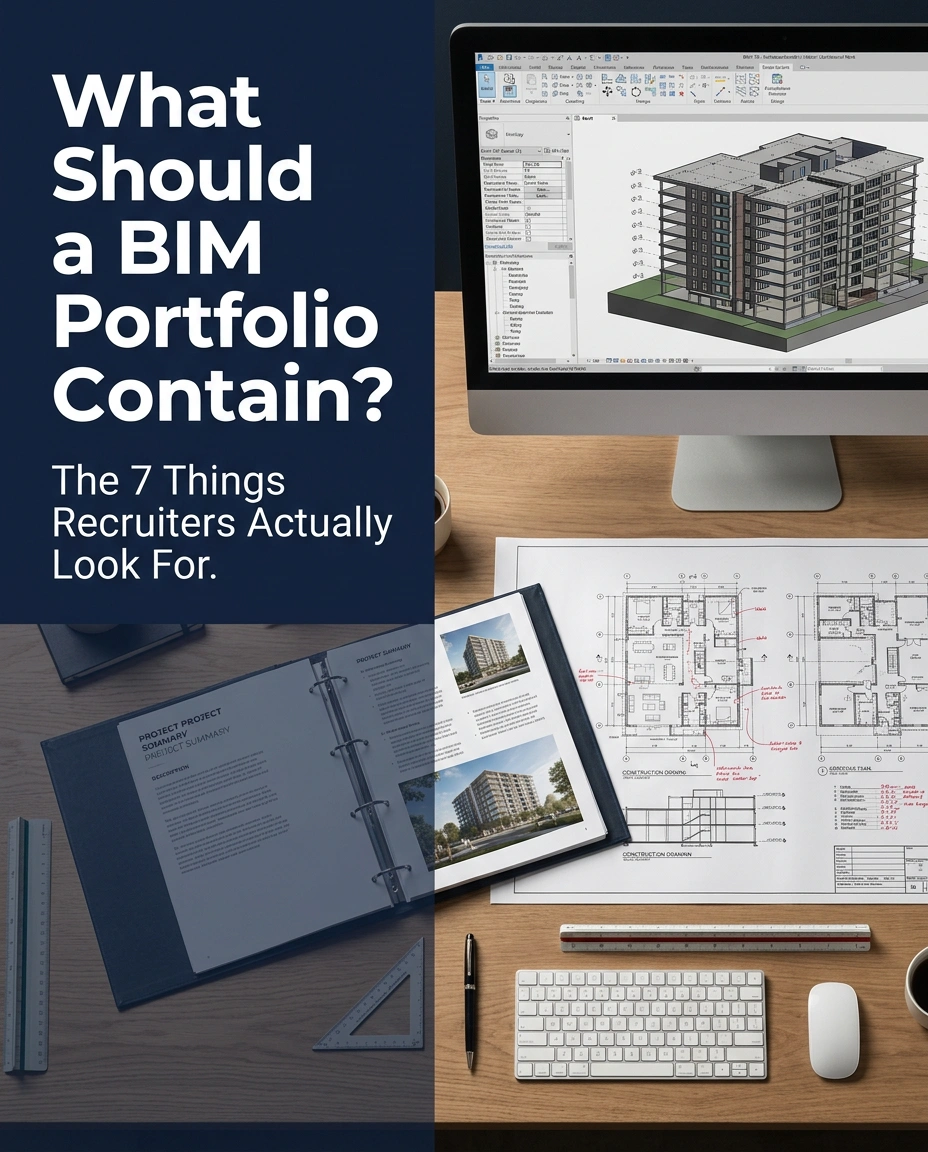
👉 This is why CV and portfolio alignment must happen during learning, not after repeated rejection.
Professionals who document real project exposure as they learn progress faster and face far fewer hiring roadblocks.
India vs Gulf: Skill Expectation Difference
| Aspect | India | Gulf |
| Entry Roles | BIM Modeler | BIM Modeler / Junior Coordinator |
| Focus | Speed + Accuracy | Standards + Coordination |
| Tools | Revit-heavy | Revit + Navisworks + CDE |
| CV Style | Skill-based | Responsibility-based |
| Growth | Faster entry | Higher accountability |
Preparing for both markets requires structured learning, not scattered tutorials.
How to Future-Proof Your BIM Career (2026 Strategy)
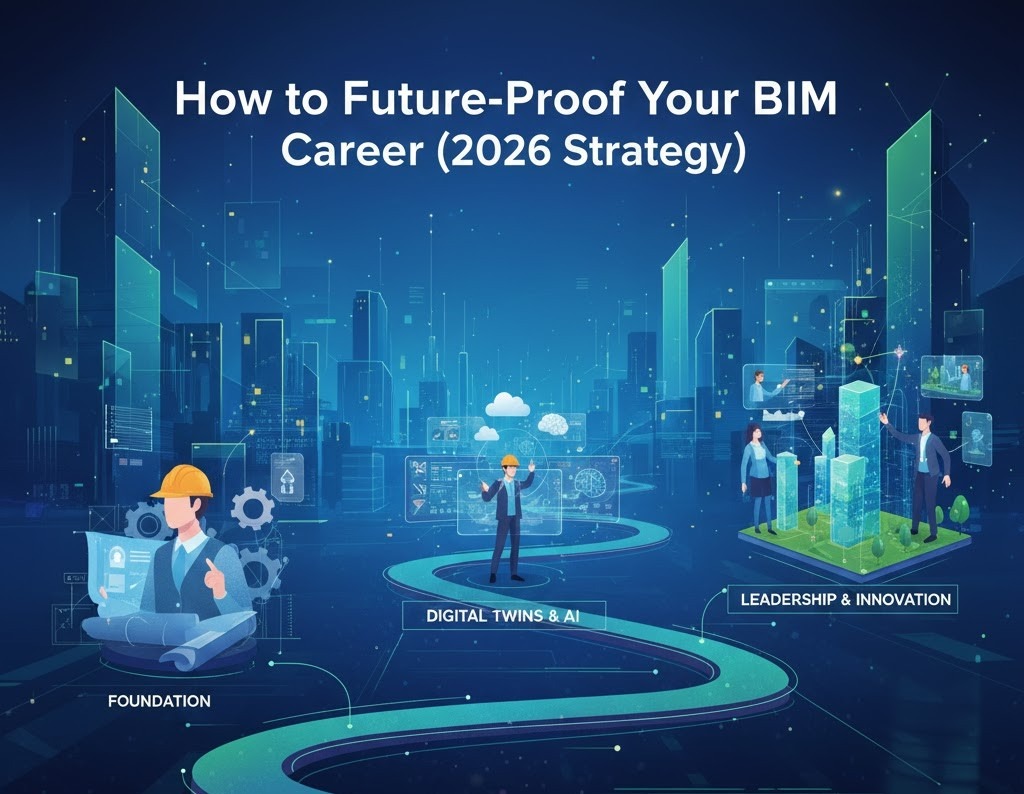
BIM professionals who succeed in 2026 do not chase tools.
They build workflow confidence.
Instead of repeatedly asking:
“Which software should I learn next?”
High-value BIM professionals ask:
- Can I execute a complete BIM workflow from model setup to delivery?
- Have I participated in coordination scenarios and issue resolution?
- Can I clearly explain my role, responsibilities, and outputs in a project?
This shift in thinking is critical.
Recruiters are not impressed by long software lists. They are convinced by professionals who understand how BIM functions inside real projects—from coordination to documentation, from standards to deliverables.
📌 This mindset shift separates:
- Employable BIM professionals
from - Course collectors with no project direction
Future-proof BIM careers are built on application clarity, not learning volume.
Where Most BIM Learners Go Wrong
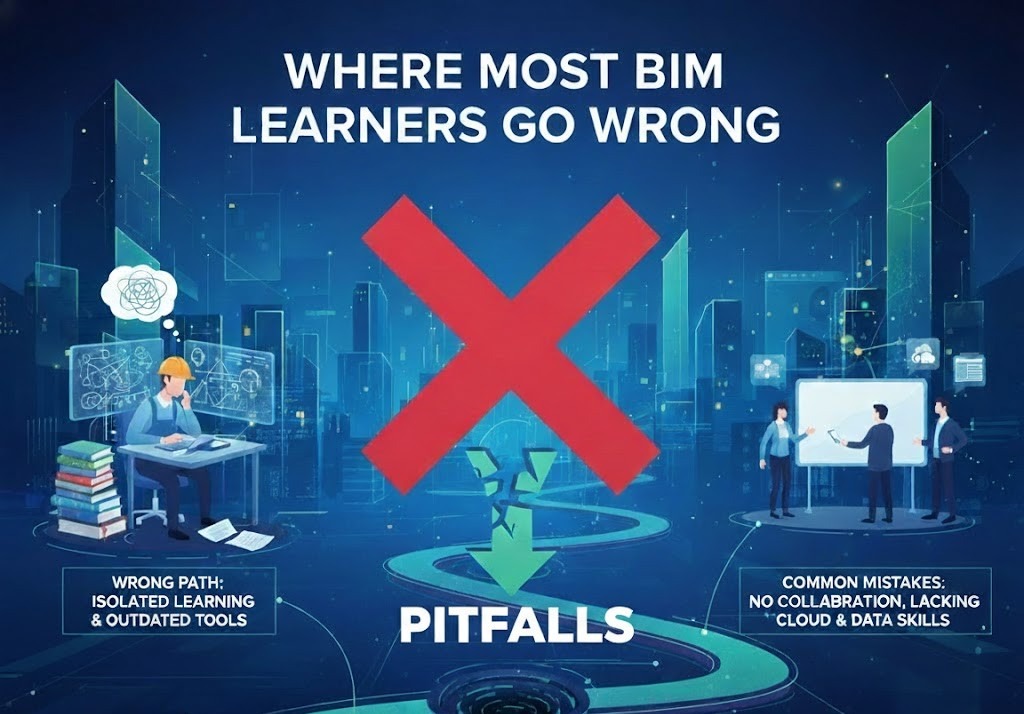
Despite good intentions, many learners unknowingly block their own career growth.
Common mistakes include:
- Jumping between courses without completing full workflows
- Learning tools in isolation, disconnected from real project context
- Ignoring BIM standards and structured documentation practices
- Delaying real project exposure in favour of endless tutorials
- Fixing CVs only after repeated rejections, instead of aligning early
Each of these delays real employability.
👉 The correct approach is learning + applying + documenting — simultaneously.
This is the model followed in structured BIM learning environments, where training is built around:
- Real project workflows
- Discipline-specific depth
- Job-ready deliverables
- Continuous CV and portfolio alignment
- Placement assurance through project-oriented exposure
When learning mirrors real project execution, hiring becomes a natural outcome—not a struggle.
Final Thought
BIM careers in 2026 reward clarity, responsibility, and workflow understanding—not the quantity of tools or certificates.
- India-focused roles demand strong execution, disciplined modelling, and reliable delivery speed
- Gulf-focused roles demand coordination strength, standards awareness, and accountability
If your learning path prepares you for both execution and coordination, you are already ahead of the majority of applicants.
Learn BIM the Way the Industry Actually Works
At BIM Cafe, learning is built around real project workflows, discipline-specific depth, and hiring-aligned expectations—so professionals don’t just learn BIM, they become project-ready.
If you’re serious about building a sustainable BIM career in India or the Gulf, start by learning how BIM is applied on real projects, not just how tools work.
Explore structured BIM learning at BIM Cafe and align your skills with real hiring expectations.
Want to Evaluate Your BIM Readiness?
Many professionals believe they are job-ready—
until they see what recruiters actually filter for.
A structured BIM roadmap aligned with real hiring expectations can save years of trial, rejection, and confusion.
👉 Start by evaluating your project exposure, role clarity, and workflow understanding—not just your software list.
That clarity is what turns BIM learning into a sustainable career.