Author: Devika R
March 2, 2026
8 min read
A Major Shift in the AECO Industry Cloud

In a move that signals the next phase of digital transformation across the AECO sector, Autodesk has announced that Autodesk Construction Cloud (ACC) will officially join the Autodesk Forma industry cloud platform on March 24, 2026.
This development goes far beyond a simple product rename. It reflects Autodesk’s long-term vision to unify the entire Architecture, Engineering, Construction, and Operations lifecycle within a single, connected ecosystem.
For decades, the AECO industry has struggled with fragmented workflows — where design, coordination, and construction often operated in partially disconnected environments. By bringing construction management capabilities into the Forma ecosystem, Autodesk is directly addressing one of the industry’s most persistent inefficiencies: the gap between design intent and field execution.
For BIM, VDC, and digital delivery professionals, this announcement marks an important evolution in how cloud-based workflows will function in the coming years.Starting March 24, 2026, the familiar Autodesk Construction Cloud modules will be repositioned under the Autodesk Forma umbrella with updated naming. Functionally, the tools remain the same — but strategically, they become part of a larger unified AECO platform.
Product Renaming Overview
| Current Name | New Name (Effective March 24, 2026) |
| Autodesk Docs | Forma Data Management |
| Autodesk Build | Forma Build |
| Autodesk Takeoff | Forma Takeoff |
| Autodesk Estimate | Forma Estimate |
| BIM Collaborate Pro | Forma Design Collaboration |
Important Clarification
The early-stage planning and environmental analysis solution previously known as Autodesk Forma will now be renamed Forma Site Design. This change helps clearly distinguish it as one capability within the broader Forma industry cloud.
This restructuring positions Autodesk Forma not as a single tool, but as the central AECO cloud ecosystem.
Why Autodesk Is Moving Everything to Forma
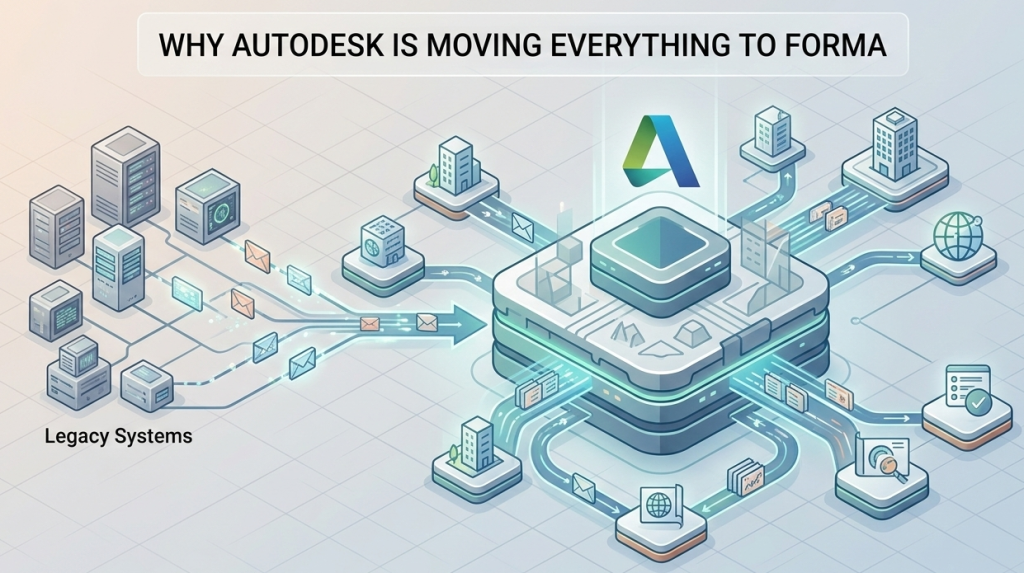
Historically, construction projects have relied heavily on file-based and phase-separated workflows. While functional, this approach created several recurring problems across projects:
- Information loss during handovers
- Rework between design and construction teams
- Communication gaps across disciplines
- Limited lifecycle visibility
- Fragmented data environments
Autodesk’s Forma strategy is designed to eliminate these inefficiencies by shifting the industry toward an AI-native, cloud-first, data-centric model.
Key Strategic Drivers Behind the Shift
1. Unified Data Environment
At the heart of the new ecosystem is Forma Data Management (formerly Autodesk Docs), which becomes the central source of truth for project information.
In the Forma vision, data flows continuously across:
- Site feasibility
- Concept design
- Detailed design
- Construction execution
- Project handover and operations
This unified approach reduces data silos and improves lifecycle continuity — something the AECO industry has long struggled to achieve.
2. From File-Based Collaboration to Granular Data Exchange
One of the most significant conceptual shifts in Forma is the move away from heavy file transfers toward granular data sharing.
Traditionally, teams exchanged large:
- RVT files
- DWG files
- PDFs
In the Forma ecosystem:
- Specific data elements can be accessed independently
- Tools communicate at the data level
- Full file duplication becomes less necessary
- AI insights become more precise and contextual
This represents a fundamental transition from file-based workflows to data-driven collaboration.
3. Deep Integration with Desktop Authoring Tools
Autodesk is maintaining strong integration between Forma and core desktop platforms such as:
- Revit
- Civil 3D
This is critical because most production modeling still occurs in desktop environments.
The new architecture aims to bridge three historically separate zones:
- Local model authoring
- Cloud collaboration
- Construction execution
For BIM teams, this ensures workflow continuity rather than forcing a disruptive cloud-only transition.
What This Means for BIM and VDC Professionals
For digital delivery teams, this change signals a broader evolution in role expectations and skill priorities.
The Role Is Expanding Beyond Model Coordination
Traditionally, many BIM roles focused heavily on:
- Clash detection
- Model cleanup
- Coordination meetings
In the Forma-driven future, the role is expanding toward information strategy and lifecycle thinking.
Professionals will increasingly be expected to manage:
- Data structure and governance
- Information flow between phases
- Cross-platform integration
- Model intelligence and automation readiness
In simple terms, BIM is moving from model management toward data orchestration.
AI Will Become Embedded in Daily Workflows
Forma is designed as an AI-enabled platform rather than one that adds AI as an afterthought.
Expected impacts include:
- Predictive risk identification
- Automated model insights
- Generative design support
- Intelligent workflow recommendations
- Data-driven decision support
For professionals, this means understanding data quality and structure will become just as important as modeling accuracy.
True End-to-End Project Continuity
One of the most powerful outcomes of the Forma ecosystem is lifecycle visibility.
With Site Design, Design Collaboration, Build, and Data Management unified, teams can:
- Track sustainability goals from concept through construction
- Maintain consistent project data
- Validate that design intent is executed correctly on site
- Improve handover quality to owners
This closes a long-standing gap in AECO workflows where information often degraded between phases.
Will Existing ACC Users Experience Disruption?
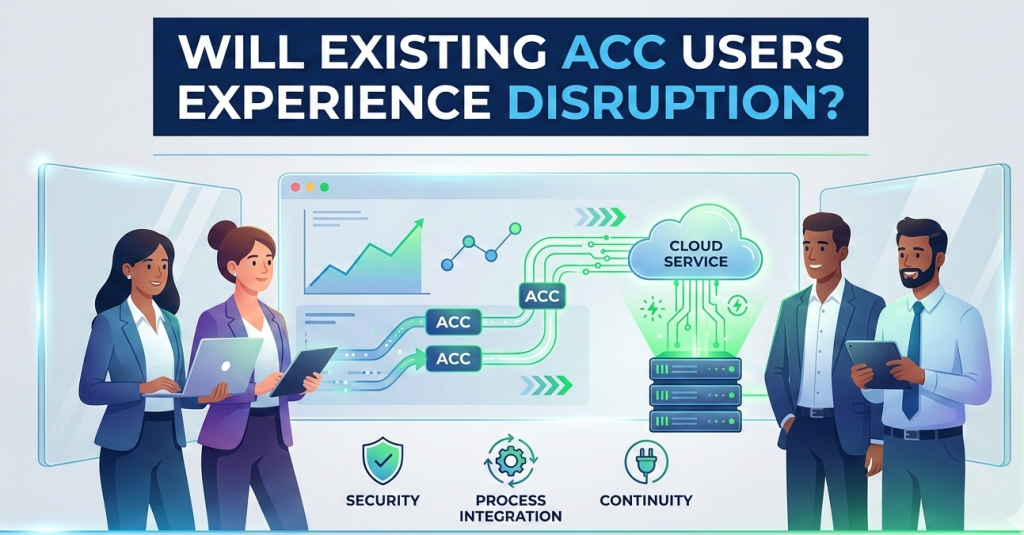
The short answer: No major disruption is expected.
Autodesk has positioned this as an evolution rather than a forced migration.
What Stays the Same
- Existing ACC project data remains intact
- No mandatory data migration
- Current workflows continue functioning
- User access and permissions remain unchanged
What Changes
- Product naming and interface alignment
- Platform positioning within Forma
- Long-term roadmap direction
For most active project teams, the transition should feel like a structural and visual update rather than a technical overhaul.
The Bigger Picture: The Rise of the Unified AECO Cloud
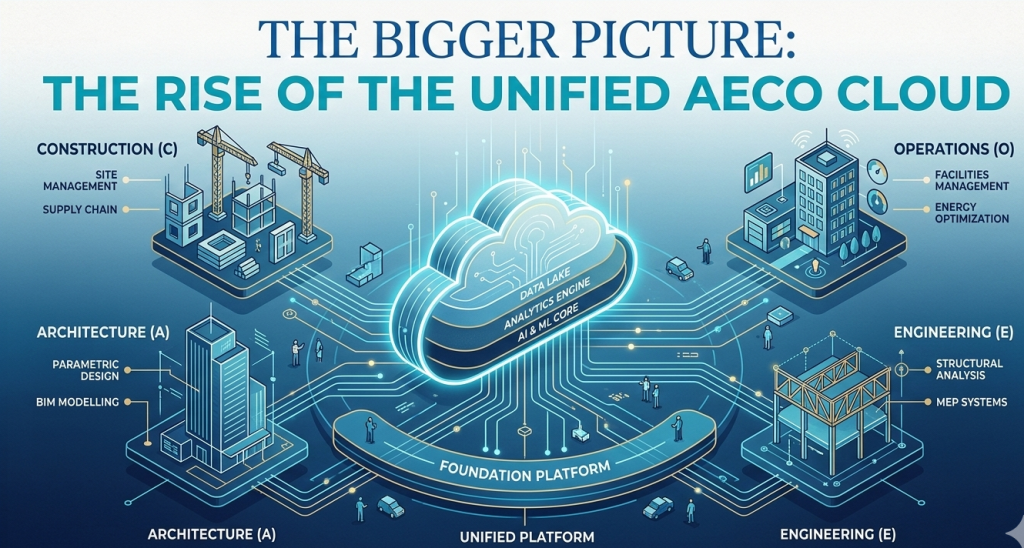
This move signals the gradual end of the “separate platforms for separate phases” era.
The industry is shifting toward a model where:
- Data is the primary asset
- Collaboration is continuous
- AI supports decision-making
- Lifecycle visibility is standard
- Cloud connectivity is foundational
Autodesk Forma is being positioned as the central nervous system of this future AECO environment.
What This Means for BIM Learners and Emerging Professionals
For students and early-career BIM professionals, this transition carries an important message: tool knowledge alone is no longer enough.
Future-ready professionals will need stronger capability in:
- Cloud collaboration workflows
- Common Data Environment (CDE) practices
- Data management principles
- Lifecycle-based BIM thinking
- Cross-platform coordination
As hiring expectations evolve, candidates who understand connected ecosystems like Forma and ACC will be significantly better positioned in the job market.
Strategic Takeaway
The integration of Autodesk Construction Cloud into Autodesk Forma marks a defining milestone in the digital evolution of the AECO industry.
This is not merely about renaming products.
It represents a structural shift toward:
- Connected lifecycle delivery
- AI-assisted project intelligence
- Data-centric collaboration
- Cloud-native construction management
For BIM professionals, the direction is clear: the future belongs to those who understand not just how to model — but how information flows across the entire project ecosystem.
Final Thoughts
The AECO industry is entering a deeply connected, cloud-driven phase of digital maturity. Autodesk Forma is positioned at the center of this transformation, bringing design, coordination, and construction into a unified environment.
Organizations and professionals who begin adapting now — by strengthening data literacy, cloud workflows, and lifecycle thinking — will be far better prepared for the next wave of digital project delivery. Learners who want structured, industry-focused preparation can explore the BIM Cafe professional BIM course to build real project readiness aligned with modern AECO workflows.
The tools are evolving.
The workflows are evolving.
And the expectations for BIM professionals are evolving just as quickly.