Author: Devika R
February 2, 2026
5 min read
The Shift No One Can Ignore

For decades, construction and design careers followed a predictable path:
Degree → Job → Experience → Growth
But by 2026, that formula is no longer enough.
Across architecture, engineering, and construction (AEC), companies are asking a different question:
“What can you actually do on a real project?”
At BIM Cafe Learning Hub, we regularly meet graduates with strong academic backgrounds who still struggle to secure BIM roles — while others with practical BIM skills move ahead faster.
This blog explains why BIM skills now matter more than degrees, and what students and professionals must focus on to stay relevant in the construction industry.
Degrees Still Matter — But They’re No Longer Enough

Let’s be clear from the outset: degrees still matter in construction and engineering careers. They provide the essential foundation on which professionals are built. Through formal education, students gain:
- Core engineering and design principles
- Technical theory and problem-solving skills
- Professional discipline and structured thinking
- Academic credibility required for regulated roles
However, by 2026, the construction industry has evolved far beyond what a degree alone can demonstrate.
A degree does not automatically prove that you:
- Can work efficiently inside a live BIM environment
- Understand real-world project workflows used by consultants and contractors
- Can coordinate effectively with architectural, structural, and MEP teams
- Are capable of contributing meaningfully from Day One on a live project
This gap between education and execution has become more visible as projects grow in scale and complexity.
Modern construction projects in 2026 are:
- Faster, with compressed timelines and overlapping design stages
- More complex, involving multidisciplinary coordination and advanced systems
- More collaborative, requiring constant interaction between global teams
- More digitally driven, relying heavily on BIM, cloud platforms, and model-based decision-making
In this environment, employers can no longer afford long learning curves. This is where BIM skills become the deciding factor, bridging the gap between academic knowledge and real project performance.
What the Construction Industry Actually Needs Today

Across the AEC sector — particularly in firms handling Middle East, US, UK, and other international projects — hiring priorities have shifted decisively toward practical capability.
Today’s employers are not just looking for qualified graduates. They are looking for professionals who can operate confidently within active BIM workflows.
Modern AEC firms expect candidates who can:
- Work fluently in Revit-based BIM models, not just draft views
- Understand and deliver models aligned with LOD 300 and LOD 350 requirements
- Coordinate effectively between architecture, structure, and MEP disciplines
- Perform clash detection and issue resolution using Navisworks
- Collaborate within BIM 360 / Autodesk Construction Cloud (ACC) environments
- Follow BIM standards, BEPs, and project-specific protocols
- Manage revisions, comments, RFIs, and coordination cycles professionally
These competencies directly impact project timelines, coordination quality, and construction accuracy.
Importantly, these are execution-driven skills, not theoretical concepts — and they are rarely taught in depth within traditional degree programs. This is why graduates often feel unprepared when they step into BIM-focused roles.
Why BIM Skills Are Becoming More Valuable Than Degrees
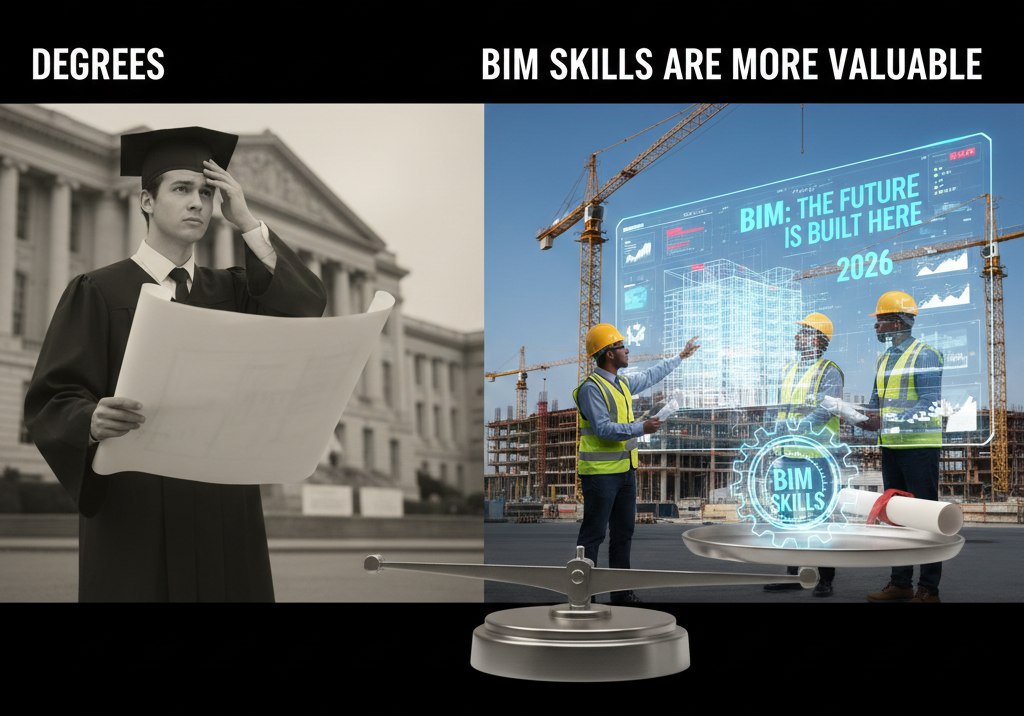
1️⃣ BIM Is How Projects Are Actually Built Today
Large construction projects no longer rely on isolated 2D drawings exchanged via email.
Instead, they operate using:
- Federated, multi-discipline BIM models
- Centralised Common Data Environments (CDEs)
- Model-based coordination and decision-making
The BIM model now functions as the single source of truth throughout design, coordination, and construction.
If a professional cannot work confidently inside this environment — creating, coordinating, and managing model data — their academic qualifications alone offer limited practical value on modern projects.
2️⃣ BIM Reduces Risk — And Companies Hire to Reduce Risk
From an employer’s perspective, hiring is fundamentally about risk management.
Companies prefer BIM-skilled professionals because they are more likely to:
- Make fewer coordination and documentation errors
- Identify clashes before construction begins
- Understand dependencies between disciplines
- Reduce rework, delays, and cost overruns
Every unresolved clash or coordination error represents potential financial and reputational risk.
Professionals with strong BIM skills directly help reduce these risks, making them significantly more valuable to employers than candidates who require extensive on-the-job training.
3️⃣ BIM Skills Are Measurable and Verifiable
A degree demonstrates that someone has completed an academic program.
BIM skills demonstrate execution ability.
In BIM-focused interviews, employers increasingly ask questions such as:
- “Can you show a BIM model you have worked on?”
- “Have you delivered models based on LOD requirements?”
- “How do you identify and resolve clashes?”
- “Have you worked in a common data environment?”
These questions cannot be answered through certificates alone.
They require practical experience, workflow understanding, and real project exposure. This makes BIM skills tangible, testable, and far more influential in hiring decisions.
4️⃣ BIM Enables Global and Remote Opportunities
BIM has become a global language of construction.
Professionals with strong BIM capabilities can work on:
- International construction and infrastructure projects
- Outsourced BIM and coordination roles
- Remote design and coordination teams across time zones
While degrees are often region-specific, BIM skills are globally transferable.
This global relevance gives BIM-skilled professionals greater mobility, stronger career resilience, and access to a wider range of opportunities — both locally and internationally.
The Biggest Mistake Students Make
One of the most common — and most costly — mistakes construction students make is this assumption:
“I’ll finish my degree first, then I’ll think about BIM.”
On the surface, this sounds logical. Degrees have traditionally been the starting point of a career. However, in the fast-evolving construction industry of 2026, this mindset puts students at a disadvantage.
By the time many graduates complete their degree:
- Industry expectations have already moved ahead, driven by rapid digital adoption
- Competition has intensified, with more candidates entering the market each year
- Employers expect immediate contribution, not extended training periods
Construction companies today operate under tight deadlines and budgets. They are no longer structured to “teach BIM from scratch” to fresh graduates.
The result is a growing gap:
Graduates with strong academic scores often feel unprepared, underconfident, and unsure of how real projects actually function.
This disconnect is not due to lack of intelligence or effort — it’s due to delayed exposure to practical BIM workflows.
Students who wait until after graduation to learn BIM often find themselves trying to catch up, while others who started earlier move ahead faster in their careers.
How BIM Cafe Bridges the Gap Between Degree and Industry
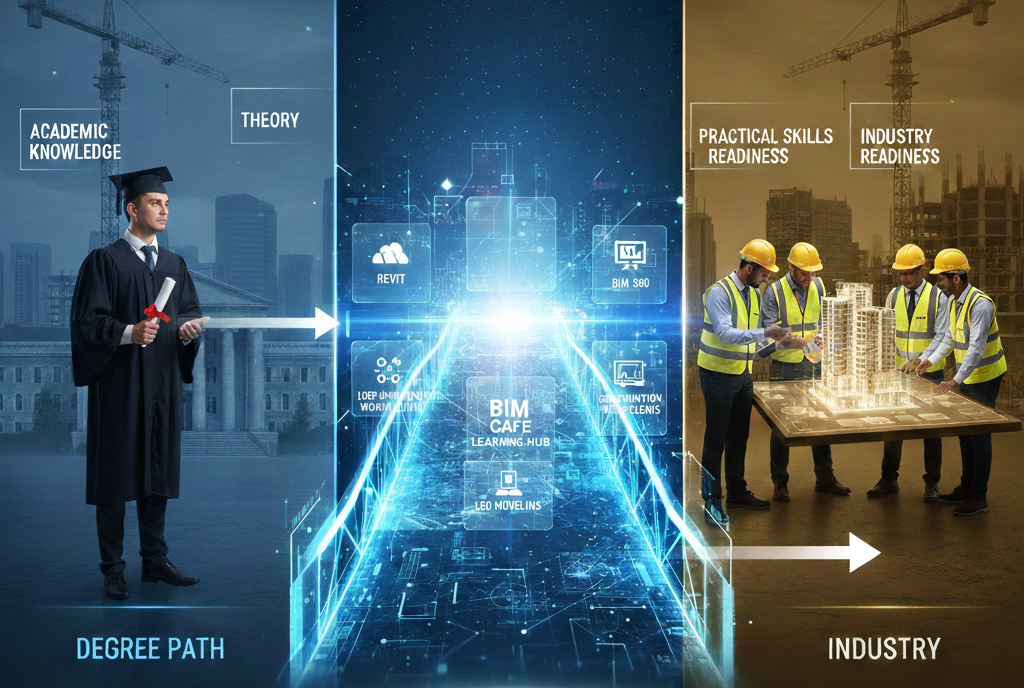
At BIM Cafe Learning Hub, we don’t aim to replace degrees — we complete them.
Our training philosophy is built around a simple idea:
Academic knowledge becomes valuable only when it can be applied on real projects.
That’s why our focus is on industry-aligned, execution-driven BIM training, not just software instruction.
We help students and professionals develop skills in:
- Real BIM project workflows, mirroring how consultants and contractors actually work
- Architecture, Structural, and MEP coordination, not isolated modeling
- LOD-based modeling, aligned with real client and contractor deliverables
- Scan-to-BIM processes and documentation logic used on live projects
- Industry-standard tools, including Revit, Navisworks, and BIM 360 / Autodesk Construction Cloud (ACC)
- Live project exposure, structured around global BIM standards and expectations
Our goal is to shift learners from theoretical understanding to practical confidence.
We train students to move from:
“I studied this” → “I can do this on a live project.”
That transition is exactly what employers look for when hiring BIM professionals in 2026.
BIM Skills vs Degree: The 2026 Reality
When hiring decisions are made today, companies quietly compare academic qualification versus practical readiness.
Here’s how that comparison looks in reality:
| Aspect | Degree | BIM Skills |
| Proves education | ✅ | ❌ |
| Proves execution ability | ❌ | ✅ |
| Job readiness | Limited | High |
| Industry relevance | General | Direct |
| Global mobility | Limited | Strong |
The most successful professionals combine both a solid degree and strong BIM skills.
However, when deadlines are tight and project risk is high, skills carry more weight than qualifications alone.
What Students and Professionals Should Do Now
If you’re planning or reassessing your construction career in 2026, the path forward is clear.
You should aim to:
✔ Build strong fundamentals through formal education
✔ Learn BIM tools that are actually used on real projects
✔ Work on live, LOD-based BIM models, not just practice files
✔ Understand coordination workflows, not only software commands
✔ Focus on execution and problem-solving, not just certifications
This approach prepares you to be industry-ready, not just degree-qualified.
Final Thoughts
Degrees still matter.
They open doors, provide credibility, and build foundational knowledge.
But in today’s construction industry, BIM skills decide how far you go after you walk through that door.
Employers are no longer asking:
“Where did you study?”
They are asking:
“Can you work in BIM?”
At BIM Cafe Learning Hub, we help students and professionals answer that question with confidence — by focusing on the practical skills, workflows, and project exposure that truly matter in 2026 and beyond.
Start building practical BIM skills that make you job-ready in 2026 and beyond.
Explore our BIM programs or speak with our mentors to plan your career path today.
Because in modern construction, skills don’t just support your degree — they define your career.