Author: Devika R
December 15, 2025
9 min read
Because a building is more like a human than you think.
Buildings Are Not Just Structures — They Are Living Systems
Many people entering construction or BIM struggle to clearly understand the difference between Architectural (ARC), Structural (STR), and MEP disciplines. At first glance, they can feel like separate technical domains filled with drawings, symbols, and software commands. But when you look at a building the right way, everything becomes far simpler.
Here’s the core idea that changes how you see BIM forever:
👉 A building functions exactly like the human body.
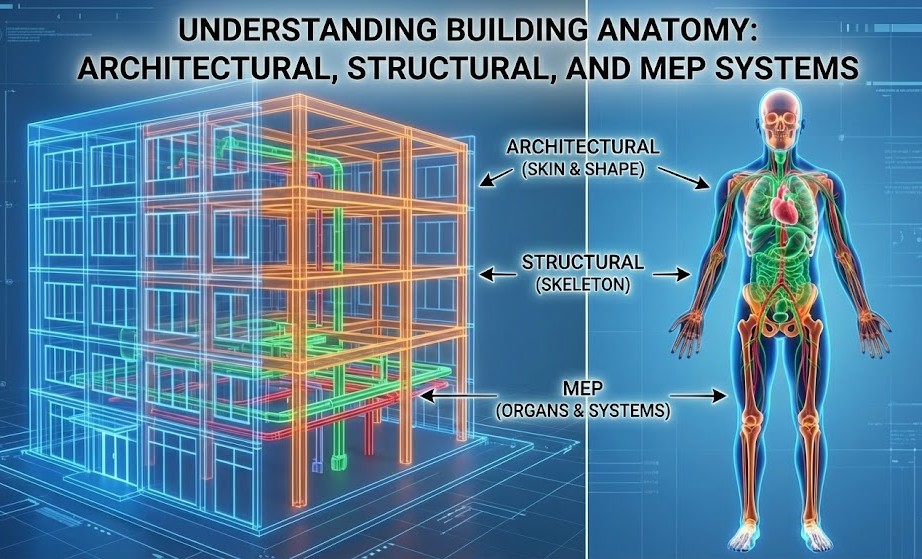
Just as the human body is not a random collection of bones, skin, and organs, a building is not just concrete, steel, and services. It is a living system, where every part has a specific role and where all parts must work together for the whole to function properly.
Think about your own body for a moment.
Your skin defines how you look and interact with the world.
Your skeleton gives you strength, posture, and stability.
Your organs and internal systems keep you alive, comfortable, and functioning.
A building follows the same logic.
1. Architectural = The Skin, Shape & Identity of the Body
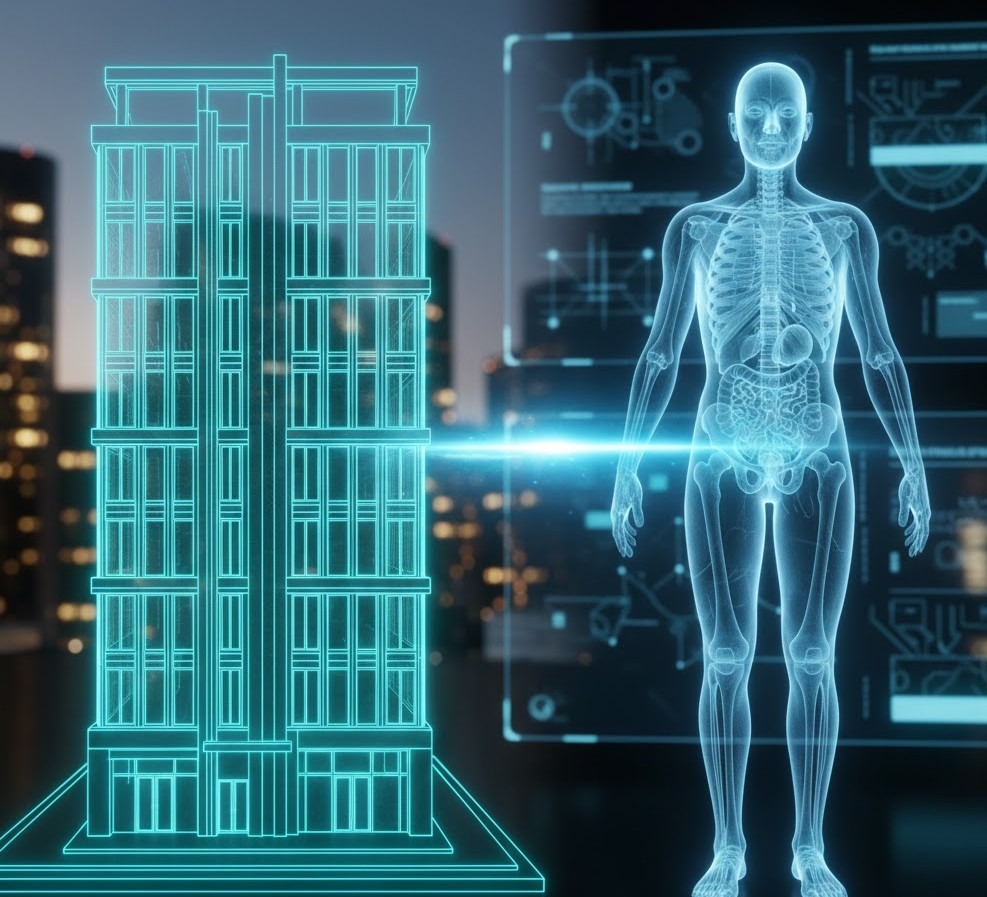
Architecture represents the visible form, spatial experience, and functional layout of a building—much like the skin, face, and posture define the identity of a human body. It is the discipline that people interact with first and the one that shapes how a building feels, looks, and functions in everyday life.
When you look at a building and admire its design, flow, and comfort, you are experiencing architecture at work.
What Architectural (ARC) BIM Includes
Architectural BIM focuses on creating and managing all elements that define space and usability:
- Floor plans – How spaces are arranged and connected
- Walls & partitions – Defining rooms, privacy, and circulation
- Doors & windows – Access, ventilation, lighting, and movement
- Rooms & layouts – Functional zoning for living, working, or public use
- Ceilings – Aesthetic design, heights, and coordination with MEP systems
- Finishes & aesthetics – Materials, textures, colors, and visual identity
These elements shape the user experience, just as your skin and posture shape how others perceive and interact with you.
The Human Body Analogy
In the human body, architecture is comparable to:
- Skin – The outer layer that defines appearance
- Facial structure – Identity and expression
- Posture – How the body stands and moves
- Body shape & proportions – Balance, symmetry, and comfort
- Outer appearance – The first impression
What Architecture Decides
✔ How the building looks and feels
✔ How people experience spaces emotionally and physically
✔ How people move, interact, and live inside the building
Architecture = Design + Function + Aesthetics
Just like skin + appearance + how we use our body.
In BIM, architectural models form the base reference for structural and MEP systems. Any change in layout—walls, ceiling heights, or room sizes—directly affects structure and services.
2. Structural = The Skeleton That Holds Everything Together
If architecture gives the building its identity, structure gives it life-support and survival strength. Structural systems are the bones of the building, responsible for holding everything together and protecting it from collapse, stress, and natural forces.
A beautiful building without proper structure is like a body without bones—it simply cannot stand.
What Structural (STR) BIM Includes
Structural BIM focuses on all load-bearing and support elements:
- Columns – Vertical elements transferring load to the foundation
- Beams – Horizontal members supporting slabs and walls
- Slabs – Floors and roofs that distribute loads
- Foundations – The base that anchors the building to the ground
- Reinforcements – Steel bars and systems that increase strength
- Load-bearing elements – Components that resist gravity and lateral forces
These elements ensure that the building is safe, stable, and durable throughout its lifespan.
The Human Body Analogy
In the human body, structure is equivalent to:
- Bones – The framework of the body
- Spine – Central support and balance
- Rib cage – Protection for vital organs
- Joints – Movement and flexibility
- Skeleton – The system that holds everything together
What Structure Decides
✔ Whether the building stands or collapses
✔ How much weight and load it can safely carry
✔ How it responds to stress, wind, vibrations, and earthquakes
Structure = Strength + Stability + Safety
Just like your skeleton.
Without a strong structural system:
- The building cannot support architectural spaces
- MEP systems cannot be safely installed
- Occupants are at risk
In BIM, structural models must perfectly align with architectural designs and allow space for MEP services. Even a small change in beam depth or column placement can trigger major coordination changes across all disciplines.
3. MEP = The Organs & Systems That Keep the Body Alive
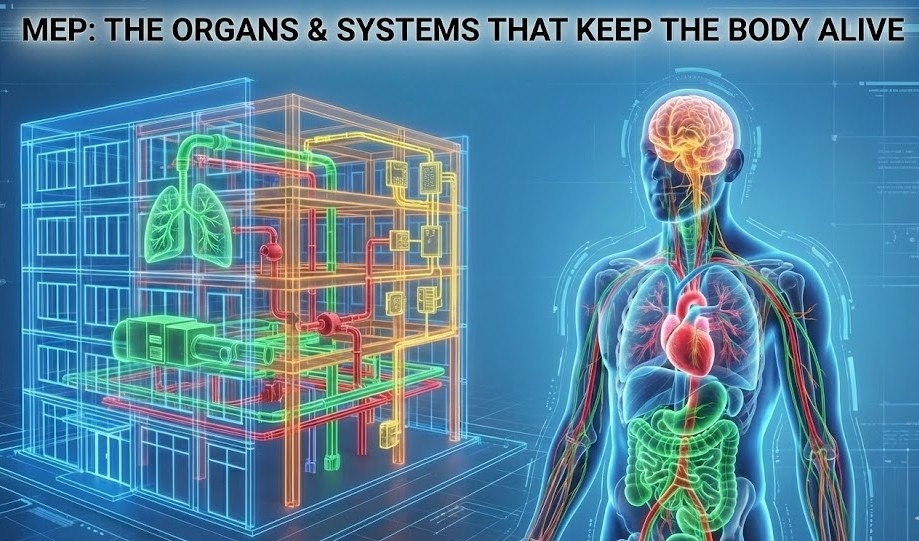
If architecture is the skin and structure is the skeleton, MEP is the life inside the building. MEP systems are what make a building livable, functional, and comfortable. Without them, a building may stand—but it cannot be occupied or used effectively.
Just as the human body depends on organs and internal systems to survive, a building depends on Mechanical, Electrical, and Plumbing systems to operate every single day.
What MEP Really Means in Buildings
MEP stands for Mechanical, Electrical, and Plumbing. Together, these systems control air, power, water, safety, and comfort.
Mechanical (M) – The Lungs & Breathing System
Mechanical systems regulate air quality, temperature, and ventilation.
- HVAC systems (Heating, Ventilation, Air Conditioning)
- Ducting & air distribution
- Ventilation systems
- Chillers, AHUs, FCUs, exhaust systems
Human body analogy:
➡ Lungs & breathing system
Just as lungs supply oxygen and remove carbon dioxide, HVAC systems supply fresh air, control temperature, and remove heat and pollutants.
Electrical (E) – The Nervous System & Brain Signals
Electrical systems power the building and enable communication and safety.
- Power distribution & cabling
- Lighting systems
- Fire alarm & emergency systems
- Data, CCTV, access control, and low-voltage systems
Human body analogy:
➡ Nervous system & brain signals
Like nerves transmitting signals from the brain to the body, electrical systems distribute power and control signals throughout the building.
Plumbing (P) – The Digestive & Circulatory Systems
Plumbing systems manage water supply, waste removal, and pressure.
- Cold & hot water supply
- Drainage & sewage systems
- Pumps & tanks
- Stormwater and firefighting lines
Human body analogy:
➡ Digestive system & blood circulation
Just as blood and fluids move through the body to sustain life, plumbing systems circulate water and safely remove waste.
MEP in the Human Body Analogy
MEP systems collectively represent:
- Heart – Pumps and circulation systems
- Lungs – Air movement and ventilation
- Blood flow – Water and fluid circulation
- Nerves – Electrical and data systems
- Kidneys – Filtration and waste removal
- Internal plumbing of the body
What MEP Decides in a Building
✔ Whether the building is comfortable to occupy
✔ Whether people can live, work, and function inside it
✔ Whether all systems operate smoothly, safely, and efficiently
MEP = Building Services + Comfort + Utilities
Just like organs + system functions + life-support in the human body.
A structurally sound and beautifully designed building is still unusable without MEP.
The Full Analogy: A Building = A Human Body
Here’s the perfect way to remember it:
| Building Component | Human Body Equivalent | Purpose |
| Architectural | Skin, face, body shape | Appearance, usability, space design |
| Structural | Skeleton, bones | Strength, stability, support |
| MEP | Organs, nerves, lungs | Life-support, comfort, function |
A building isn’t complete unless all three work together.
Just like a human cannot survive with bones alone or skin alone —
a building cannot function with only architecture or only structure.
Why This Understanding Matters in BIM
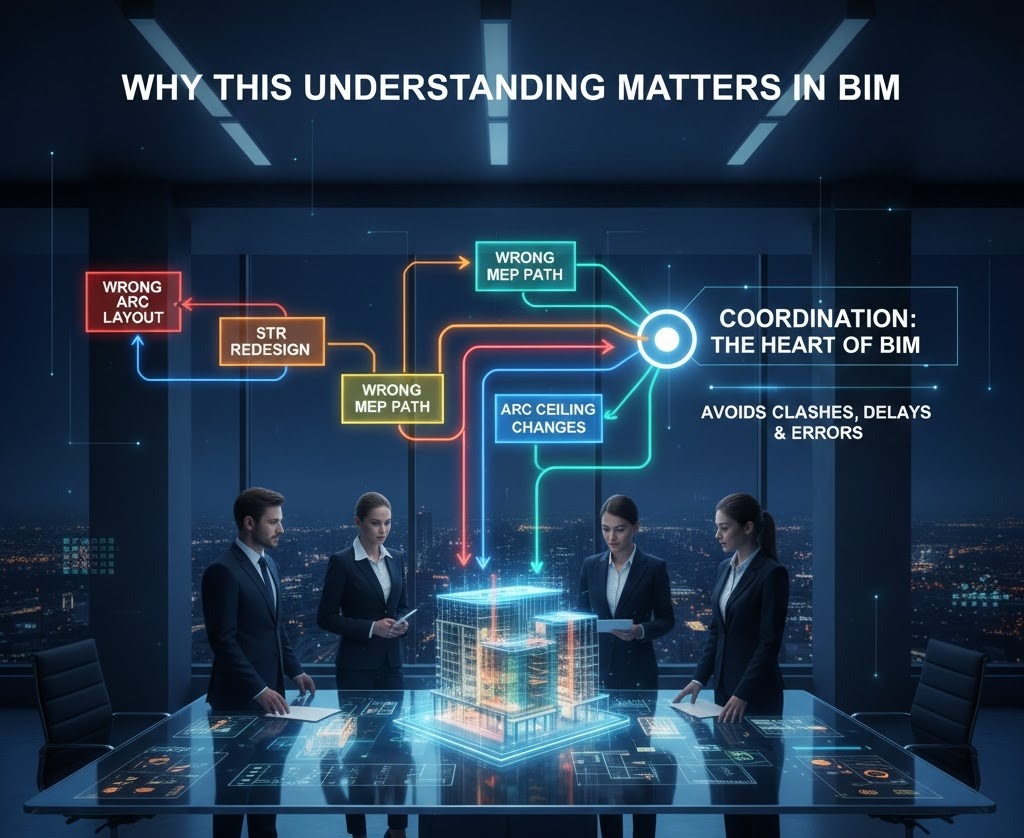
In BIM, ARC, STR, and MEP teams must work together — just like the human body’s systems coordinate seamlessly.
A mistake in one discipline affects all the others:
- Wrong ARC layout → STR redesign
- Wrong STR beam height → MEP duct clashes
- Wrong MEP path → ARC ceiling changes
This is why coordination is the heart of BIM.
At BIM Cafe, we train students to understand:
- How ARC, STR, and MEP interact
- How coordination happens
- How clashes occur
- How real projects solve issues
- How multidisciplinary BIM models work
Because BIM isn’t software —
it’s understanding how a building “lives and breathes.”
How BIM Cafe Helps You Learn ARC, STR & MEP in Real Projects

At BIM Cafe learning Hub, BIM goes far beyond software commands and theory. Our training is designed to help you understand how buildings actually function as integrated systems, exactly the way they work on real construction projects.
Instead of teaching ARC, STR, and MEP in isolation, we focus on how these disciplines interact, clash, and coordinate—because that’s what the industry truly demands.
What Our Training Focuses On
- Comprehensive Revit Training (ARC, STR & MEP)
You gain hands-on experience with Revit Architecture, Structure, and MEP modules, learning how each discipline models its components and contributes to a single, coordinated BIM model. - Multidisciplinary Coordination
You learn how architectural layouts, structural elements, and MEP systems overlap in real projects—and how to coordinate them efficiently without errors. - Navisworks Manage for Clash Detection
Training includes real-time clash detection and resolution workflows using Navisworks Manage, helping you identify and solve conflicts before they reach the construction site. - BIM 360 / ACC Workflows
You work with cloud-based collaboration tools like BIM 360 and Autodesk Construction Cloud (ACC), learning version control, model sharing, and team coordination used on global projects. - LOD-Based Deliverables
You understand how models evolve from concept to construction through different Levels of Detail (LOD), preparing you to meet international project requirements. - Live Project Exposure
Students work on real or simulated live projects that reflect industry scenarios—so you graduate with practical experience, not just certificates. - Assurance of Placement Support
BIM Cafe provides structured placement assistance and career guidance to help you transition confidently into BIM roles in India and international markets.
Our Philosophy
We don’t just teach tools.
We teach how buildings actually work.
Conclusion: A Building Is Alive — Learn All Its Parts
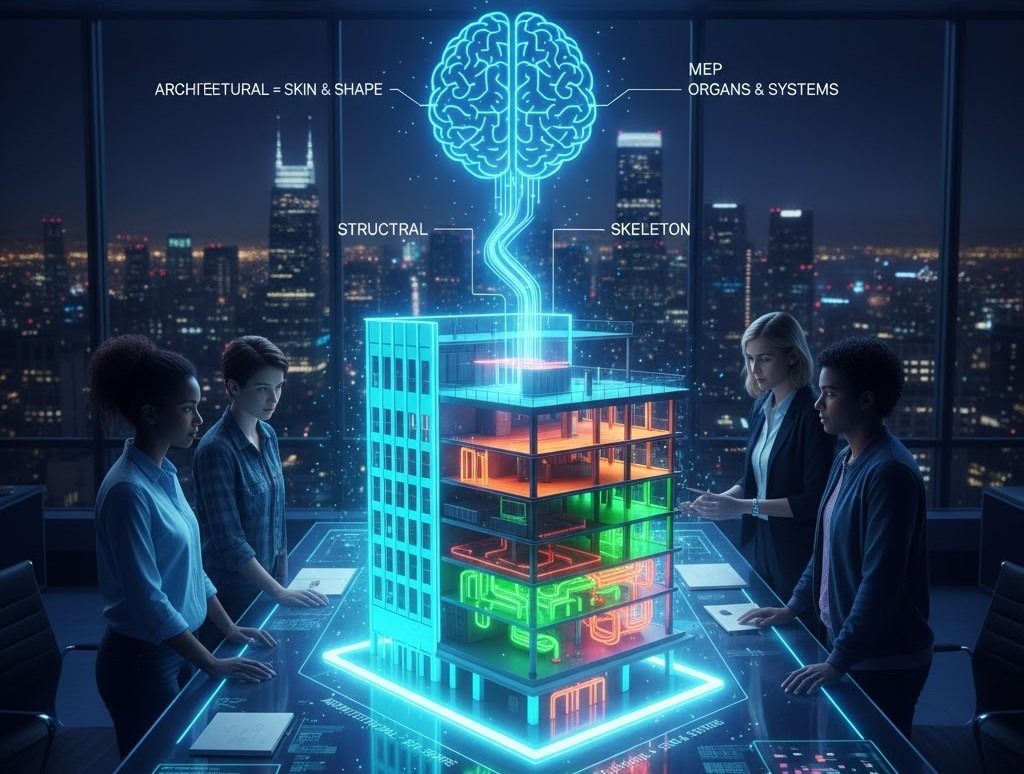
When you understand Architectural, Structural, and MEP systems as the skin, skeleton, and organs of a living body, BIM stops feeling complex and starts making sense.
The most successful BIM professionals know that:
- Architecture creates experience
- Structure creates strength
- MEP creates life
Together, these systems form a building that functions like a living organism—responsive, coordinated, and efficient.
So the real question is:
Do you want to learn BIM as just another software skill…
or do you want to understand BIM as the science of how buildings live and breathe?
At BIM Cafe, we teach you both—and prepare you for real-world, multidisciplinary BIM projects with confidence.
FAQs
Best Overall Multidisciplinary Courses
- Professional BIM Course — Covers architecture, structure, and MEP fundamentals with live project workflows.
- Master BIM Course — Advanced focus on coordination, documentation, and interdisciplinary integration.
- Revit MEPF Master Course — Ideal for MEP systems and coordination.
- Architectural BIM & Design Development Course — Focuses on architectural modeling and design best practices.
- Structural Design Concepts & BIM Course — Structural modeling and integration with ARC & MEP models.
- BIM Intensive / FastTrack Programs — Short, focused training on Revit, Navisworks, BIM 360/ACC, and coordination workflows.