Author: Devika R
February 7, 2026
6 min read
A Very Common Student Question
One of the most common questions students ask before joining a BIM course is:
“Will I learn structural engineering in a BIM course?”
It’s a fair question—and a very important one.
The confusion usually comes from the similarity in terms. Structural BIM and Structural Engineering sound closely related, so many students assume they are learning the same thing through different tools. In reality, these two paths serve very different purposes in the construction industry.
This misunderstanding often leads to:
- Wrong expectations from BIM courses
- Disappointment after training
- Career confusion during job interviews
This blog is written to remove that confusion completely. By the end, you’ll clearly understand:
- What structural engineering truly involves
- What structural BIM actually focuses on
- What BIM courses teach—and what they don’t
- How to choose the right career direction based on your goals
What Is Structural Engineering?

Structural engineering is a core engineering discipline within civil engineering. It deals with the design, safety, and performance of structures.
A structural engineer’s primary responsibility is to ensure that a building or structure:
- Can safely carry all applied loads
- Remains stable over its lifetime
- Performs correctly under environmental forces
What Structural Engineers Actually Do
Structural engineers work on:
- Structural analysis and calculations
- Load assessments (dead load, live load, wind, seismic, etc.)
- Design of beams, columns, slabs, foundations, shear walls
- Earthquake-resistant and wind-resistant design
- Code-based decision-making using national and international standards
They typically use analysis and design software such as:
- ETABS
- STAAD Pro
- SAFE
- SAP2000
Key Responsibilities
A structural engineer decides:
- What size a beam or column should be
- How much reinforcement is required
- Whether a structure is safe and compliant
- How the structure behaves under real-world loads
Because of this responsibility, structural engineering usually requires:
- A civil or structural engineering degree
- Strong fundamentals in mechanics and design
- Deep understanding of codes and standards
- Years of experience and professional accountability
In simple terms:
👉 Structural engineers design the structure and take responsibility for its safety.
What Is Structural BIM?
Structural BIM is not structural design.
Instead, structural BIM focuses on digitally representing, documenting, and coordinating the engineer’s approved design using BIM platforms.
A structural BIM professional works after—or alongside—the design phase to ensure the design is accurately translated into:
- 3D models
- Drawings
- Schedules
- Coordinated project documentation
What Structural BIM Involves
Structural BIM typically includes:
- Creating detailed 3D structural models
- Modeling beams, columns, slabs, foundations, and rebar
- Preparing construction drawings from models
- Extracting quantities and schedules
- Coordinating with architectural and MEP models
- Ensuring documentation aligns with BIM standards
These tasks are usually performed using tools such as:
- Autodesk Revit
- Navisworks
- Other BIM coordination platforms
What Structural BIM Professionals Do NOT Do
Structural BIM professionals do not:
- Decide beam or column sizes
- Perform load calculations
- Validate structural safety
- Take engineering responsibility
They work strictly on approved design inputs provided by structural engineers.
In simple terms:
👉 Structural BIM professionals model, document, and coordinate the engineer’s design.
What We Teach in Our BIM Course at BIM Cafe
At BIM Cafe Learning Hub, our Structural BIM training is designed around real industry job roles, not engineering design education.
The focus is on preparing students for employable BIM positions, especially in global markets.
Our Structural BIM Training Covers
- Modeling structural elements (columns, beams, slabs, foundations) in Revit
- Reinforcement (rebar) modeling and detailing
- Preparing structural drawings and schedules
- Quantity take-offs from BIM models
- Clash detection and coordination with Architecture and MEP
- BIM documentation standards and collaboration workflows
Roles This Training Prepares You For
- Structural BIM Modeler
- BIM Modeler
- Revit Technician
- BIM Coordinator (with experience)
This training mirrors how BIM professionals actually work inside consulting firms and contracting companies.
What We Do NOT Teach in Our BIM Course
To maintain complete transparency, our BIM course does not include:
- Structural design or analysis
- ETABS, STAAD, SAFE calculations
- Load calculations or code-based design logic
- Engineering responsibility or design approvals
These topics belong to structural engineering education and professional practice, not BIM execution training.
Why This Distinction Is So Important
In real-world construction projects:
- Structural Engineers design the structure
- BIM Modelers create accurate BIM models and drawings
- BIM Coordinators manage coordination across disciplines
These are different roles, each critical to project success.
Confusing these roles leads to:
- Misaligned learning expectations
- Wrong course selection
- Poor interview performance
Understanding the distinction helps students:
- Choose the right career path early
- Invest in the correct type of training
- Build realistic career goals
- Avoid frustration and wasted time
Structural BIM vs Structural Engineering: A Simple Comparison
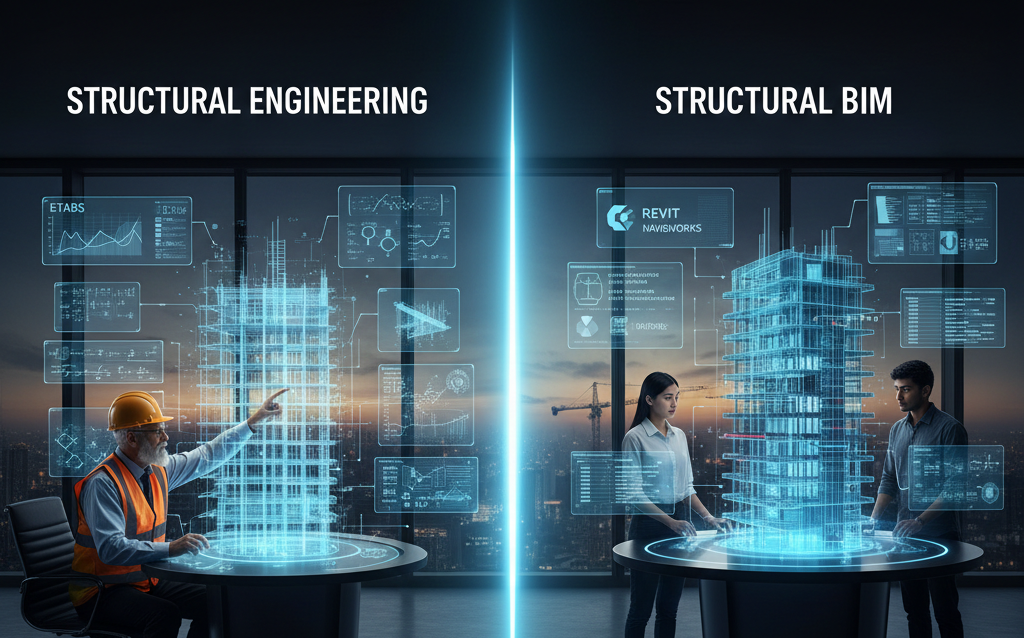
| Aspect | Structural Engineering | Structural BIM |
| Primary Focus | Design & safety | Modeling & documentation |
| Engineering Decisions | Yes | No |
| Tools Used | ETABS, STAAD, SAFE | Revit, Navisworks |
| Responsibility | Structural performance & safety | Accurate BIM models & drawings |
| Education | Civil / Structural Engineering degree | BIM & software-based training |
| Role in Project | Designs the structure | Represents the design digitally |
Final Thoughts
BIM is a powerful and fast-growing career path, especially in international construction markets. But it is not a replacement for structural engineering.
At BIM Cafe Learning Hub, our Professional BIM Course is designed to:
- Make you job-ready for BIM roles
- Train you in real project workflows
- Prepare you for modeling, coordination, and documentation careers
We believe in honest, transparent training that reflects real industry expectations—not marketing promises.