Author: Devika R
January 21, 2026
11 min read
Why Point Cloud to BIM Technology Matters in 2026
In the past decade, the construction and infrastructure industry has witnessed an unprecedented shift toward digital workflows. Among these, Point Cloud to BIM Technology has emerged as a cornerstone for both renovation and new construction projects. For BIM Coordinators, engineers, and surveyors, understanding how raw scan data transforms into usable BIM models is no longer optional — it’s essential.
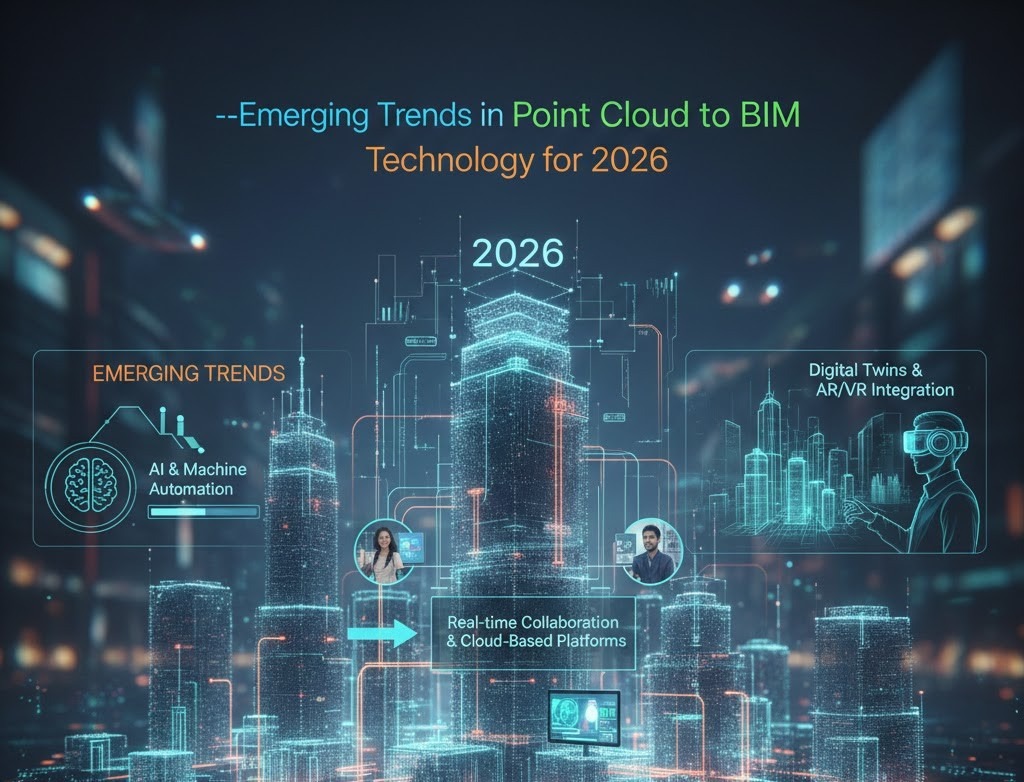
By 2026, the combination of AI-assisted automation, cloud processing, and interoperability standards is set to make point cloud workflows faster, more accurate, and more accessible. This article explores emerging trends, practical workflows, and actionable strategies to stay ahead in the evolving Point Cloud to BIM landscape.
What Is Point Cloud to BIM Technology?
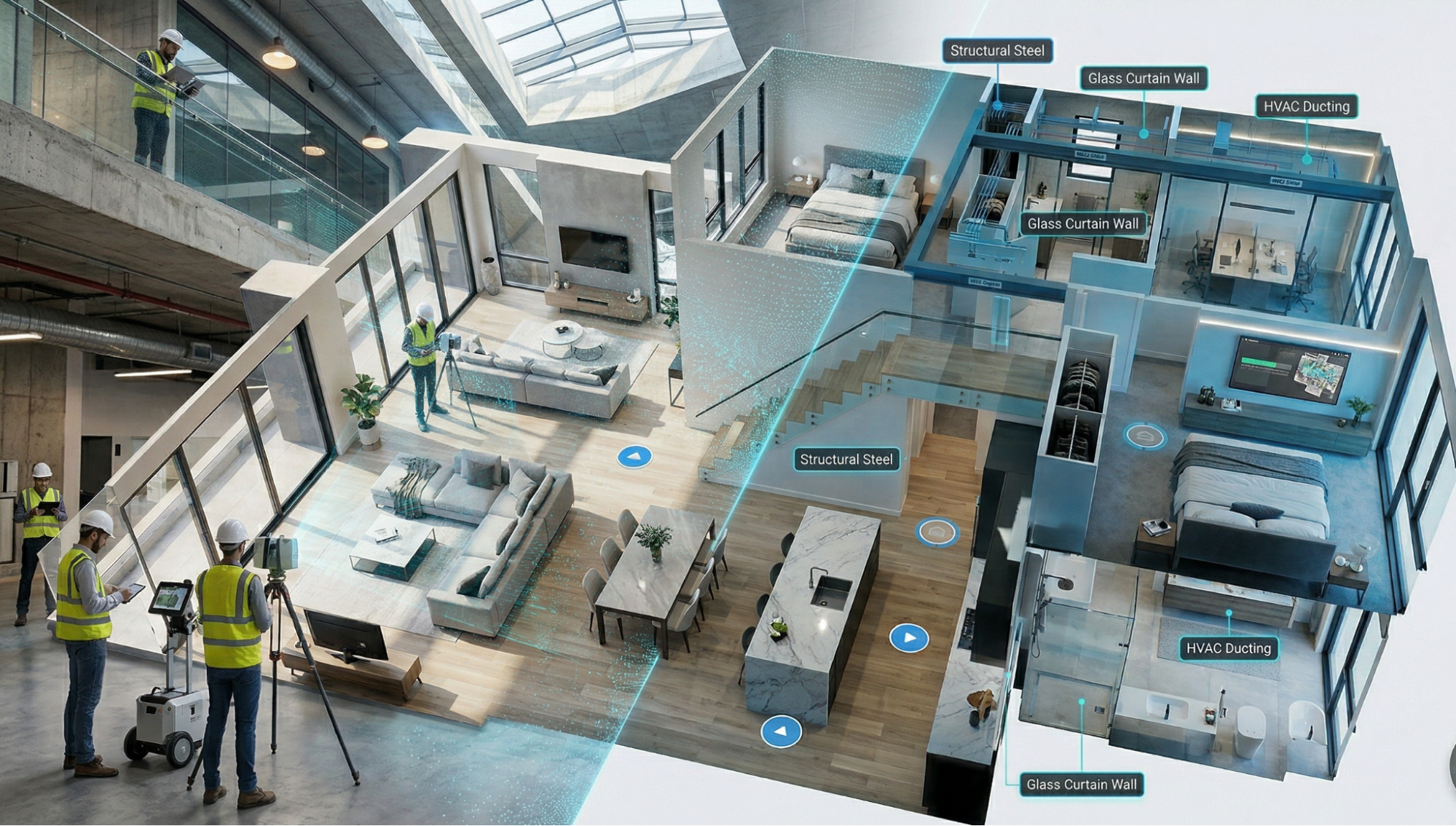
Point clouds are dense collections of spatial data captured through scanning technologies such as terrestrial LiDAR, drones, and mobile scanning systems. Each point records precise 3D coordinates, capturing real-world geometry down to millimeter-level accuracy.
Point Cloud to BIM Technology refers to the process of converting these dense point clouds into structured, information-rich BIM models that can be used for design, coordination, construction, and asset management. This process involves several steps:
- Preprocessing the point cloud data to remove noise and redundant points
- Segmenting and classifying objects such as walls, slabs, and MEP elements
- Translating these segments into BIM authoring tools (e.g., Revit, Archicad, Tekla)
- Validating models against project standards, LOD requirements, and coordination needs
Understanding this workflow is critical for BIM Coordinators, as it bridges the gap between survey data and actionable BIM models.
Evolution of Point Cloud to BIM: From Manual Modelling to Intelligent Automation
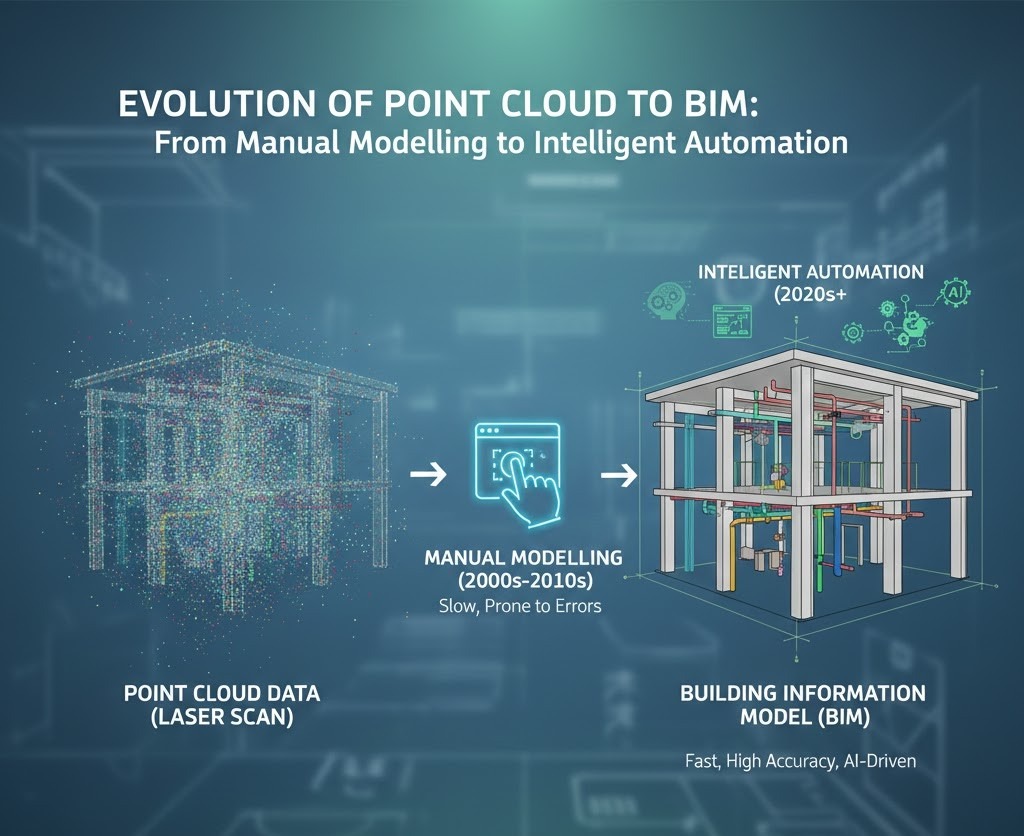
Initially, Point Cloud to BIM processes were manual and time-consuming. Professionals traced over scanned data to create BIM elements — a painstaking process prone to errors. Over time, semi-automated tools emerged, allowing object recognition and rule-based model generation.
In 2026, workflows are increasingly AI-assisted, combining automation with human validation. This hybrid approach accelerates modelling, reduces manual errors, and allows BIM Coordinators to focus on model quality, LOD compliance, and cross-disciplinary coordination rather than repetitive drafting.
Key Point Cloud to BIM Technology Trends Shaping 2026
1. AI-Driven Object Recognition & Classification
Artificial Intelligence is revolutionising point cloud processing. Modern algorithms can identify structural elements, MEP components, and architectural features directly from scanned data. While AI accelerates modelling, it still requires human oversight, especially for complex geometries and areas with noisy scans.
2. Automation With Human Validation Models
Automation now handles repetitive modelling tasks, but BIM Coordinators play a critical role in validating geometry, checking standards, and ensuring interoperability. This hybrid approach improves productivity while maintaining model integrity.
3. Improved Accuracy Through Multi-Sensor Data Fusion
Point cloud data can now be collected using multiple sensors — terrestrial LiDAR, drone photogrammetry, and mobile scanning. Combining these datasets produces more complete, accurate models while reducing blind spots. Coordinators must manage these multi-source datasets carefully to ensure smooth BIM integration.
4. Standardised LOD & BIM Execution Alignment
Project teams increasingly align Point Cloud to BIM outputs with Level of Development (LOD) specifications and BIM Execution Plans (BEPs). This ensures that models meet design, construction, and handover requirements consistently across disciplines.
5. Integration With Digital Twins & Asset Management Platforms
Point Cloud to BIM models are no longer limited to design. They now feed into digital twins and asset management platforms, providing a foundation for predictive maintenance, lifecycle planning, and facility management. Coordinators must understand how these models will be used downstream.
Role of BIM Coordinators in Point Cloud to BIM Projects (2026 Perspective)
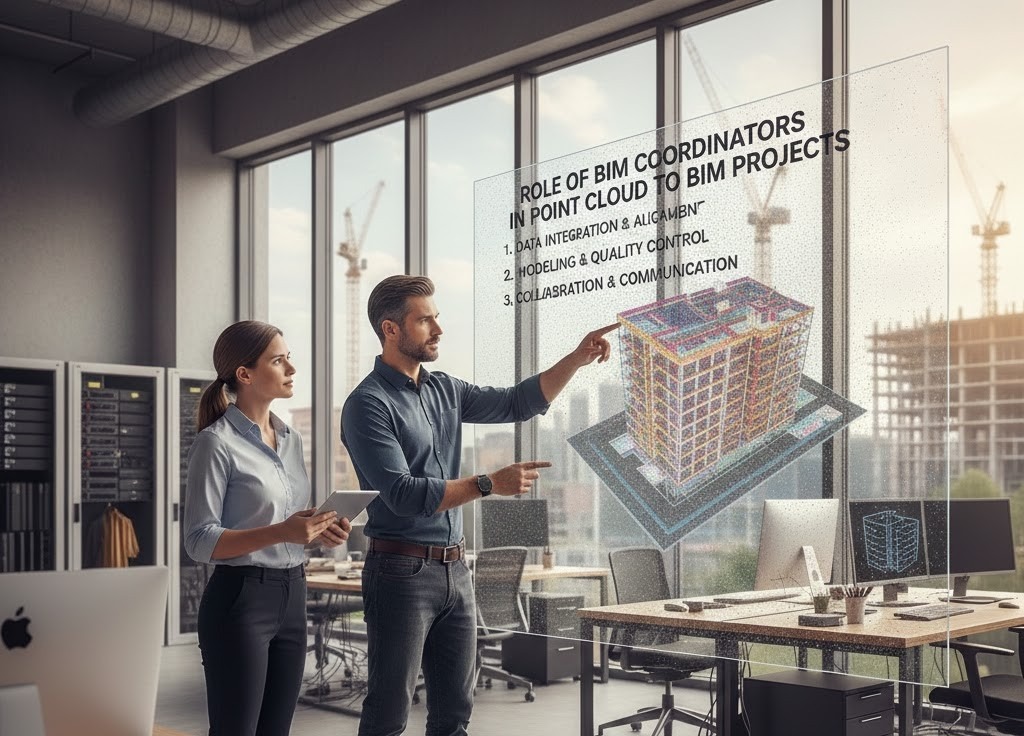
BIM Coordinators remain central to successful Point Cloud to BIM workflows. Key responsibilities include:
- Scan validation: Ensuring data quality before modelling
- Model structuring: Creating clash-ready, LOD-compliant models
- Interoperability checks: Maintaining standards and IFC compliance
- Team coordination: Bridging surveyors, designers, and project managers
By combining technical expertise with process knowledge, coordinators ensure that point cloud data becomes actionable BIM information.
Common Challenges Still Facing Point Cloud to BIM Technology
Despite technological advances, challenges remain:
- Data noise: Scans often contain redundant or distorted points
- Over-automation assumptions: AI cannot replace human judgment
- Interoperability gaps: Not all tools communicate seamlessly
- Skill gaps: Teams often lack experience in processing and validating complex point cloud datasets
Recognising these challenges early allows BIM Coordinators to plan workflows that mitigate risks.
Best Practices for Adopting Point Cloud to BIM Technology in 2026

To successfully adopt Point Cloud to BIM Technology, follow these practices:
- Define modelling intent before scanning: Know LOD requirements and downstream use
- Select tools based on workflow needs: Avoid overloading teams with multiple platforms
- Set validation checkpoints: Include quality control and review steps
- Align outputs with project requirements: Ensure models are suitable for coordination, design, or FM
Implementing these practices ensures models are usable, accurate, and valuable across all stages of the project.
Software & Platforms Supporting Point Cloud to BIM Workflows
While avoiding tool promotion, it’s important to understand categories:
- Scan processing platforms: For noise removal, meshing, and preprocessing
- BIM authoring tools: Revit, Archicad, Tekla for model creation
- Coordination & validation tools: Navisworks, Solibri for clash detection
- AI-assisted add-ons: Plugins or software extensions for object recognition and classification
Selecting software that fits your workflow and project goals is more important than using every tool available.
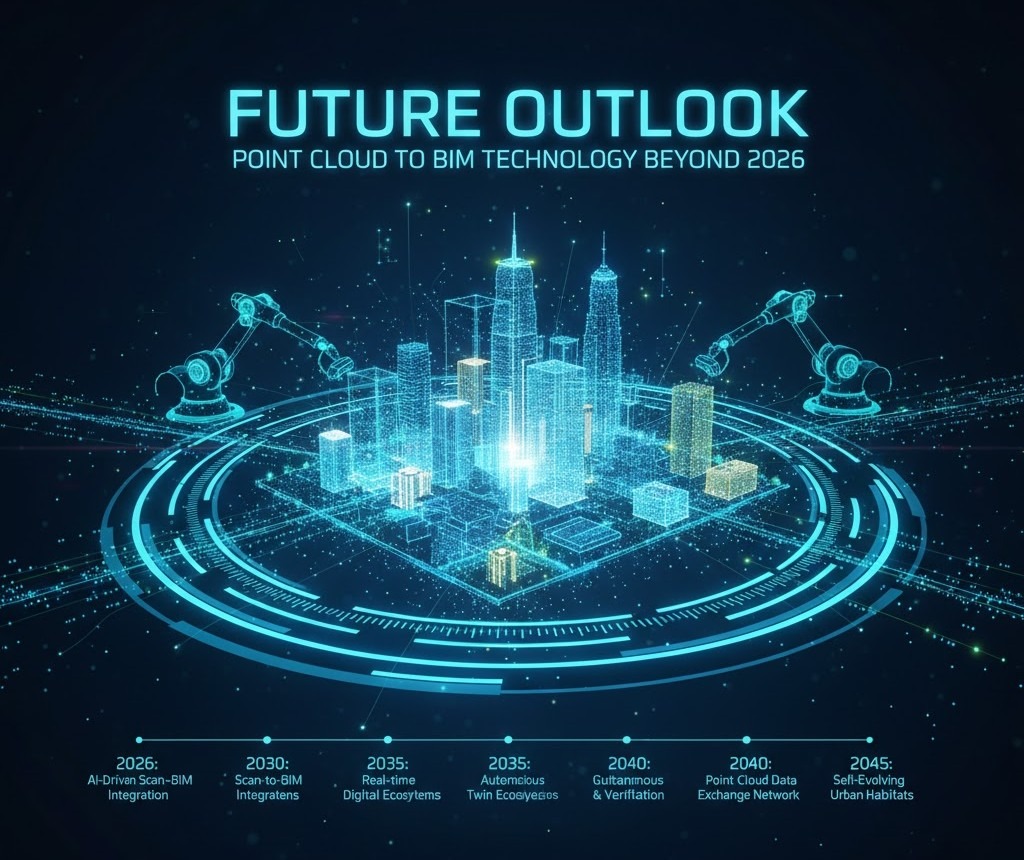
Future Outlook: Where Point Cloud to BIM Technology Is Headed Beyond 2026

Looking forward, we can expect:
- Greater semantic intelligence: AI will classify complex elements with higher accuracy
- Tighter BIM–FM integration: Models will be directly usable in facility management platforms
- Further automation: Reduced modelling time without compromising quality
- Increased demand for skilled coordinators: Automation won’t replace human decision-making
The role of the BIM Coordinator will evolve, but remain indispensable.
Why Point Cloud to BIM Technology Is a Core BIM Skill, Not a Niche Tool
Point Cloud to BIM Technology is no longer a niche skill; it’s central to modern construction, retrofits, and digital twin initiatives. Success depends not on having the latest software but on understanding workflows, validating data, and coordinating multidisciplinary teams effectively.
What defines success in Point Cloud to BIM today is not access to advanced software alone, but a strong understanding of workflows, data validation, and multidisciplinary coordination.
For aspiring BIM professionals and coordinators in 2026, mastering Point Cloud to BIM means developing a balanced skill set that combines technical capability with process awareness. This is where structured, industry-aligned learning environments such as BIM Cafe Learning Hub play a critical role. By focusing on real project workflows, coordination standards, and practical deliverables, BIM Cafe Learning Hub ensures learners understand how point cloud data is used within live BIM ecosystems—not just how it is converted into geometry.