Author: Devika R
January 27, 2026
7 min read
When Is the Internship?”
One of the most common questions BIM students ask—often within the very first week of training—is:
“When is the internship?”
It’s a genuine question.
And it’s an important one.
For many learners, an internship feels like the final missing piece between learning BIM and getting a job. They see it as proof that they’ve crossed from education into the professional world.
But here’s the uncomfortable truth most students discover too late:
In the BIM industry, the way internships actually work is very different from what most learners imagine.
This misunderstanding is one of the biggest reasons why many BIM learners finish courses with certificates—but still struggle to clear interviews or perform confidently on real projects.
This blog is written to give you absolute clarity, especially if your real goal is to become job-ready in BIM, not just certificate-ready.
What Do Students Usually Mean by “Internship”?
For most students—especially fresh graduates or engineers transitioning into BIM—the word internship usually means:
- Visiting a company office physically
- Sitting under a senior engineer or BIM manager
- Observing live projects from a distance
- Getting exposure to “how things work”
- Receiving an internship or experience certificate
In simple terms, the expectation is:
Physical presence + limited observation + certificate = internship
This model comes from traditional engineering disciplines where learning often happened through site visits, shadowing seniors, or time-based exposure.
However, BIM does not function like traditional site-based engineering roles.
And this is where the disconnect begins.
Why This Definition Doesn’t Work in BIM
BIM is not a role where learning happens by watching someone else work.
You cannot observe your way into BIM competence.
BIM roles are execution-heavy, software-driven, and delivery-focused. Your value is measured by what you can produce inside a model, not by how many hours you sat in an office.
In reality:
- Sitting next to a BIM engineer does not teach you LOD compliance
- Watching coordination meetings does not build clash-resolution skills
- Holding an internship certificate does not prove execution capability
This is why many students complete “internships” yet still feel lost when asked to:
- Create coordinated BIM models
- Produce construction-ready drawings
- Handle real project standards
- Respond to coordination comments
The industry sees this gap very clearly—even if students don’t.
How the BIM Industry Actually Hires
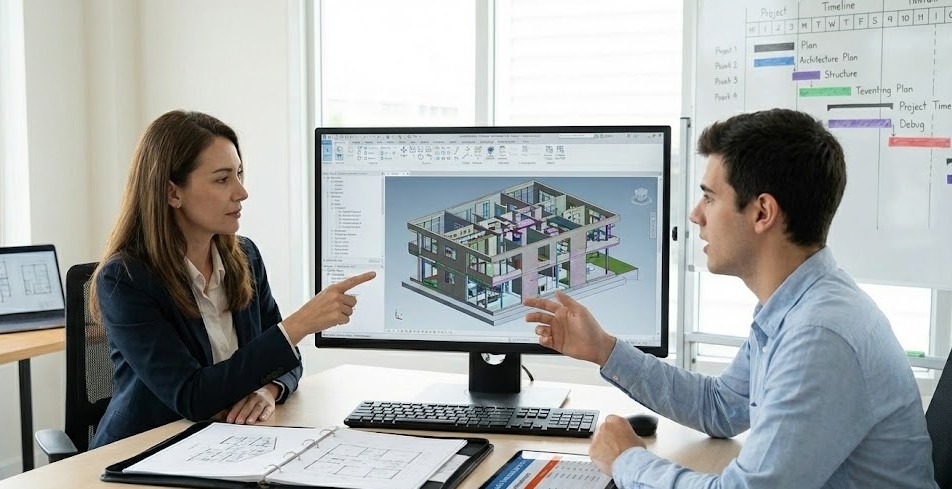
In BIM-driven markets such as the Middle East, the US, Europe, and Australia, companies do not hire based on internship letters or course completion certificates.
They hire based on execution confidence.
When recruiters and BIM managers evaluate candidates, they focus on one core question:
Can this person contribute to a live BIM project from day one?
What they actually assess includes:
- Your Revit skill depth, not surface-level tool knowledge
- Your understanding of LOD 300 and LOD 350 expectations
- Your ability to produce usable BIM deliverables, not academic models
- Your familiarity with real project workflows and naming standards
- Your mindset towards coordination, accuracy, and responsibility
If you cannot open a live BIM model and work confidently within it—
no internship certificate, recommendation letter, or course brochure can compensate for that gap.
The Core Reality Students Must Accept
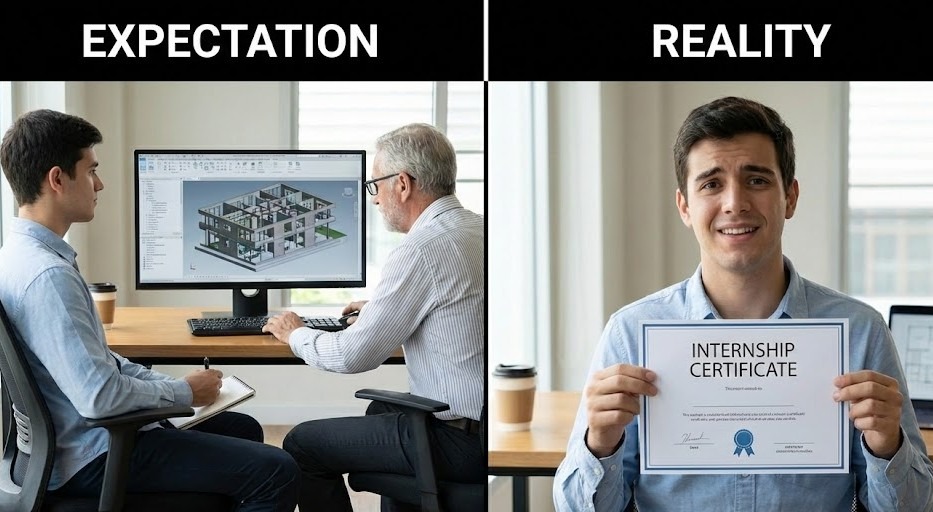
In BIM, your work speaks louder than your paperwork.
The industry does not ask:
- “Where did you intern?”
It asks:
- “What have you worked on?”
- “What level of detail have you handled?”
- “Can you show project-based outputs?”
Understanding this early can save months of confusion—and years of career stagnation.
And this is exactly why redefining what internship means in BIM is critical before choosing any course or training path.
Why Traditional Internships Often Fail BIM Students
On paper, internships sound like the right next step after completing a BIM course.
In reality, most traditional internships fail to prepare students for actual BIM roles.
The reason is simple:
they are designed around time spent, not work executed.
Most conventional internships today are:
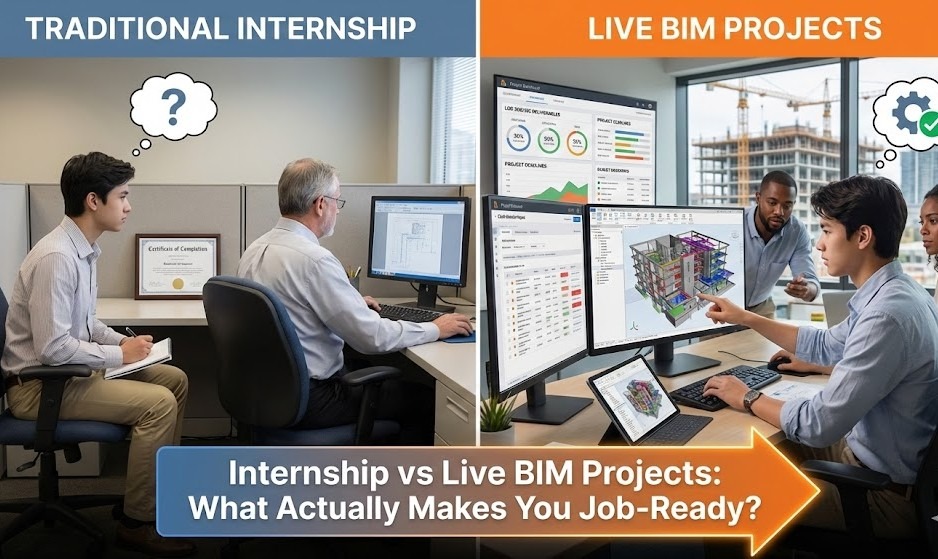
- Observation-based, where students only watch ongoing work
- Short-term, typically lasting just 2–4 weeks
- Responsibility-free, with no ownership of tasks
- Disconnected from LOD standards, especially LOD 300 and LOD 350
- Certificate-focused, rather than skill-focused
Students may attend meetings, see large BIM models on screens, or sit beside senior engineers—but they are rarely allowed to touch the live project environment.
What Students Actually Experience
- They see models, but don’t build them
- They hear coordination discussions, but don’t resolve clashes
- They observe workflows, but don’t execute deliverables
The Result?
Once the internship ends, most students face the same challenges:
- Low confidence when opening a real BIM model alone
- High interview anxiety, especially during technical rounds
- Overwhelm when assigned actual BIM tasks
- Difficulty explaining what they personally worked on
This is why many BIM learners say:
“I did an internship, but I still don’t feel job-ready.”
The issue is not the student.
The issue is how internships are defined in BIM.
So What Actually Works in BIM?

Live Industry Project–Based Internship
In BIM, execution builds employability—not observation.
Instead of placing students in offices to watch projects,
the effective model is to put students inside real projects with structured guidance.
A true BIM internship should answer one question clearly:
Can the student deliver real BIM outputs aligned with industry standards?
This is where live industry project–based internships become critical.
How BIM Cafe Defines a Real BIM Internship
At BIM Cafe Learning Hub, an internship is not a formality at the end of a course.
It is the final execution phase of professional BIM training.
Internship at BIM Cafe means:
- Working on actual Middle East and US BIM projects
- Practising LOD 300 and LOD 350 modelling, not theoretical levels
- Following real industry standards, naming conventions, and workflows
- Producing usable BIM deliverables, not academic models
- Executing tasks under technical mentorship, just like in professional teams
This is not a demo environment.
This is not a simulation.
It is real project exposure, structured to match how BIM professionals actually work on live jobs.
BIM Cafe’s 3-Month Professional BIM Program Structure
The program is carefully structured to move learners through three critical stages:
learning → execution → job readiness
Each phase prepares the student for the next—without skipping fundamentals or rushing exposure.
🔹 Month 1 to 1.5: Core BIM Foundation & Tool Confidence
This phase focuses on building strong fundamentals before touching live projects.
Key outcomes include:
- In-depth Revit training, aligned with industry usage
- Residential and building-level 3D modelling
- Discipline-wise workflows (Architecture / Structure / MEP)
- Understanding how models are structured—not just created
- Developing tool confidence, accuracy, and discipline discipline
This ensures students are not overwhelmed later when real project pressure begins.
🔹 Next 15 Days: Coordination & Project Environment Exposure
Once modelling confidence is established, students move into coordination tools and environments.
This phase covers:
- Navisworks for coordination fundamentals
- Introduction to clash detection and issue understanding
- Exposure to ACC / BIM 360, simulating real project environments
- AutoCAD for supporting documentation workflows
- Understanding how multiple tools work together in BIM delivery
Students begin thinking beyond “my model” and start understanding project-wide coordination.
🔹 Final 1 Month: Live BIM Project Internship (Execution Phase)
This is where the transformation happens.
During the final month, students work on:
- Real industry BIM projects
- LOD 300 & LOD 350 deliverables, not practice files
- Projects aligned with Middle East and US standards
- Execution-driven tasks with accountability and review cycles
- Real timelines, revisions, and coordination expectations
👉 This phase is what BIM Cafe defines as a BIM internship.
Not observation.
Not attendance.
But execution under guidance, exactly the way BIM professionals are evaluated in the industry.
The Key Difference Students Must Understand
In BIM:
- Internships are not about where you sit
- They are about what you can deliver
And that difference determines whether you feel confident—or stuck—after training.
Why We Don’t Offer 6-Month Internships
The idea that longer internships automatically lead to better jobs is a common misconception in the BIM space.
In reality, the BIM industry does not measure readiness by time spent—it measures readiness by execution ability.
Here’s the ground truth:
- BIM companies do not expect freshers to intern for six months
Employers know that a fresher’s role is to support production—not to slowly “learn by sitting.” What they expect is baseline execution capability from day one. - Long internships delay employability instead of improving it
Spending six months observing workflows or doing repetitive, low-impact tasks does not increase job confidence. It only postpones real responsibility. - Duration does not equal competence
A student can spend six months in an office and still struggle to:
- Build models independently
- Follow LOD standards
- Understand coordination workflows
- Deliver usable BIM outputs
- Build models independently
In BIM hiring, what you can do today matters more than how long you stayed somewhere.
What Actually Matters to Employers
When recruiters assess a BIM fresher, they look for three things:
✔ What you can execute
Can you model, coordinate, and deliver according to project standards?
✔ How confidently you can work
Can you handle tasks without constant hand-holding?
✔ Whether you understand real workflows
Do you know how BIM is executed across disciplines and stages?
A focused, project-driven internship develops these skills faster and more effectively than long, passive internships ever can.
Final Takeaway for BIM Students
If your goal is:
✔ To clear technical BIM interviews
✔ To work confidently on real projects
✔ To handle international BIM standards (Middle East, US, Europe)
Then what you need is not an internship letter.
What you need is:
👉 Live BIM project experience
Because interviews don’t ask:
“How many months was your internship?”
They ask:
“What BIM work have you actually done?”
That is exactly what BIM Cafe Learning Hub delivers—
by training students inside real project workflows, not outside them.
The outcome is simple:
- Stronger interviews
- Higher confidence
- Faster transition from learner to professional