Author: Devika R
August 31, 2026
8 min read
1. What If the BIM Model Is Going to a Factory?
Think about the traditional construction workflow.
- Design
- BIM
- Coordination
- Construction
Now imagine a different scenario.
The wall panel isn't built piece by piece on site.
It is manufactured in a controlled facility, transported to the project and assembled there.
An MEP module is coordinated digitally before it reaches the site.
A bathroom pod is manufactured almost as a finished unit.
Structural components are produced according to digital information and delivered when they are needed.
Suddenly, the BIM model has another responsibility.
It isn't only helping people understand what to build.
It may also need to help determine how something will be manufactured, transported and assembled.
This is where Design for Manufacturing and Assembly (DfMA) enters the conversation.
And it is becoming an increasingly important topic in industrialised construction.
BIMForum's 2026 DfMA Symposium is specifically focused on moving from concept to reality, including fabrication-ready information, off-site production, digital handoffs and integration between design, manufacturing and site delivery.
2. What Exactly Is DfMA?
Design for Manufacturing and Assembly means considering how building components will be manufactured and assembled while they are still being designed.
That sounds simple.
But it changes the way teams approach design.
Instead of asking only:
“Does this design work?”
Teams also start asking:
“Can this component be manufactured efficiently?”
“Can it be transported?”
“Can it be installed on site?”
“What information does the fabricator need?”
“Can the design be repeated and produced consistently?”
That shift connects design, BIM, fabrication and construction much earlier in the project.
3. Why Is This Becoming Important Now?
Construction is under pressure to deliver projects with greater predictability, efficiency and quality.
At the same time, the industry is dealing with:
- Labour shortages
- Tight project schedules
- Rising material costs
- Waste reduction targets
- Increasing project complexity
- Demand for better quality control
Industrialised construction, including prefabrication, modular construction and off-site manufacturing, is one response to these challenges.
Autodesk's current research on industrialised construction highlights DfMA, productisation and prefabrication as key components of this shift, with BIM and other digital technologies helping enable the approach.
But DfMA isn't simply about moving construction into a factory.
The design process itself has to change.
4. The BIM Model Gets a New Job
In a conventional workflow, a BIM model might primarily support:
- Design
- Coordination
- Documentation
With DfMA, the information may need to continue further:
- Design
- Coordination
- Fabrication
- Manufacturing
- Assembly
That means the model and its associated information may need to communicate requirements that are much closer to production.
For example:
- Exact dimensions
- Connections
- Materials
- Component identifiers
- Fabrication requirements
- Tolerances
- Assembly information
- Installation sequence
The model therefore becomes part of a digital handoff between design and production.
5. From Design Intent to Fabrication-Ready Information
This is one of the most important changes.
A design model communicates design intent.
A manufacturing workflow needs information that is reliable enough to support production.
These aren't necessarily the same thing.
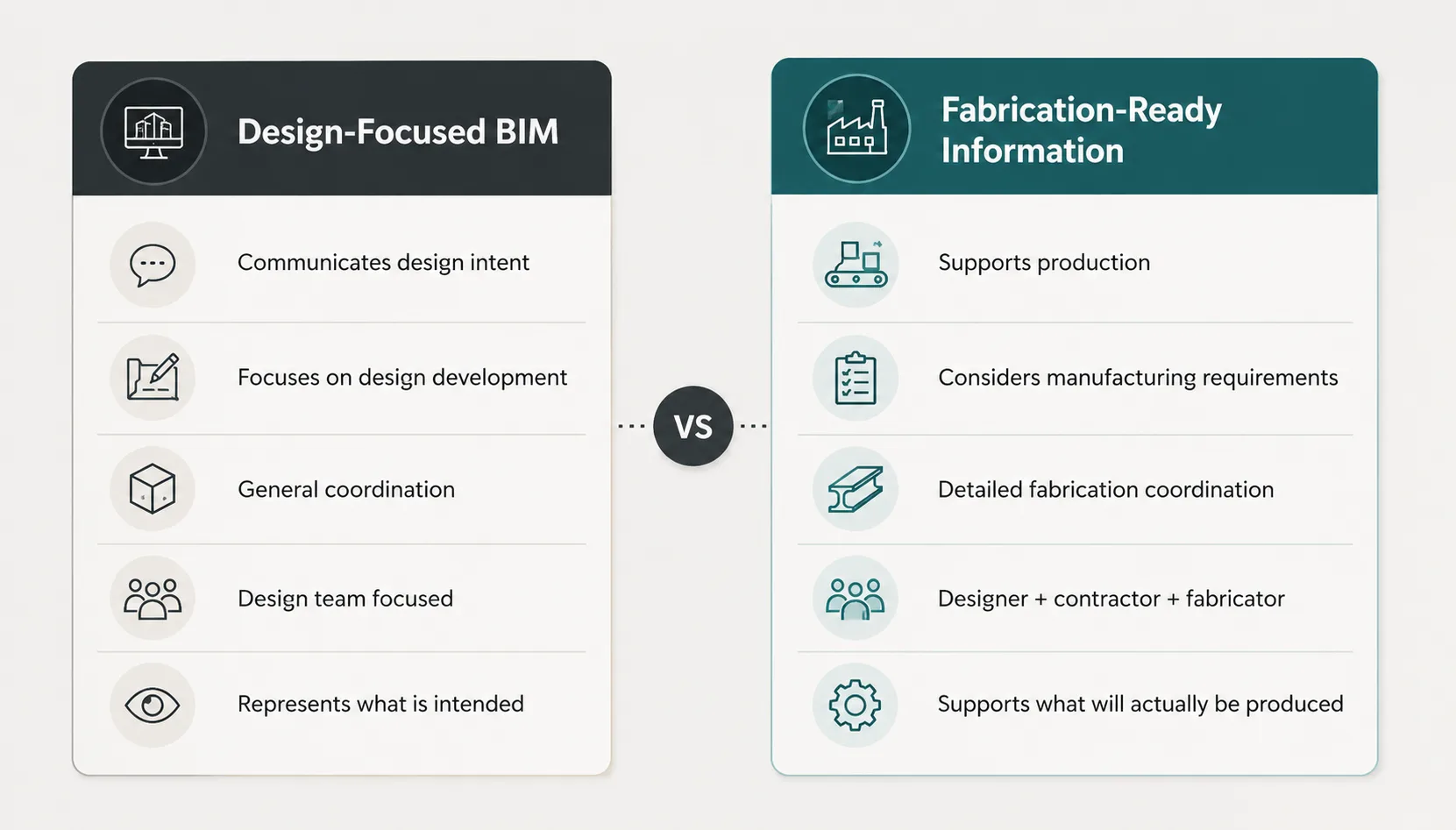
The goal isn't simply to create more detailed models.
It is to create the right information at the right stage for the people who need it.
That distinction is critical.
6. A Simple Example: An MEP Module
Imagine an MEP service module that will be assembled off-site.
The process might look like:
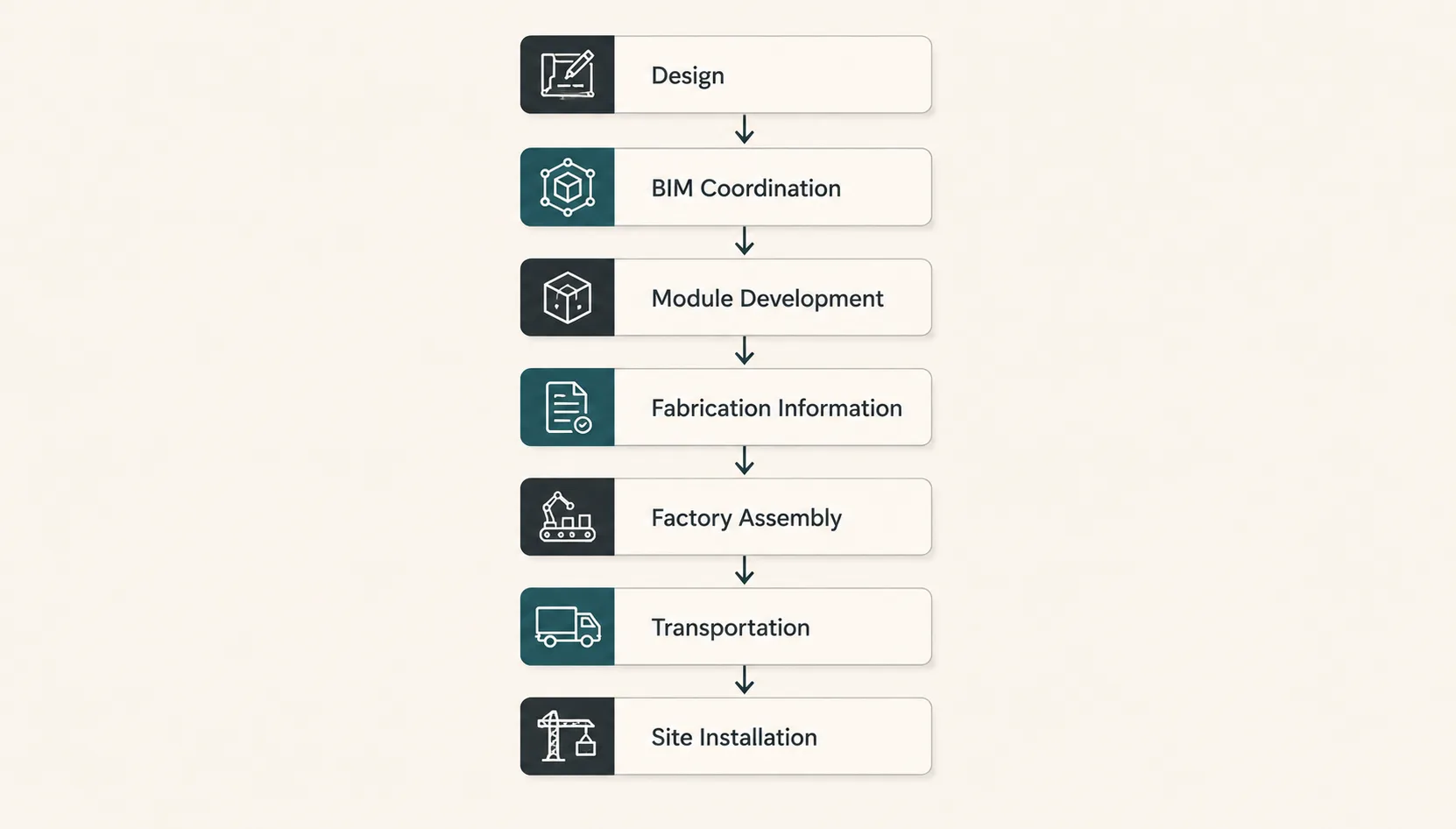
The BIM environment can help teams coordinate the module before it reaches the factory.
But the model alone doesn't solve everything.
The team also needs to consider:
- Manufacturing constraints
- Access
- Connections
- Transportation dimensions
- Installation sequence
- Site conditions
- Tolerances
A component that works perfectly in a digital model may still be difficult to manufacture or install.
That is why DfMA needs collaboration, not just software.
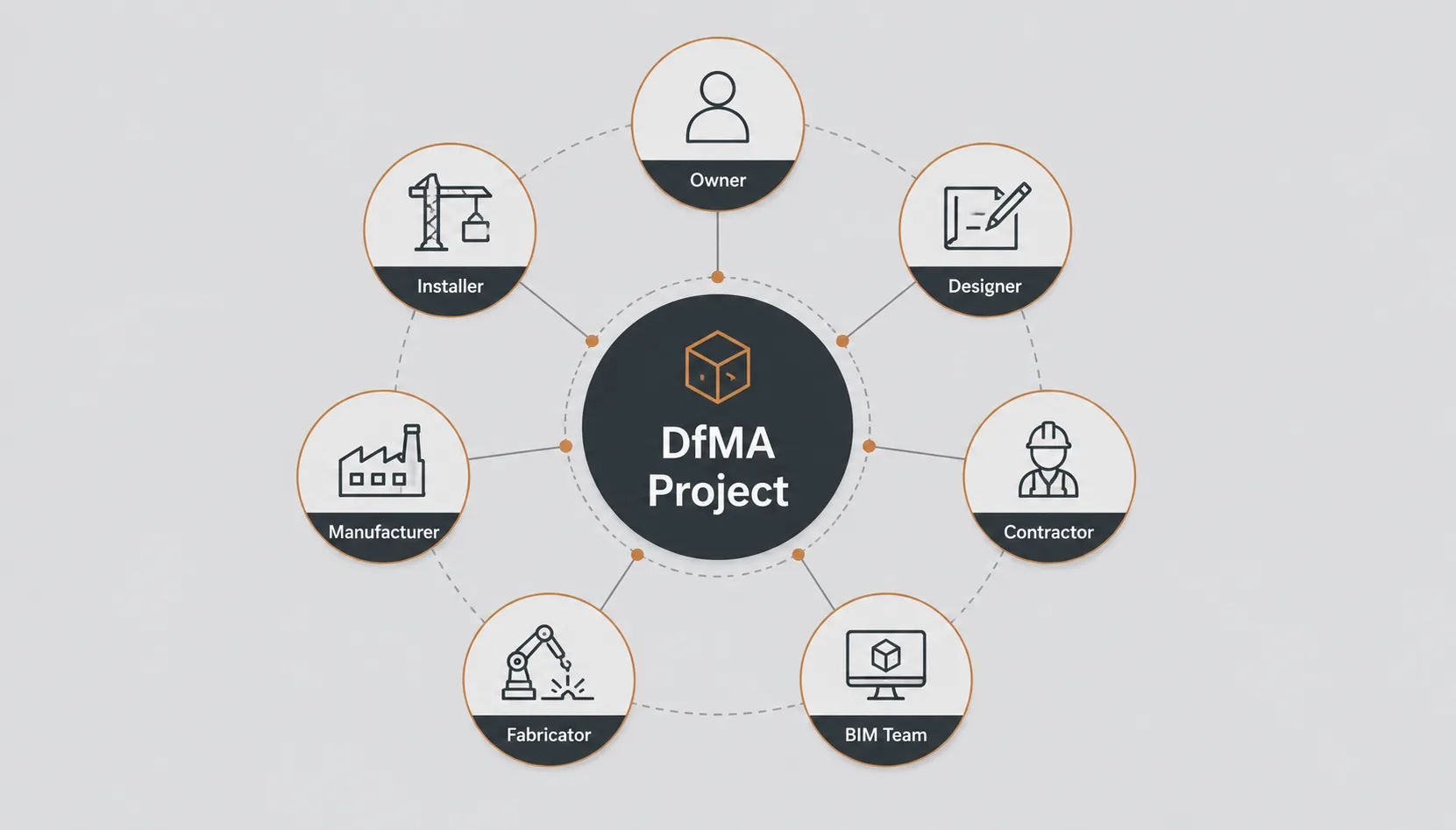
7. The Project Team Gets Bigger
Traditional design coordination may involve:
Architect + Structural Engineer + MEP Engineer
A manufacturing-driven project can bring additional stakeholders into the process:
- Owner
- Designer
- Contractor
- BIM Team
- Fabricator
- Manufacturer
- Installer
Each stakeholder brings a different requirement.
The fabricator knows what can realistically be produced.
The contractor understands site constraints.
The manufacturer understands production capabilities.
The installer understands what can actually be assembled on site.
DfMA brings these perspectives closer to the design process.
BIMForum's current DfMA programme explicitly brings together owners, designers, contractors, fabricators, manufacturers and BIM/digital delivery leaders around this wider workflow.
8. Does DfMA Mean Every Building Becomes Modular?
No.
DfMA exists on a spectrum.
It can involve:
- Individual prefabricated components
- Single-trade assemblies
- Multi-trade assemblies
- Modular systems
- Volumetric modules
- Larger industrialised building systems
So DfMA doesn't necessarily mean an entire building arrives on a truck.
A project may simply use manufacturing and assembly principles for selected components.
That flexibility is one reason the approach can apply across different project types.
9. What Changes for BIM Professionals?
This is where the discussion becomes particularly relevant for students and working professionals.
If construction becomes increasingly manufacturing-driven, BIM professionals may need to understand more than conventional modelling.
Skills can extend toward:
Fabrication Awareness
Understanding how modelled components are actually manufactured.
Constructability
Considering whether a digital solution can realistically be built and installed.
Information Accuracy
Understanding that incorrect dimensions or missing information can affect production—not just the model.
Coordination
Working with designers, contractors and fabricators before fabrication begins.
Digital Handoffs
Understanding how information moves from one team or platform to another.
Sequencing
Considering how components will be manufactured, transported and assembled.
The important point is:
The BIM professional doesn't necessarily become a manufacturer.
But understanding manufacturing constraints can make their digital work much more useful.
10. More Detail Isn't Always Better
Here's a misconception worth challenging.
If a project requires fabrication-ready information, you might assume the answer is simply:
“Model everything in extreme detail.”
Not necessarily.
Over-modelling can create unnecessary work, larger files and information that nobody actually needs.
The better question is:
What level of information is required for this decision or deliverable?
This connects DfMA directly with BIM information management and Level of Development (LOD).
BIMForum's LOD framework is designed to communicate the content and reliability of model elements at different project stages, helping downstream users understand what they can reasonably rely on.
So DfMA isn't about maximum detail.
It's about usable information.
Where Does BIM Fit in the DfMA Workflow?
A simplified workflow could look like this:
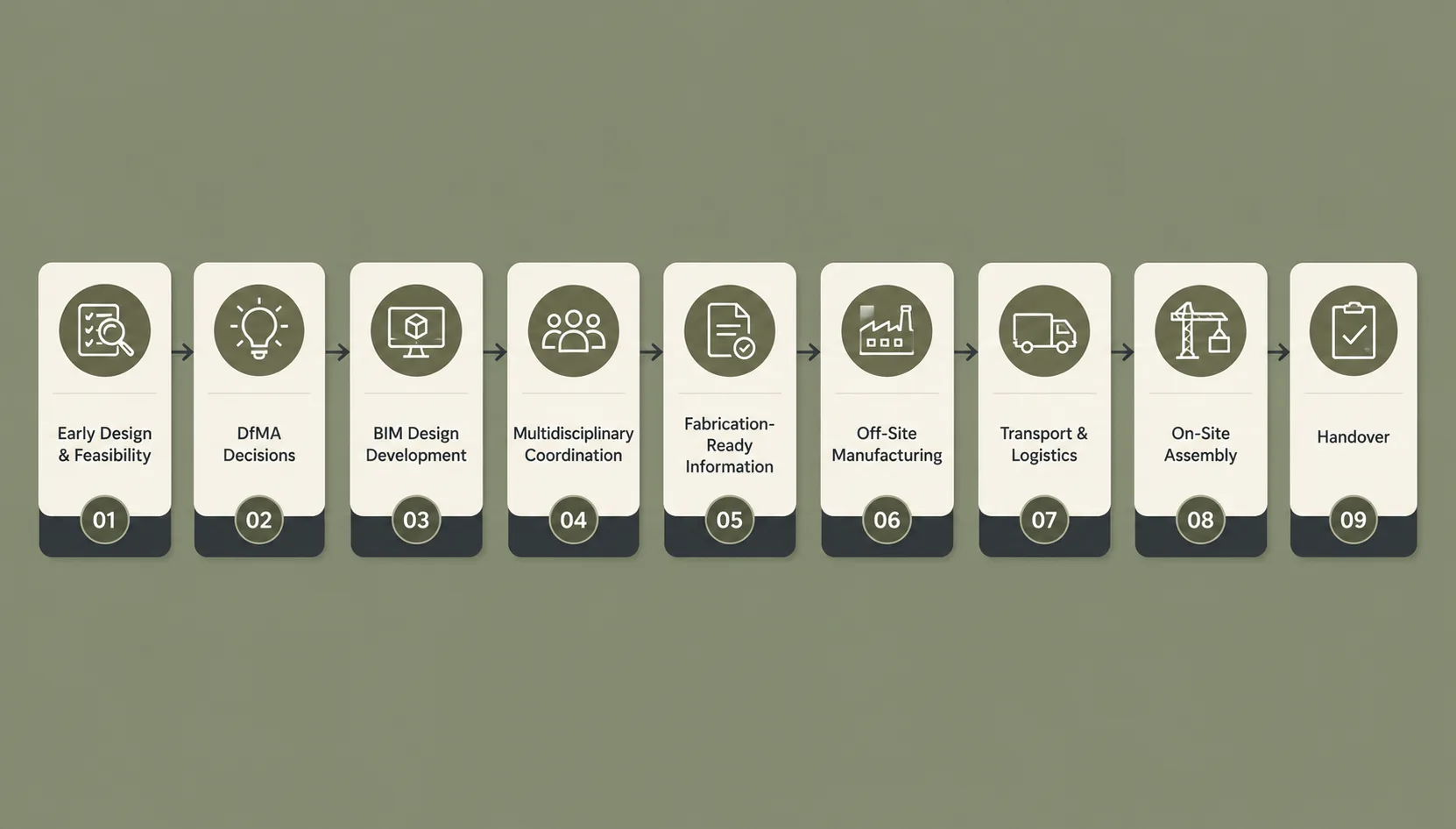
The earlier manufacturing and assembly requirements are considered, the fewer late-stage surprises teams may face.
That's one of the central ideas behind the current DfMA discussion.
11. What Could Go Wrong?
DfMA isn't automatically successful simply because a project uses BIM.
Problems can arise when:
- Manufacturing decisions happen too late
- Design teams don't understand fabrication constraints
- Information isn't standardised
- Fabricators receive incomplete information
- Procurement isn't aligned with design
- Site logistics are ignored
- Tolerances aren't properly considered
- Digital handoffs break down
BIMForum's current DfMA programme specifically highlights the need to align procurement, information standards, contractual frameworks, coordination and digital handoffs rather than treating DfMA as a software exercise.
That's an important distinction.
12. Is DfMA the Future of Construction?
It's too early—and too simplistic—to say that every construction project will become fully industrialised.
But the direction is clear.
More projects are exploring:
Prefabrication
Modular construction
Off-site manufacturing
Fabrication automation
Model-based production
Digital handoffs
The bigger shift is not necessarily from “construction” to “factories.”
It is from building everything as a one-off site activity toward finding parts of construction that can be designed, standardised, manufactured and assembled more efficiently.
13. What Should BIM Students Take From This?
You don't need to become a DfMA specialist simply because the industry is discussing it.
But there is a valuable lesson here.
When you model a wall, duct, structural element or equipment assembly, don't think only about how to create it in software.
Think:
Where will this information go next?
Will it be:
- Coordinated?
- Documented?
- Fabricated?
- Procured?
- Installed?
- Handed over?
That mindset prepares you for a BIM industry where digital information increasingly connects the entire delivery process.
14. The Bigger Shift: From Model to Product
Traditional BIM thinking often focuses on:
“Let's create a digital model of the building.”
DfMA introduces another perspective:
“Let's use digital information to help deliver the building more efficiently.”
That's a subtle but important difference.
The model becomes part of a broader system connecting:
Design + Engineering + Manufacturing + Construction + Information
And that is where BIM's role becomes much bigger than visualisation.
Final Thoughts
The next evolution of BIM may not be about making models look more impressive.
It may be about making those models more useful to the people who actually produce and assemble what has been designed.
DfMA brings BIM closer to the factory floor.
It connects design intent with manufacturing requirements, digital coordination with physical production, and models with real-world assembly.
For BIM professionals, that means one thing:
Knowing how to model is still important. Understanding what happens to that model next is becoming just as important.
The future BIM professional may not simply ask:
“How do I model this?”
They may increasingly need to ask:
“How will this be manufactured, delivered, assembled—and what information does everyone need to make that happen?”
That's where BIM moves from a model of construction to an enabler of how construction gets made.
Frequently Asked Questions
What is DfMA in construction?
DfMA stands for Design for Manufacturing and Assembly. It involves considering manufacturing and assembly requirements during design so components can be produced and installed more efficiently.
How is BIM related to DfMA?
BIM can provide the digital information and coordination environment needed to connect designers, contractors, fabricators and manufacturers and support the transition from design intent to fabrication-ready information.
Is DfMA the same as prefabrication?
No. Prefabrication is one form of off-site production. DfMA is a broader design approach that considers how components can be manufactured and assembled efficiently.
Does DfMA mean modular construction?
Not necessarily. DfMA can apply to individual components, single-trade assemblies, multi-trade assemblies, modular systems or larger volumetric modules.
What does DfMA mean for BIM professionals?
It increases the importance of understanding fabrication, constructability, information accuracy, coordination, tolerances, digital handoffs and assembly requirements alongside conventional BIM modelling skills.
Will DfMA replace traditional construction?
Not entirely. DfMA is better understood as an approach that can complement traditional construction by shifting suitable parts of the delivery process toward manufacturing, prefabrication and more controlled assembly.
Professional BIM Course
Master BIM Course
Structural Design Concepts and BIM
Certified MEPF BIM Master Course
Electrical BIM Professional Program
RenderLab – Master 3D Modeling & Photorealistic Rendering
Multi-Tool Mastery for Architects & Engineers
BIM Coordinator Workflow Program
BIM FastTrack – 30 Day Intensive Training
Global Architectural & Structural BIM Project Program