Author: Devika R
February 28, 2026
8 min read
The Question Students Rarely Ask (But Should)

Every week at BIM Cafe Learning Hub, students and fresh graduates ask familiar questions:
- “Which BIM course should I take?”
- “Is Revit enough to get a job?”
- “Do companies care about certificates?”
These are valid concerns. However, they miss the deeper issue that actually determines hiring success in today’s market.
The more important question — and the one many candidates overlook — is:
What do BIM recruiters actually look for when they hire in 2026?
Understanding this single point can completely change how you prepare for BIM jobs in 2026.
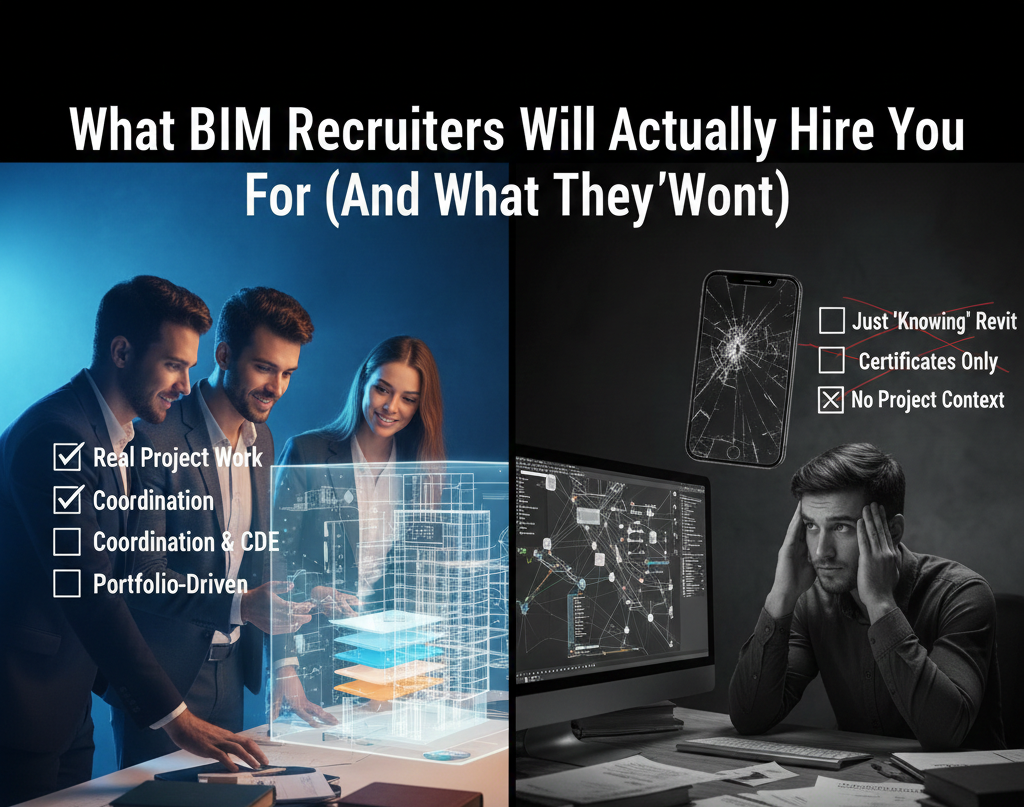
The industry has matured. Employers are no longer evaluating candidates purely on course completion or software familiarity. Instead, hiring decisions are increasingly based on practical output, workflow awareness, and project readiness.
In today’s competitive AEC environment:
- Companies prioritize execution over theory
- Recruiters assess real BIM workflow capability
- Technical interviews focus on deliverables, not just tools
- Portfolios often carry more weight than certificates
Simply put, organizations don’t hire based on what you studied — they hire based on what you can deliver inside a real project environment.
This shift is especially visible across global markets, where BIM teams must maintain high coordination accuracy and fast project turnaround. As a result, the skills BIM recruiters look for have become far more practical and performance-driven.
In this guide, you’ll clearly understand:
- What actually gets candidates hired in BIM
- What no longer impresses hiring managers
- How to prepare strategically for BIM jobs in 2026
- Where most freshers still make critical mistakes
If your goal is to align with real BIM recruiter expectations, the insights below will help you focus your effort where it truly matters.
First, a Reality Check About BIM Hiring
To understand modern hiring patterns, you must first look at the pressure BIM teams operate under.
In real-world projects — particularly across the Middle East, US, and other international markets — companies are constantly working to improve delivery efficiency and reduce coordination risks.
Today’s BIM environments demand teams that can:
- Deliver coordinated models faster
- Reduce clashes and documentation errors
- Improve multidisciplinary collaboration
- Control project cost and rework
- Maintain accurate, construction-ready deliverables
Because of these pressures, recruitment priorities have changed significantly.
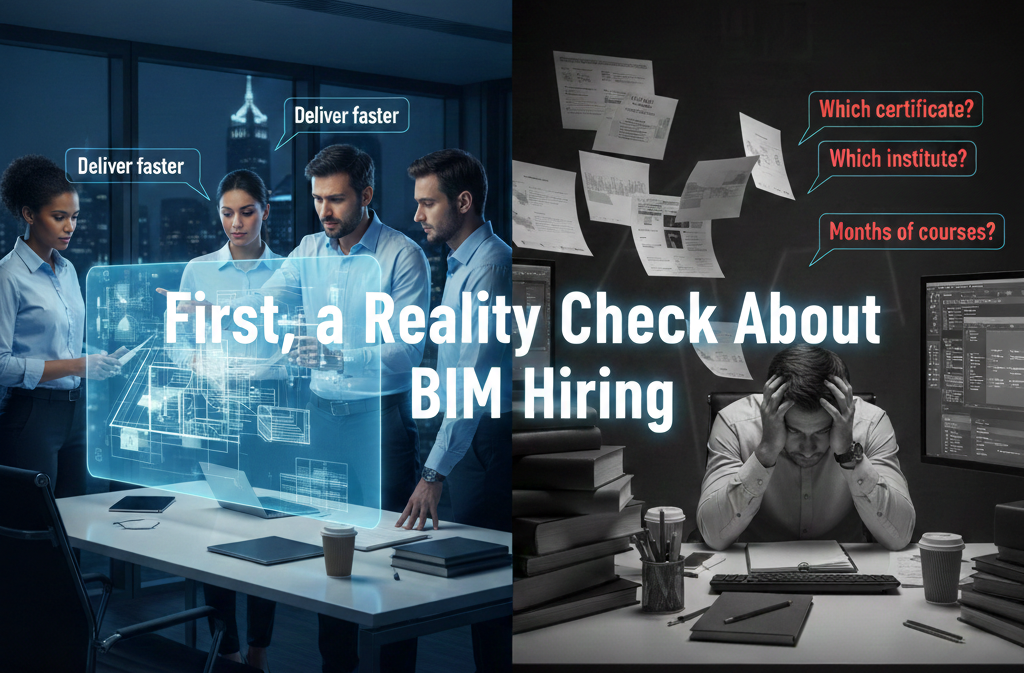
When companies evaluate freshers or junior BIM professionals, their primary internal question is now:
“Can this person contribute to the project from Day One?”
Notice what they are not asking first:
- “Which certificate does the candidate have?”
- “Which institute trained them?”
- “How many months was the course?”
This marks a major shift in BIM recruiter expectations.
Modern hiring managers assume that many candidates know basic software operations. What they are truly screening for is:
- Workflow understanding
- Model discipline
- Coordination awareness
- Deliverable readiness
- Problem-solving ability inside BIM environments
Students who recognize this shift early position themselves far better for BIM jobs in 2026.
Those who don’t often spend months collecting certificates but still struggle during technical interviews.
Understanding this reality is the first step toward preparing smartly — and standing out in an increasingly competitive BIM job market.
What BIM Recruiters WILL Hire You For
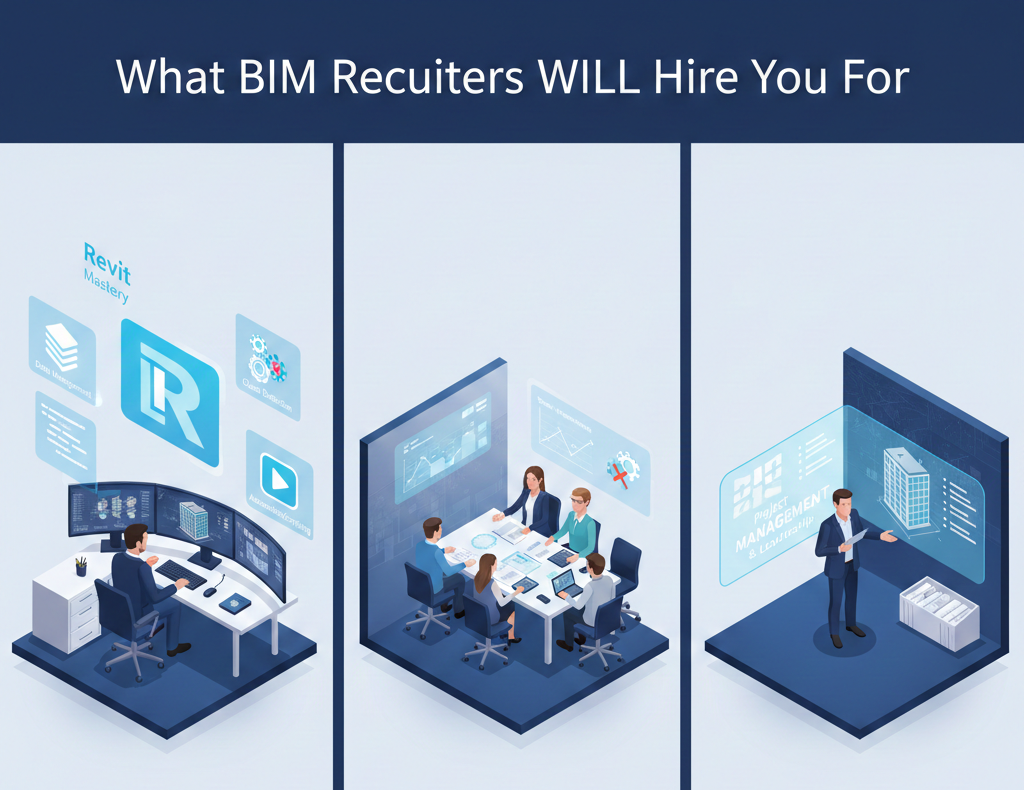
Understanding what BIM recruiters will actually hire you for in 2026 can dramatically improve your chances of landing interviews and offers. Hiring managers today evaluate practical capability far more than theoretical knowledge.
Below are the core areas that strongly influence BIM recruiter expectations and selection decisions.
1️⃣ Your Ability to Work Inside a Real BIM Model
One of the first things recruiters assess is whether you can function inside a structured project model — not just create isolated 3D elements.
In most BIM jobs in 2026, teams expect freshers to contribute to live models with proper discipline and accuracy.
Recruiters look for candidates who can:
- Model correctly using industry-ready Revit workflows
- Follow BIM execution plans (BEP) and project standards
- Set up levels, grids, and reference planes properly
- Organize views, sheets, and annotations clearly
- Produce construction-usable drawings and model outputs
Basic visualization skills alone are no longer sufficient.
If a candidate can only:
- Create simple 3D views
- Place generic components
- Produce presentation-style models
…it signals tutorial-level exposure rather than project readiness.
Strong candidates demonstrate:
- Proper modeling logic and element relationships
- Clean, structured documentation
- Correct family usage and parameter control
- Discipline-wise workflows across ARC, STR, and MEP
These are core skills BIM recruiters look for during technical screening.
2️⃣ Your Understanding of LOD and Deliverables
Level of Development (LOD) awareness has become a major differentiator in hiring decisions.
In real BIM projects, LOD 300 and LOD 350 are not theoretical concepts — they directly define scope, responsibility, and modeling depth.
Recruiters actively prefer candidates who understand:
- What to model vs what to keep schematic
- Geometry requirements at each project stage
- Information requirements tied to LOD
- The difference between design intent and construction-ready models
- How deliverables evolve from concept to IFC stage
Many candidates who rely only on software tutorials struggle here.
A common gap seen in how to get a BIM job discussions is that learners know how to model but not how much to model.
Strong applicants can clearly explain:
- Why certain elements are modeled in detail
- When to avoid over-modeling
- How LOD affects coordination and documentation
- How BIM deliverables change across project phases
This level of clarity strongly aligns with modern BIM recruiter expectations.
3️⃣ Your Exposure to Coordination Workflows
BIM today is fundamentally collaborative. No discipline works in isolation on real projects.
Because of this, companies highly value candidates who understand coordination fundamentals.
Recruiters prefer applicants who have at least basic exposure to:
- Clash detection using Navisworks
- Model federation processes
- Multidisciplinary coordination workflows
- Issue identification and tracking
- Coordination comment implementation
- Revision management
Even introductory Navisworks knowledge can significantly strengthen your interview performance.
Why this matters for BIM jobs in 2026:
- Most project delays come from coordination errors
- BIM teams are measured on clash reduction
- Early issue detection saves project cost
- Coordinated models improve site execution
Candidates who demonstrate coordination awareness signal that they are closer to real project environments, not just classroom exercises.
4️⃣ Your Familiarity With Real Project Environments (CDE)
Modern BIM delivery depends heavily on Common Data Environments (CDE). This is now a major screening factor in many firms.
Typical platforms used in professional workflows include:
- BIM 360
- Autodesk Construction Cloud (ACC)
- Cloud-based document management systems
- Model sharing and version control platforms
Recruiters increasingly prefer candidates who understand how digital collaboration actually works.
They look for familiarity with:
- Structured folder hierarchies
- Model upload and publishing workflows
- Version control basics
- Model review processes
- Cloud-based coordination environments
- File naming conventions
This knowledge demonstrates alignment with real BIM recruiter expectations.
Candidates without CDE exposure often appear classroom-trained, while those with even basic familiarity appear industry-aware.
For anyone serious about how to get a BIM job, CDE awareness is becoming a quiet but powerful advantage.
5️⃣ Your Portfolio and Practical Proof
Perhaps the most decisive factor in BIM jobs in 2026 is portfolio strength.
Recruiters consistently emphasize one simple reality:
A well-structured model proves more than a long certificate list.
During interviews, hiring managers commonly ask candidates to:
- Walk through their BIM model
- Explain modeling decisions
- Show sheet setups
- Demonstrate coordination understanding
- Discuss challenges faced
Because of this, your portfolio must clearly demonstrate real capability.
Recruiters want to see evidence such as:
- Discipline-specific BIM models (ARC / STR / MEP)
- Properly organized drawing sheets
- Annotation and documentation quality
- Clash detection screenshots
- Coordination reports
- Project-style deliverables
A strong beginner portfolio typically includes:
- One architectural model
- One MEP or structural sample
- Sheet set with annotations
- Basic Navisworks coordination output
- Model screenshots with explanations
Candidates who focus on portfolio quality align strongly with skills BIM recruiters look for today.
What BIM Recruiters Will NOT Hire You For
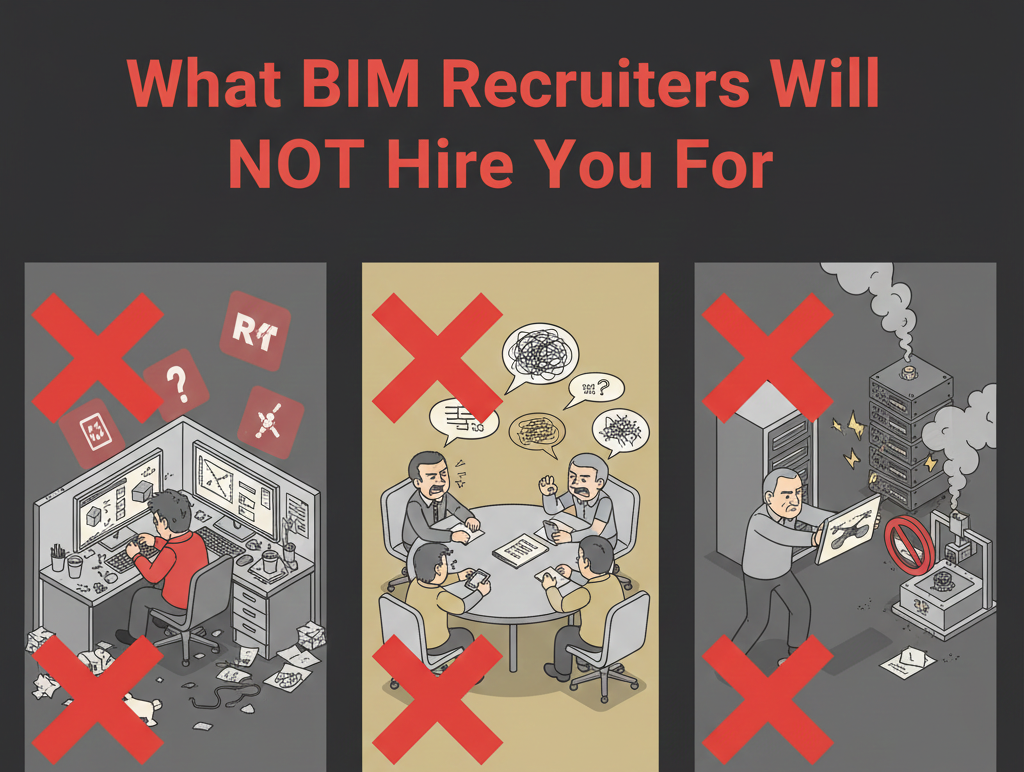
Understanding what doesn’t impress hiring managers is just as important as knowing the skills BIM recruiters look for. Many candidates still focus on areas that no longer carry strong weight in technical interviews.
Below are the most common gaps that prevent applicants from succeeding in BIM jobs in 2026.
1. Just Knowing Revit Buttons
Basic software navigation is now considered entry-level knowledge. Almost every BIM applicant today has some familiarity with Revit, so recruiters look far beyond tool usage.
Knowing which button does what may help you complete tutorials, but it does not demonstrate project readiness.
Recruiters quickly identify candidates who only have surface-level exposure.
Typical red flags include:
- Modeling without proper project standards
- Incorrect level and grid setup
- Poor view organization
- Unstructured sheet layouts
- Overuse of generic families
- Presentation-style models with no documentation logic
Without workflow understanding, Revit skills remain at a tutorial level and do not meet modern BIM recruiter expectations.
What recruiters actually want to see:
- Modeling discipline aligned with BEP
- Logical element relationships
- Clean documentation structure
- Project-ready sheet outputs
In today’s hiring environment, software knowledge alone is not enough to succeed in how to get a BIM job conversations.
2. Only Certificates, No Practical Work
Certificates still have value as proof of learning, but they are no longer decisive in hiring decisions.
Recruiters increasingly prioritize demonstrated capability over course completion.
A certificate tells employers:
- You attended training
- You completed modules
- You passed assessments
But it does not prove that you can:
- Build a coordinated model
- Produce construction drawings
- Handle real project constraints
- Work within BIM team workflows
During technical interviews for BIM jobs in 2026, candidates are commonly asked:
- “Show me your work.”
- “Explain this model.”
- “Why did you model it this way?”
- “How did you resolve this clash?”
- “Walk me through your sheet setup.”
Candidates who cannot confidently explain their own models often struggle, even if they hold multiple certificates.
This is why practical training, project simulation, and portfolio development matter far more than certificate count in current BIM recruiter expectations.
3. Zero Site or Project Context
You do not need full site experience to start a BIM career. However, you must understand how BIM outputs are used in the real construction environment.
Recruiters look for basic construction awareness because BIM is ultimately built to support project execution.
They expect candidates to understand:
- Why drawings follow certain standards
- How contractors interpret BIM models
- How different disciplines interact on site
- Why clearances and tolerances matter
- What makes a model construction-friendly
Common signs of weak project context include:
- Over-modeled elements with no purpose
- Missing access clearances
- Poor annotation clarity
- Unrealistic routing in MEP models
- Ignoring coordination zones
When candidates lack this awareness, their work appears academic rather than industry-ready.
For anyone serious about how to get a BIM job, developing basic construction understanding significantly improves interview performance and model quality.
4. Long Internships With No Real Responsibility
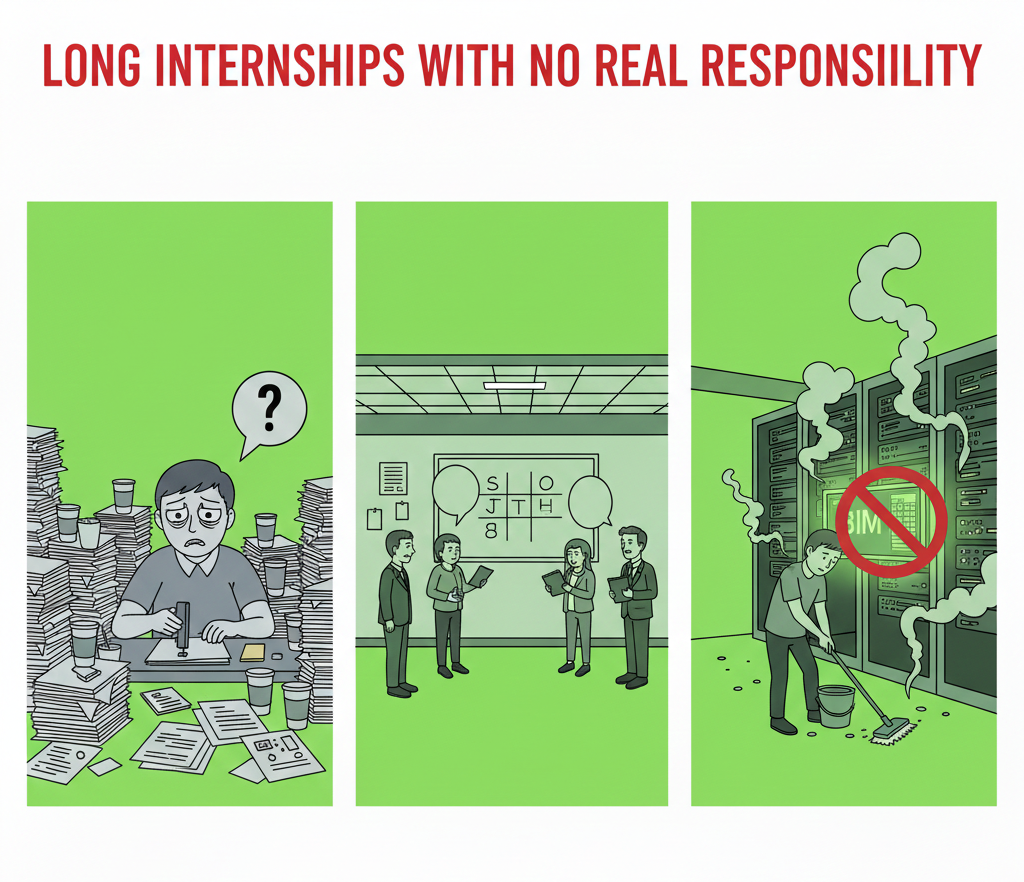
Many freshers believe that internship duration alone improves employability. In reality, recruiters focus on contribution, not just time spent.
A 2–6 month internship adds limited value if the candidate only:
- Observed senior modelers
- Assisted with minor edits
- Attended meetings without hands-on work
- Worked on sample files instead of live models
- Did not own any deliverables
During interviews, hiring managers typically ask:
- What exactly did you model?
- Which sheets did you produce?
- What coordination issues did you handle?
- What problems did you solve independently?
Candidates who cannot answer these clearly often struggle in BIM jobs in 2026 hiring rounds.
What recruiters truly value:
- Ownership of model components
- Hands-on drawing production
- Participation in coordination workflows
- Measurable project contribution
- Evidence of problem-solving
A short, hands-on internship with real deliverables is far more powerful than a long observational one.
How Should You Prepare for BIM Jobs in 2026?
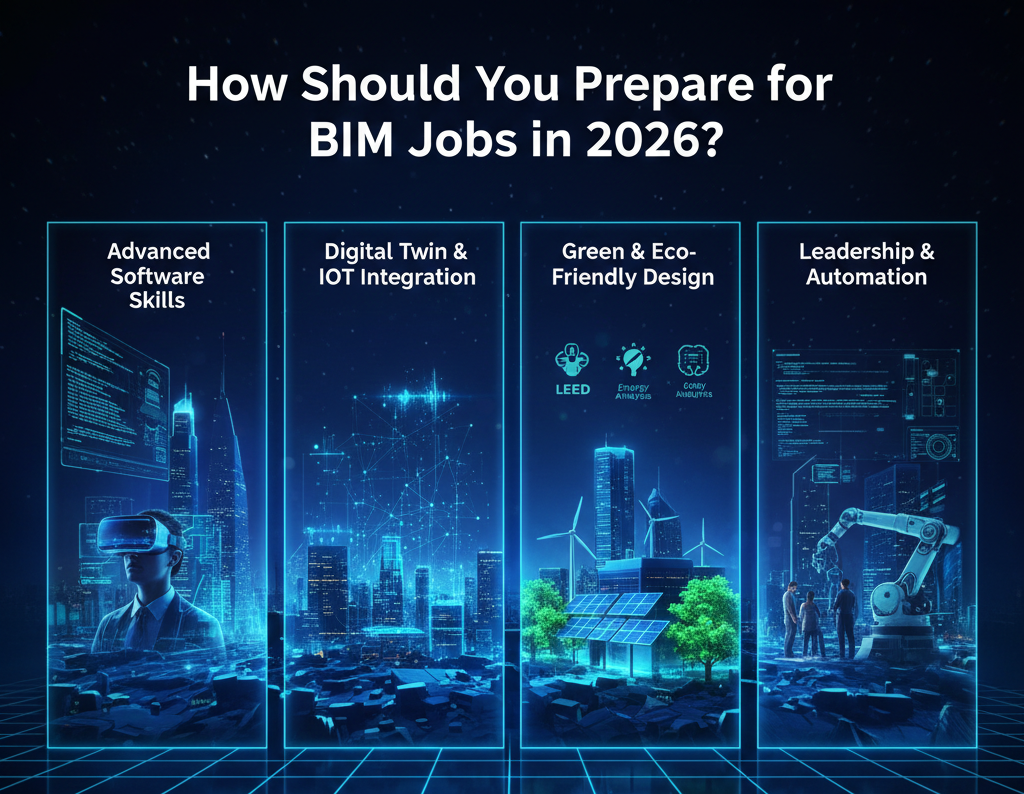
If you want to align with real BIM recruiter expectations, preparation must go beyond software tutorials. The hiring landscape now rewards candidates who demonstrate structured workflows, coordination awareness, and portfolio-backed proof.
Below is the smart, realistic roadmap that improves your chances in BIM jobs in 2026.
✔ Learn Revit Properly — Not Just the Basics
Revit remains the foundation tool in most BIM environments. However, recruiters expect production-level proficiency, not beginner familiarity.
Focus on mastering:
- Project-based modeling workflows
- Proper level and grid setup
- View templates and visibility control
- Sheet composition and annotation standards
- Family selection and parameter usage
- Model organization and cleanliness
To meet modern skills BIM recruiters look for, your Revit knowledge must reflect real project discipline rather than tutorial practice.
Candidates interested in MEP coordination roles can strengthen their discipline expertise through the Revit MEP Course, which focuses on system-based modeling and clash-aware workflows.
✔ Understand LOD and BIM Deliverables
LOD awareness is now a core technical screening factor.
To strengthen your how to get a BIM job readiness, build clarity on:
- Differences between LOD 100, 200, 300, and 350
- Geometry vs information requirements
- Stage-wise deliverable expectations
- Avoiding over-modeling
- Construction-ready documentation
Candidates who understand LOD demonstrate maturity and alignment with professional BIM workflows.
✔ Gain Live or Project-Simulated Experience
Hands-on exposure significantly improves your credibility during interviews.
If live projects are not available, focus on realistic project simulations that include:
- Full model setup from scratch
- Discipline-based modeling
- Drawing production
- Basic coordination review
- Issue correction workflows
Recruiters in BIM jobs in 2026 consistently prefer candidates who have worked in project-like environments rather than purely academic exercises.
✔ Learn Coordination Workflows (Navisworks and ACC)
Coordination awareness is one of the fastest ways to stand out.
To align with current BIM recruiter expectations, build familiarity with:
- Navisworks clash detection basics
- Model federation workflows
- Issue identification and tracking
- Coordination viewpoints
- Autodesk Construction Cloud (ACC) basics
- BIM 360 model sharing
Even beginner-level exposure signals that you understand real multidisciplinary BIM environments.
✔ Build a Small but Strong Portfolio
In today’s hiring process, portfolio quality often outweighs certificate quantity.
Your portfolio for BIM jobs in 2026 should include:
- One clean architectural model
- One MEP or structural sample
- Proper sheet set with annotations
- LOD-based modeling example
- Basic clash detection output
- Model screenshots with explanations
Focus on clarity, structure, and realism. A compact, well-executed portfolio aligns strongly with skills BIM recruiters look for.
✔ Focus on Execution, Not Just Course Completion
Many candidates still measure progress by:
- Number of courses completed
- Duration of training
- Certificate count
Recruiters, however, measure:
- Modeling accuracy
- Documentation quality
- Coordination awareness
- Problem-solving ability
- Workflow discipline
If your goal is success in how to get a BIM job, prioritize execution-based learning over passive course consumption.
How BIM Cafe Prepares Students for This Reality
BIM Cafe Learning Hub structures its training around real industry expectations rather than purely academic learning.
The program is designed to bridge the gap between classroom exposure and project readiness.
Our Training Focus Includes:
- Real project–oriented BIM workflows
- ARC, STR, and MEP coordination exposure
- LOD-based modeling and documentation practice
- Navisworks fundamentals
- Common Data Environment (CDE) basics
- BIM 360 and ACC workflow awareness
- Practical deliverables instead of isolated exercises
- Portfolio-driven learning approach
- Placement assurance support through DDG BIM Services
This structured approach helps students align closely with modern BIM recruiter expectations and improves readiness for BIM jobs in 2026.
If your goal is to transition from basic modeling to full project ownership, the Master BIM Courses are designed to strengthen advanced BIM workflow capability.
Our Philosophy
At BIM Cafe Learning Hub:
- We don’t train students just to finish courses
- We don’t focus on tool-only learning
- We don’t promote shortcut-based preparation
Instead, the focus remains on building professionals who can contribute meaningfully inside real BIM teams.
Final Thoughts
The hiring landscape for BIM jobs in 2026 is clear and increasingly performance-driven.
Recruiters are moving away from evaluating candidates based on:
- Fancy course names
- Long certificate lists
- Basic software familiarity
They are actively hiring professionals who demonstrate:
- Ability to work within real BIM workflows
- Strong understanding of deliverables and coordination
- Portfolio-backed practical output
- Day-One project readiness
- Structured modeling discipline
For anyone serious about how to get a BIM job, the path forward is practical, focused, and execution-oriented.
At BIM Cafe Learning Hub, the goal remains straightforward:
When a recruiter reviews your profile, they should see a contributor — not a beginner.