Author: Devika R
September 12, 2026
5 min read
AI can generate, check, and coordinate BIM information—but who takes responsibility when the result is wrong?
Artificial intelligence is moving quickly into the AEC industry.
It can already help professionals automate repetitive tasks, analyse information, generate design options, identify potential issues and support BIM workflows. As AI becomes more capable, the next step is not simply better automation. It is the possibility of AI performing increasingly complex sequences of tasks with less direct human intervention.
That creates a question the construction industry cannot ignore:
If AI contributes to a BIM decision and that decision turns out to be wrong, who is responsible?
The answer is not simply “the software.”
As AI becomes more deeply integrated into BIM, responsibility, human review and clear approval processes become just as important as the technology itself. Current industry discussions around AI and construction are already raising questions about professional responsibility, contractual risk and how AI-assisted decisions should be reviewed.
AI Can Make a Suggestion. But Who Approves It?
Imagine an AI tool analyses an MEP model and recommends moving a duct to another ceiling zone.
The clash disappears.
The new route looks efficient.
The team accepts the suggestion.
Later, during construction, the revised route creates an access problem that was not obvious in the model.
So, who made the decision?
Was it the AI?
The BIM coordinator?
The MEP engineer?
The designer who approved the change?
This is where the difference between AI assistance and professional responsibility becomes important.
An AI system can generate a recommendation. But a recommendation does not automatically become an approved engineering decision.
Someone still needs to evaluate whether the proposed solution satisfies the project’s technical requirements and real-world constraints.
As AI moves toward more autonomous and “agentic” workflows, this question becomes even more important: what can AI do independently, and what still requires human authority? Industry discussions around agentic BIM are increasingly focused on this gap between automation and professional control.
“The Software Did It” Is Not a BIM Strategy
There is an easy argument to make when something goes wrong:
“The AI generated it. We only used the software.”
But once an AI-assisted output becomes part of a project deliverable, that explanation becomes much less useful.
If information is incorporated into a BIM model, issued for coordination, used to produce drawings or relied upon during construction, the project team needs to know who reviewed and approved it.
The more useful question is therefore not:
“Did AI make the mistake?”
It is:
“What process allowed that mistake to become an approved project output?”
That shift matters.
AI may be the source of an incorrect suggestion, but the project workflow determines whether that suggestion is detected, corrected, or allowed to move further downstream.
This is also why emerging discussions around AI and construction disputes are examining questions such as how AI tools were used, whether their outputs were reviewed, and who was responsible for relying on those outputs.
AI Can Produce a Convincing Answer That Is Still Wrong
One of the biggest challenges with AI-assisted BIM is that an incorrect result may not look incorrect.
A duct can be beautifully modelled but incorrectly routed.
A piece of equipment can appear in exactly the right location while containing incorrect information.
A proposed design solution can remove a clash while creating a constructability problem elsewhere.
The output may be technically detailed, visually convincing, and generated in seconds.
It can still be wrong.
Consider an AI-recommended HVAC route. The system may identify an efficient path based on the information available to it. But the real project may also depend on:
- maintenance access,
- installation sequence,
- structural constraints,
- fire-safety requirements,
- ceiling zones,
- equipment replacement,
- site conditions, and
- decisions made during coordination meetings.
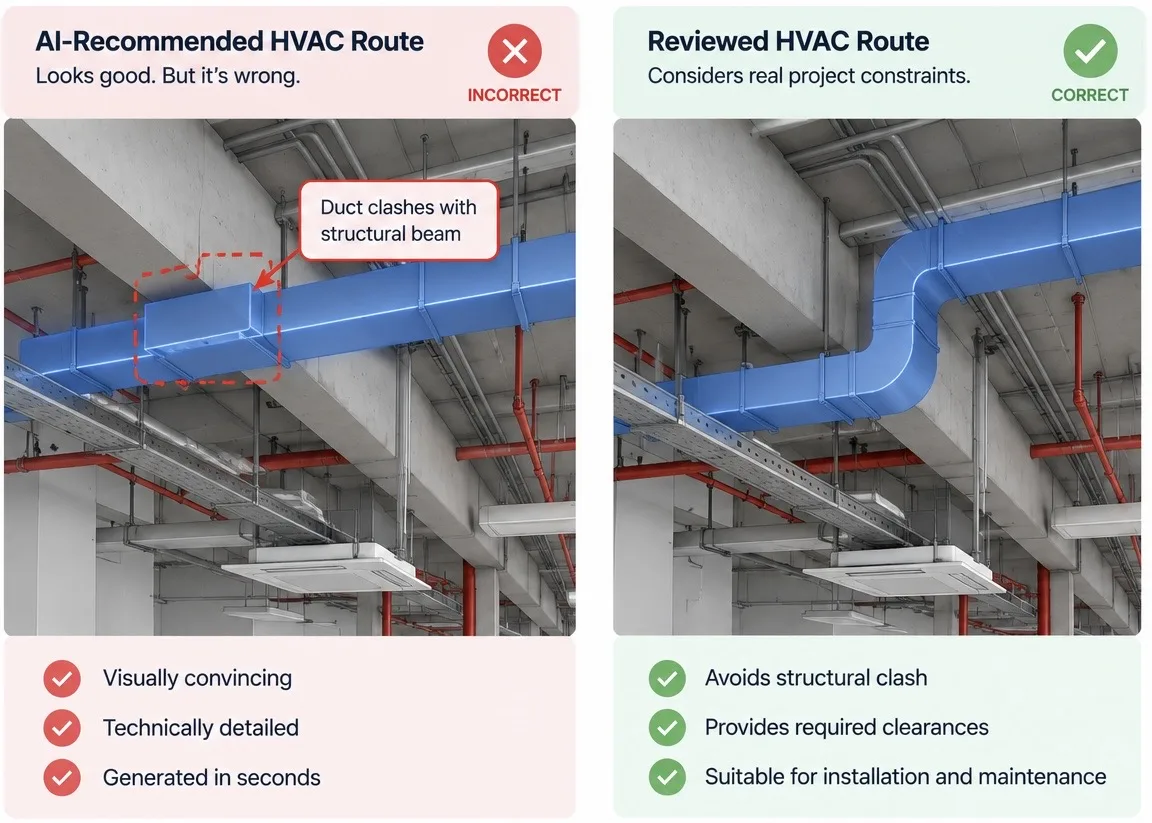
Not every project constraint is necessarily represented in the same structured form inside the model.
That is why a successful AI output is not automatically a successful project solution.
The professional still has to ask:
Does this actually work?
The Real Risk: Can You Trace What AI Changed?
Imagine that a project discovers a problem six months after a model was issued.
The team needs to understand:
- What changed?
- When did it change?
- Why was it changed?
- Was AI involved?
- Which information influenced the change?
- Who reviewed it?
- Which version was approved?
If the workflow cannot answer these questions, identifying the source of an error becomes much harder.
This makes traceability increasingly important in AI-assisted BIM.
As automation increases, project teams may need better ways of recording significant changes and decisions—not just the final model, but the process that led to it.
This does not mean every minor AI-assisted action needs a lengthy report.
The principle is simpler:
The more important the decision, the more important its history becomes.
For high-impact design or coordination decisions, teams should be able to understand how the final outcome was reached.
Not Every AI Decision Should Have the Same Freedom
Not all BIM tasks carry the same level of risk.
Consider three examples.
Low-risk task
AI reorganises internal model views according to an established naming convention.
A quick review may be sufficient.
Medium-risk task
AI identifies potentially duplicated or unnecessary model elements.
A BIM professional should verify the recommendation before removing anything.
High-risk task
AI proposes a design change that affects structural elements, fire-safety requirements or critical MEP coordination.
That requires substantially stronger professional review.
This suggests a practical principle for BIM teams:
The higher the consequence of an AI decision, the stronger the human verification should be.
AI does not need to be treated as either completely trusted or completely untrusted.
Its level of autonomy can instead be matched to the risk and consequence of the task.
What Happens When AI Crosses Disciplines?
The challenge becomes even greater when AI starts working across multidisciplinary BIM environments.
Imagine three systems:
Architectural AI optimises the building layout.
Structural AI optimises the structural system.
MEP AI optimises service routing.
Each system may produce a good result within its own discipline.
But buildings are not independent systems.
One decision affects another.
A structural change may reduce ceiling space.
An architectural change may affect MEP distribution.
An MEP optimisation may create maintenance problems.
This is where BIM coordination becomes particularly important.
The challenge is no longer simply detecting whether two elements clash. It becomes determining which solution best satisfies the combined requirements of the project.
As AI moves toward more autonomous BIM workflows, industry discussions are increasingly considering how these systems should handle conflicting requirements, verification and escalation rather than simply making more decisions automatically.
The BIM Coordinator May Become More Important, Not Less
It may seem that AI will reduce the importance of BIM coordinators.
But consider what happens when AI produces more design options and coordination recommendations.
Someone still needs to ask:
Is this the right solution?
That requires understanding:
- design intent,
- multidisciplinary coordination,
- constructability,
- project requirements,
- BIM standards, and
- practical construction constraints
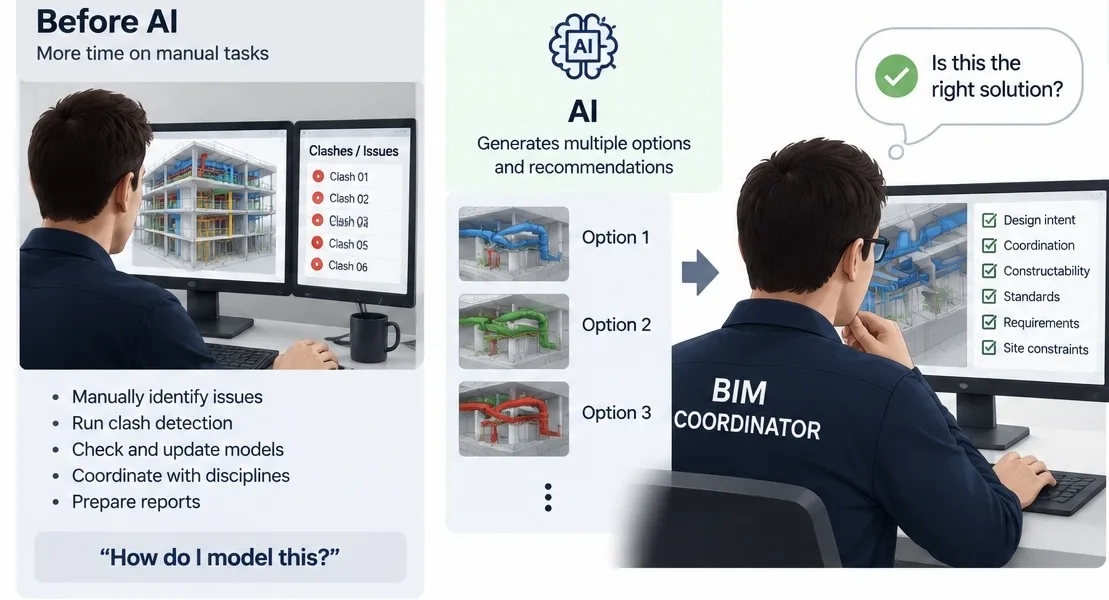
The role of the BIM coordinator could therefore evolve.
Instead of spending most of the time manually identifying every issue, the coordinator may increasingly spend time reviewing, validating, prioritising and managing automated outputs.
The question may shift from:
“How do I model this?”
to:
“Should this output be accepted?”
That is a different skill—and potentially a more valuable one.
What Should BIM Teams Do Now?
AI adoption does not require a complicated governance system from day one.
BIM teams can start with four practical principles.
Define where AI can be used
Identify which tasks are suitable for AI assistance and which require mandatory professional approval.
Keep human approval for high-risk decisions
Do not allow an AI recommendation to automatically become an approved design or coordination decision.
Record important AI-assisted changes
For significant decisions, maintain enough information to understand what changed, why it changed and who approved it.
Make responsibility clear
Everyone involved should understand who reviews and approves AI-assisted outputs before they become project deliverables.
The goal is not to slow AI down.
It is to make sure automation does not move faster than accountability.
The New BIM Skill: Knowing When to Question the Model
Future BIM professionals will still need software skills.
They will still need to understand modelling, coordination, information management and construction workflows.
But AI introduces another important capability:
Knowing when not to trust the model immediately.
A strong BIM professional should be able to look at an AI-generated result and ask:
Does this make engineering sense?
Does it satisfy the project requirements?
Can it actually be constructed?
Does it create another problem somewhere else?
Can I explain why this decision was made?
If those questions cannot be answered, the model should not be considered reliable simply because the software produced it.
The Future of BIM Is Not Just About Smarter Software
AI will continue to change BIM workflows.
It may automate more repetitive modelling, analyse larger amounts of project information, generate design options, identify issues and support multidisciplinary coordination.
More advanced systems may eventually perform increasingly complex tasks with limited direct intervention.
But the important question is no longer:
“Will AI enter BIM?”
It already has.
The more important question is:
How much authority should AI have?
The answer will probably not be to stop using AI.
Instead, BIM workflows will need to evolve so that automation, verification and accountability develop together.
A BIM model is valuable not simply because a machine can create it.
It is valuable when professionals can understand it, verify it, coordinate it and trust the information it contains.
Final Thought
AI may generate the recommendation.
AI may identify the clash.
AI may even suggest the solution.
But when that solution becomes part of a real project, someone still has to decide whether it is the right one.
The future of BIM will not be defined only by how intelligent the software becomes.
It will also be defined by how intelligently professionals use it.
Frequently Asked Questions
Can AI be responsible for a BIM error?
AI can generate or contribute to an error, but responsibility for a professional project output does not automatically transfer to the software. It depends on how the tool was used, reviewed and incorporated into the project workflow.
Will AI replace BIM coordinators?
AI may automate parts of coordination, but BIM coordinators can become more important in validating outputs, managing multidisciplinary decisions and ensuring that automated recommendations meet project requirements.
Should AI-generated BIM outputs be checked?
Yes. The level of checking should depend on the importance and potential consequences of the output. High-risk design and coordination decisions require appropriate professional review.
Professional BIM Course
Master BIM Course
Structural Design Concepts and BIM
Certified MEPF BIM Master Course
Electrical BIM Professional Program
RenderLab – Master 3D Modeling & Photorealistic Rendering
Multi-Tool Mastery for Architects & Engineers
BIM Coordinator Workflow Program
BIM FastTrack – 30 Day Intensive Training
Global Architectural & Structural BIM Project Program