Author: Devika R
July 27, 2026
7 min read
They'll help you identify whether a course teaches software or prepares you for the construction industry.
Search for a BIM course today, and you'll find hundreds of institutes promising industry-ready training, internships, and placements.
But here's the real question:
Are all BIM courses the same?
Not quite.
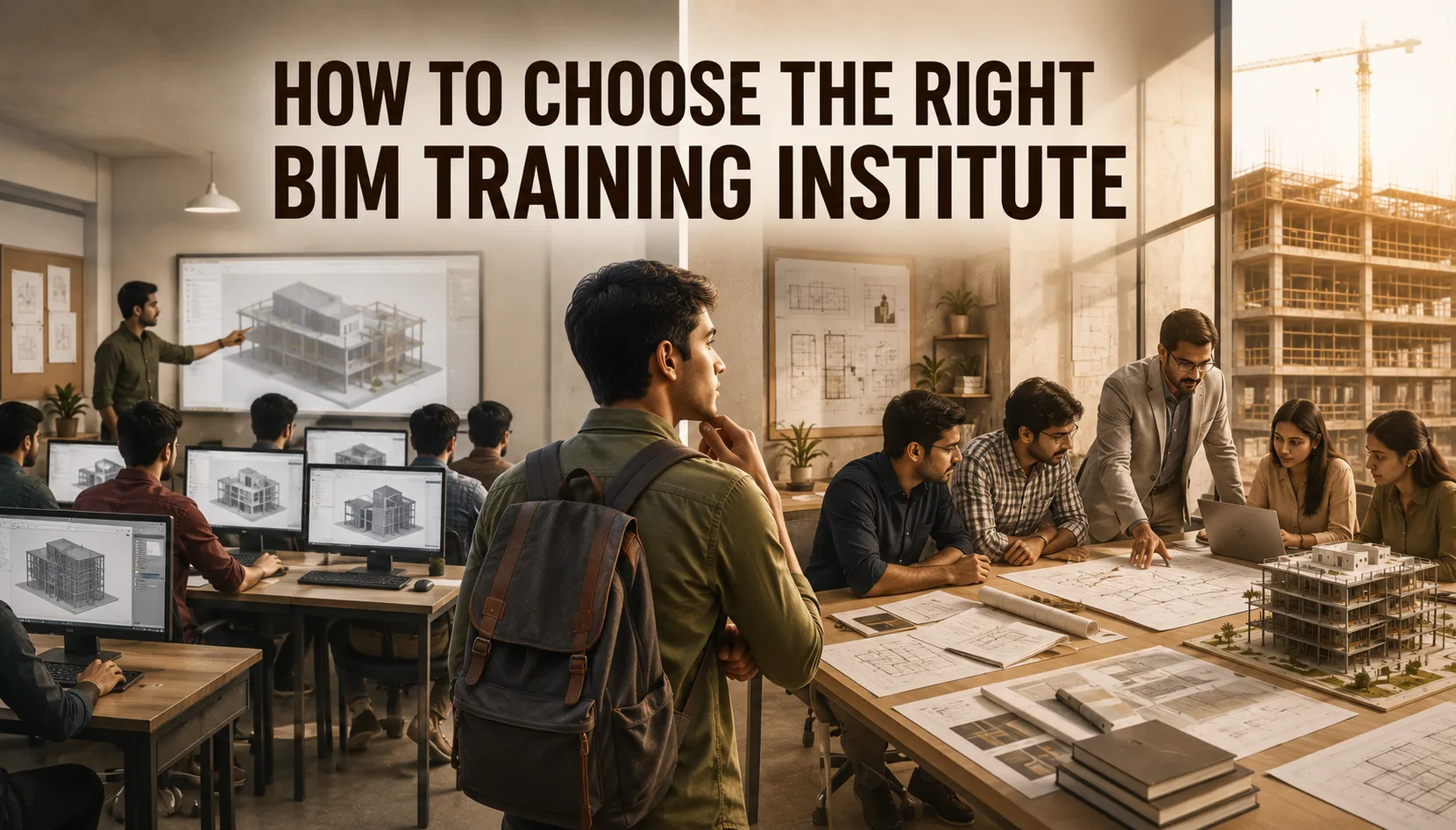
Some courses focus mainly on teaching Revit as a software tool, while others prepare students for real BIM workflows used on construction projects.
If your goal is to become a BIM Modeler, BIM Engineer, or BIM Coordinator, choosing the right training institute is just as important as choosing the course itself.
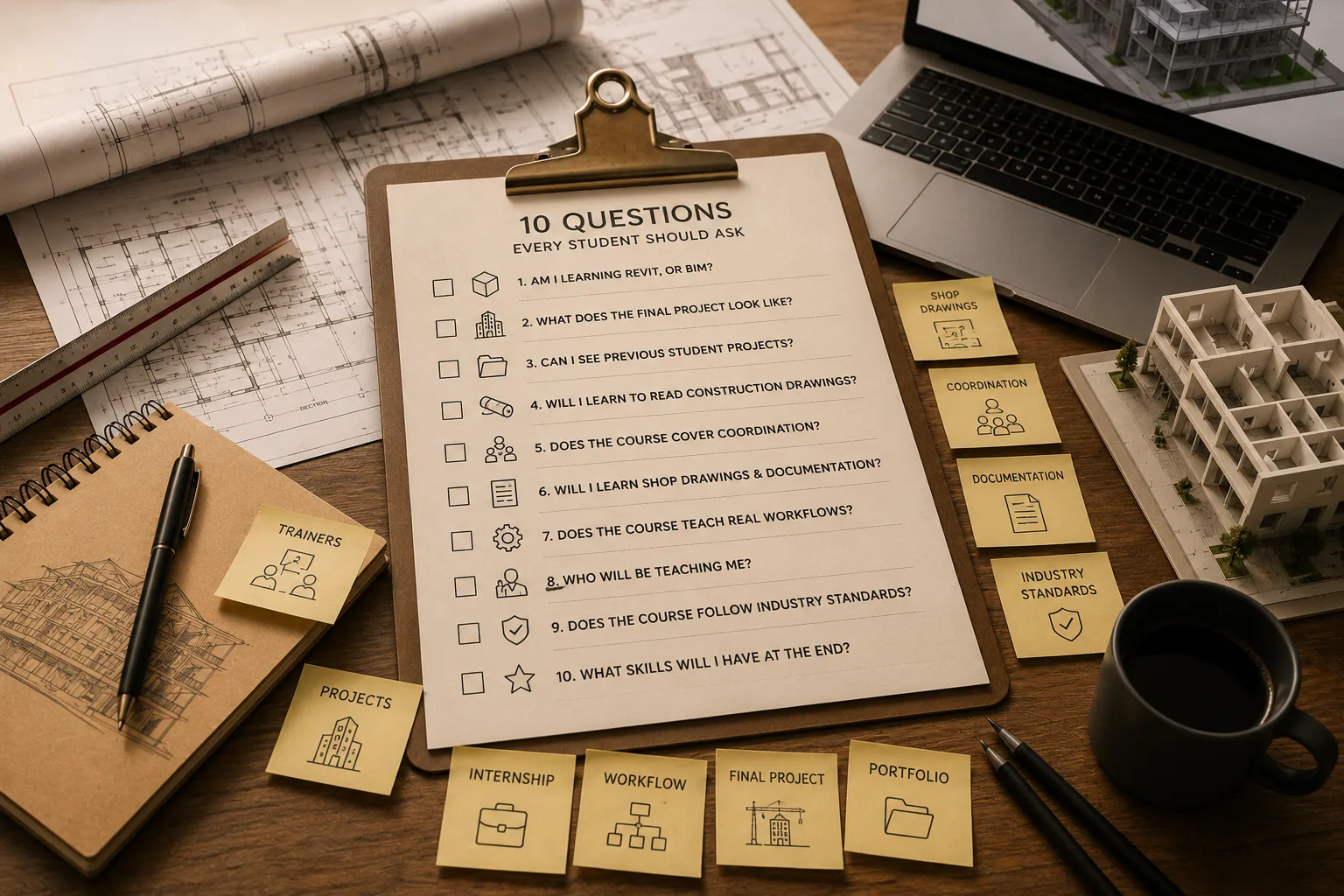
Before you invest your time and money, ask these ten questions.
What Employers Expect vs What Students Often Expect
| Students Often Expect | What Employers Actually Expect |
|---|---|
| Learn Revit commands | Understand BIM workflows |
| Receive a certificate | Demonstrate practical skills |
| Create a 3D model | Coordinate multiple disciplines |
| Complete classroom exercises | Solve real project challenges |
| Finish a course | Be ready for project delivery |
1. Am I Learning Revit, or Am I Learning BIM?
This is the first question every student should ask.

Revit is a software application.
BIM (Building Information Modeling) is a collaborative process that includes modelling, coordination, documentation, and project information management.
A good BIM course should teach more than software navigation. It should help you understand how projects move from design to construction through coordinated digital workflows.
2. What Does the Final Project Look Like?
Ask to see the final projects completed by previous students.
A single residential model may be enough to learn basic modelling, but it doesn't always reflect the complexity of commercial buildings, hospitals, airports, or industrial facilities.
The final project should demonstrate how different disciplines work together—not just how a building is modelled.
3. Can I See Previous Student Projects?
Don't rely only on brochures or advertisements.
Ask to review:
- BIM models
- Shop drawings
- Construction documentation
- Coordination models
- Student portfolios
The quality of previous student work often reflects the quality of the training.
4. Will I Learn to Read Construction Drawings?
Many graduates know how to model walls and doors but struggle when given a real architectural or structural drawing during an interview.
A practical BIM course should help you understand:
- Architectural drawings
- Structural drawings
- MEP drawings
- Fire protection layouts
- Construction documentation
Because BIM starts with understanding drawings—not just creating models.
5. Does the Course Cover Multi-Disciplinary Coordination?
Construction projects involve architects, structural engineers, and MEP teams working together.
A BIM professional should understand how these disciplines interact and how coordination helps avoid costly site issues.
Learning to model is only one part of the process.
Learning to coordinate models is where BIM becomes valuable.
6. Will I Learn Shop Drawings and Documentation?
Many employers expect BIM professionals to prepare construction documentation—not just 3D models.
Look for a course that includes:
- Shop drawings
- Sheet creation
- Annotation standards
- View preparation
- Documentation workflows
These are everyday tasks on many BIM projects.
7. Does the Course Teach Real Industry Workflows?
Professional BIM projects involve much more than modelling.
A well-structured course should introduce concepts such as:
- Clash Detection
- BIM Coordination
- Levels of Development (LOD)
- BIM Execution Plans (BEP)
- Quantity Take-Off (QTO)
- Autodesk Construction Cloud (ACC)
- Model review and quality control
These topics help bridge the gap between classroom learning and real project delivery.
8. Who Will Be Teaching You?
Software knowledge is valuable, but practical project experience adds another dimension to learning.
Before enrolling, ask:
- Have the trainers worked on real BIM projects?
- Do they have coordination experience?
- Have they prepared construction documentation?
- Can they explain project workflows—not just software features?
Learning from industry professionals often gives students a clearer understanding of workplace expectations.
9. Does the Course Follow Industry Standards?
Professional BIM projects follow structured standards to ensure consistency across teams.
Ask whether the course introduces concepts such as:
- BIM standards
- Shared Coordinates
- Naming conventions
- LOD
- BEP
- ISO 19650 (introductory awareness)
Even a basic understanding of these concepts helps students appreciate how BIM is implemented on professional projects.
10. What Skills Will I Have When the Course Ends?
Instead of asking,
"Will I receive a certificate?"
Ask,
"What will I actually be able to do?"
By the end of a practical BIM course, you should feel confident in:
- Reading construction drawings
- Creating coordinated BIM models
- Producing documentation
- Preparing shop drawings
- Understanding BIM workflows
- Collaborating with different disciplines
- Working on project-based assignments
Those are the skills employers usually value most.
Reality Check
Many graduates complete a BIM course believing they are industry-ready.
During interviews, employers rarely ask,
"Which software did you learn?"
Instead, they're more likely to ask:
- Can you understand construction drawings?
- Have you worked on multidisciplinary models?
- Can you prepare documentation?
- Have you performed clash detection?
- Do you understand BIM workflows?
The difference between learning software and understanding project delivery often becomes clear at this stage.
Final Thoughts
Choosing a BIM training institute is about far more than selecting a place to learn software.
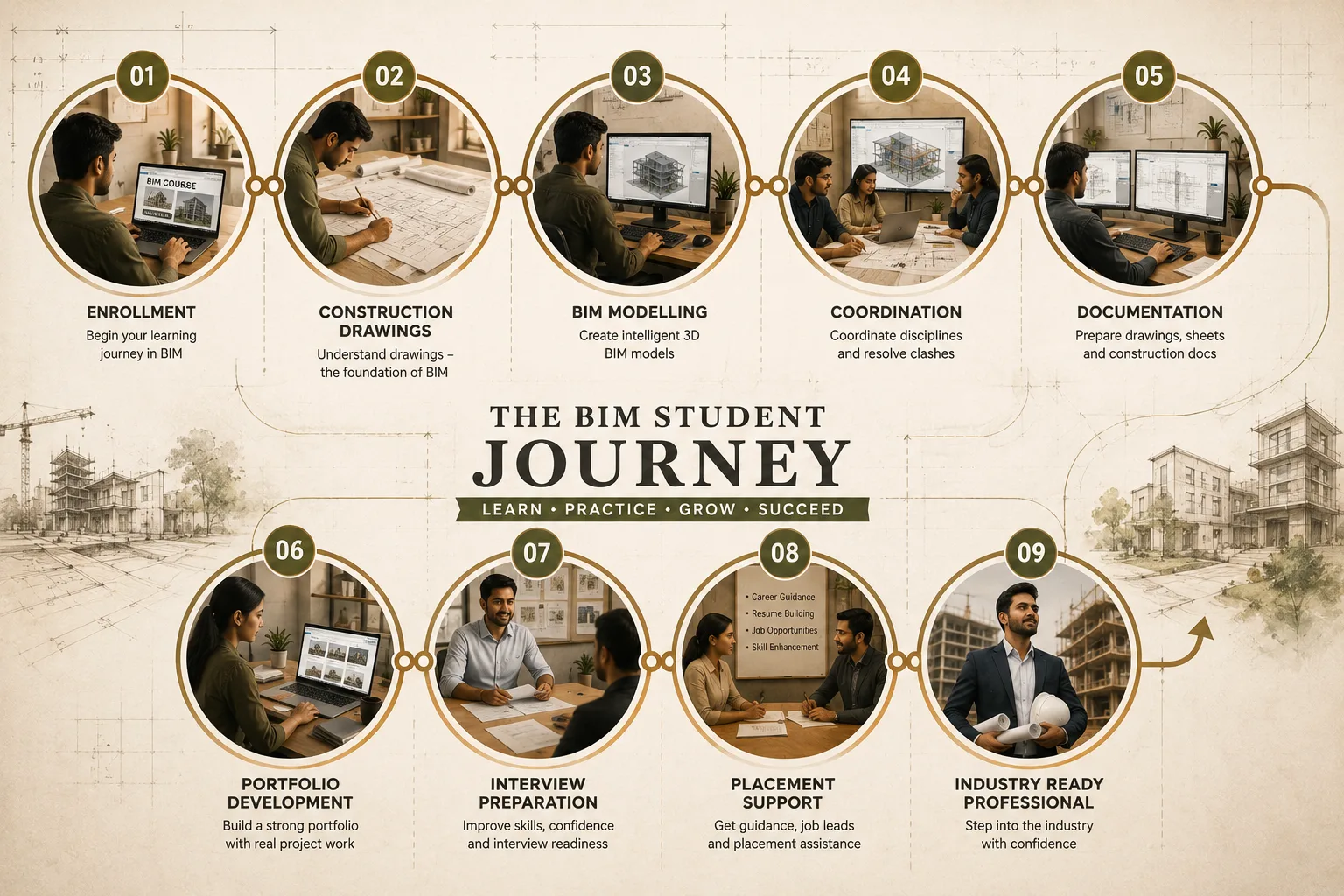
The best courses prepare you to understand how construction projects are designed, coordinated, documented, and delivered.
Before enrolling, review the curriculum, ask questions, examine previous student projects, and understand what practical experience you'll gain.
A certificate may help you complete a course.
Practical skills help you begin a career.
Frequently Asked Questions
Is learning Revit enough to get a BIM job?
Revit is an important BIM authoring tool, but employers often expect knowledge of coordination, documentation, construction drawings, and BIM workflows as well.
What should a good BIM course include?
A practical BIM course should cover modelling, construction drawings, shop drawings, coordination, clash detection, documentation, and industry workflows—not just software commands.
Should I choose a course with an internship?
An internship can be valuable if it involves real project workflows rather than observation alone. Ask what practical work you'll actually perform.
Is BIM suitable only for Civil Engineers?
No. BIM is used by Architects, Structural Engineers, MEP Engineers, Quantity Surveyors, and Construction Managers working on collaborative construction projects.
How can I compare BIM training institutes?
Compare the curriculum, trainers' industry experience, project work, documentation training, coordination exposure, and previous student portfolios—not just fees or course duration.
Professional BIM Course
Master BIM Course
Structural Design Concepts and BIM
Certified MEPF BIM Master Course
Electrical BIM Professional Program
RenderLab – Master 3D Modeling & Photorealistic Rendering
Multi-Tool Mastery for Architects & Engineers
BIM Coordinator Workflow Program
BIM FastTrack – 30 Day Intensive Training
Global Architectural & Structural BIM Project Program