
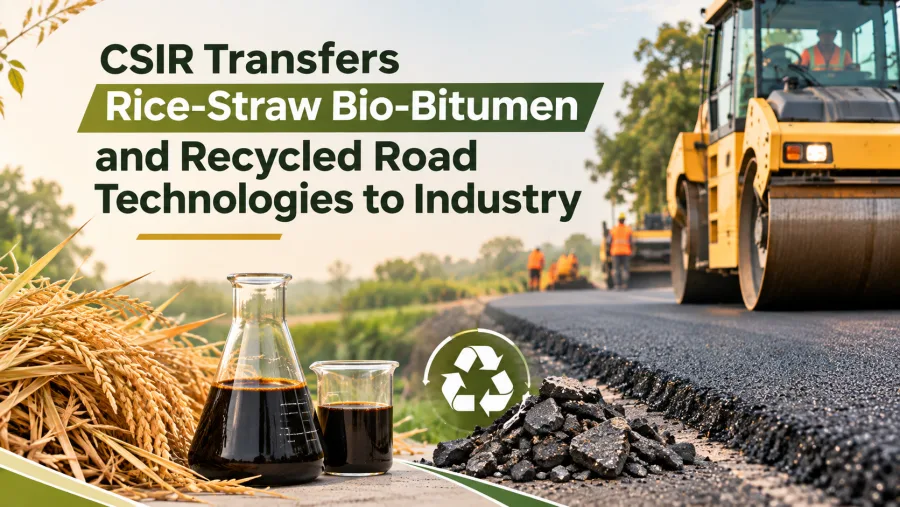
Indian research laboratories are moving sustainable road construction technologies towards commercial application through new industry partnerships.
Rice straw and reclaimed asphalt could play a larger role in road construction as Indian research institutions move several pavement technologies from laboratory development towards industrial application.
The Council of Scientific and Industrial Research (CSIR) has transferred a group of indigenous construction and infrastructure technologies to industry partners, including solutions developed by the Central Road Research Institute (CSIR-CRRI) and other CSIR laboratories.
The technology-transfer programme was held at CSIR headquarters in New Delhi.
Two Developments for Road Construction
Bio-Bitumen from agricultural waste
Developed through collaborative research involving CSIR-CRRI and CSIR-Indian Institute of Petroleum, the technology converts agricultural residues, including rice straw, into a biomass-derived material capable of partially replacing petroleum-based bitumen.
The technology was transferred to RAACS Solutions Private Limited in Bihar and SAR Parivahan Private Limited in Kolkata.
Road resurfacing using reclaimed asphalt
CSIR also transferred its MicroReAct-RAP technology, a cold micro-surfacing solution incorporating up to 40% reclaimed asphalt pavement.
Designed to reduce reliance on virgin aggregates and bitumen emulsion, the technology was transferred to three industry partners for further commercial development.
From Research to Road Applications
The transfers represent a step towards wider industrial use, rather than confirmation that the technologies have already been deployed across public roads.
Their practical value will depend on field performance, material consistency, engineering specifications and successful commercial-scale implementation.
For highway and materials engineers, the developments offer two approaches to reducing the use of conventional road construction materials while exploring alternative sources and recycling methods.