
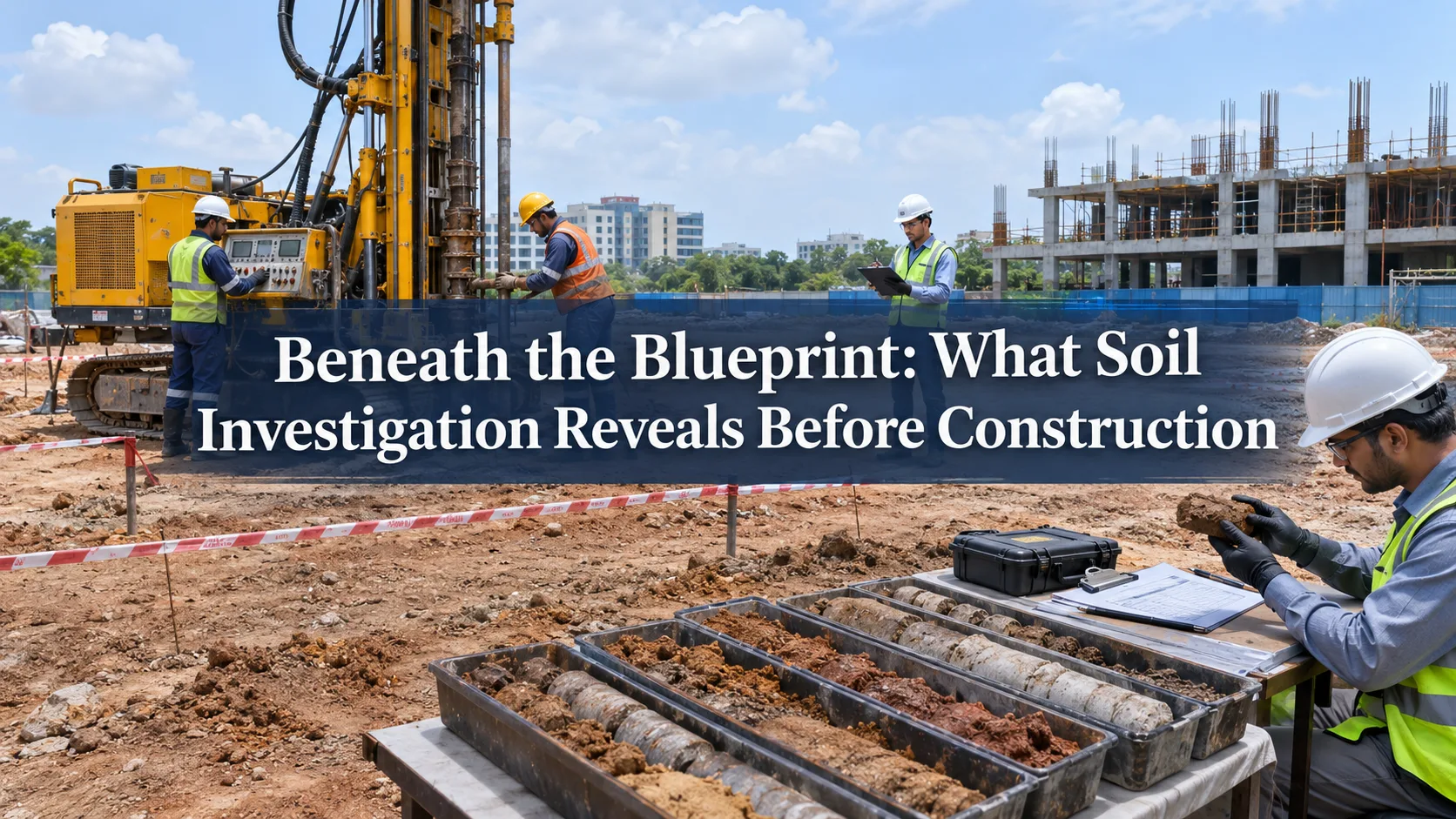
From boreholes and soil samples to groundwater and settlement, site investigation helps engineers understand what a building will stand on.
A drilling rig arrives on an empty plot long before concrete mixers, reinforcement and formwork. To someone passing by, the activity may seem disconnected from the building that will eventually stand there.
For the engineers, it is one of the earliest opportunities to test assumptions about the site.
The ground beneath a proposed building is rarely uniform. A firm surface may conceal soft clay, loose sand, weathered rock or layers that change across a short distance. Groundwater may also influence how the site behaves during excavation and throughout the building's life.
Soil investigation before construction turns these uncertainties into evidence that designers can work with. It does not eliminate every unknown, but it helps teams make foundation decisions based on more than the appearance of the land.
The Ground Is Not Always What It Appears
Two neighbouring plots can look almost identical from the road and still require different engineering responses.
One may have competent soil close to the surface. Another may contain a deeper layer of compressible material or a high groundwater table. Filled ground presents another challenge: its composition and degree of compaction can vary considerably.
A visual site visit provides useful clues, including changes in level, drainage patterns and signs of previous earthworks. But it cannot establish the full sequence or engineering properties of the layers below.
That is the purpose of a geotechnical site investigation: to build a sufficiently reliable picture of subsurface conditions for the proposed work.
What Happens During a Soil Investigation?
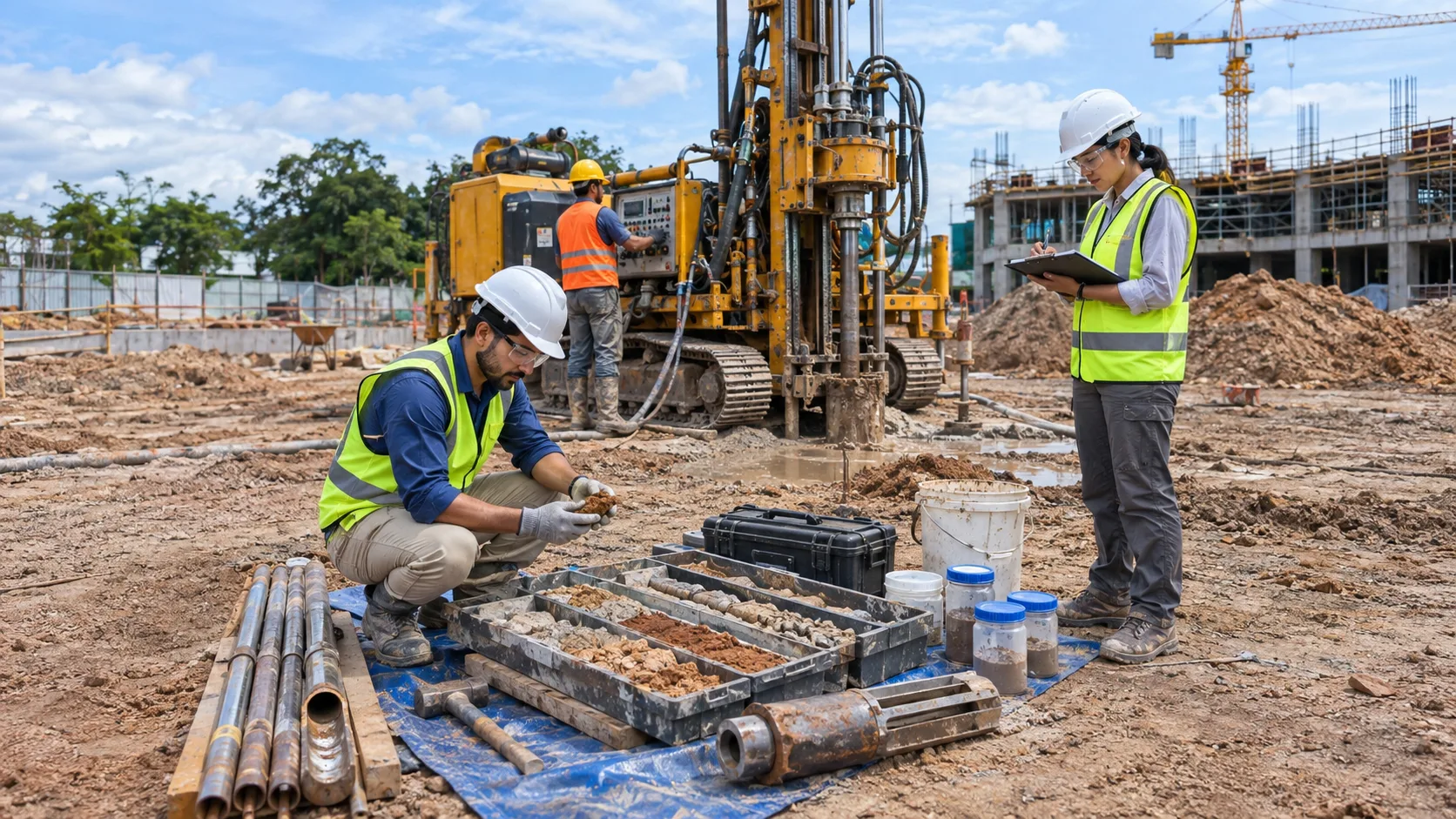
The process typically begins with information already available about the site. Geological records, earlier reports, site history and a walkover survey can help the engineer plan where further investigation is needed.
Depending on the site and project, investigation methods may include:
- Boreholes and trial pits: Boreholes reveal soil and rock layers at depth, while trial pits can allow shallow ground to be examined directly where suitable.
- Soil sampling: Engineers collect disturbed or relatively undisturbed samples, depending on the properties that need to be assessed.
- Field testing: The Standard Penetration Test (SPT) is one commonly used method. A standard sampler is driven into the ground, and the recorded blow count helps engineers interpret soil conditions.
- Laboratory testing: Tests may examine grain size, moisture content, plasticity, shear strength or compressibility.
The number, location and depth of investigations depend on the project and expected ground variability. Likewise, an SPT result must be interpreted alongside soil type, test conditions and other investigation data; it is not a standalone foundation design. Not every project requires every test.
What a Geotechnical Report Actually Tells Engineers
A useful geotechnical report does more than present a table of test results.
It typically describes the sequence of ground layers, the location and conditions of exploration, groundwater observations and the engineering parameters derived from the available evidence. It should also identify important limitations and uncertainties.
A soil described as "clay" is not enough information for design. Engineers need to understand, for example, its strength and how much it may compress under sustained loading. Granular soils, rock and made ground present different questions.
Groundwater observations matter too. Water levels can change with season, rainfall, nearby drainage and construction activity, so a reading from one visit should not automatically be treated as a permanent level.
The report gives geotechnical and structural engineers a basis for choosing and checking foundation options. It is not a promise that every part of the site will match the borehole logs exactly.
Bearing Resistance and Settlement Are Different Checks
It is tempting to reduce soil testing to one number: the soil's bearing capacity. That figure alone cannot establish whether a foundation will perform satisfactorily.
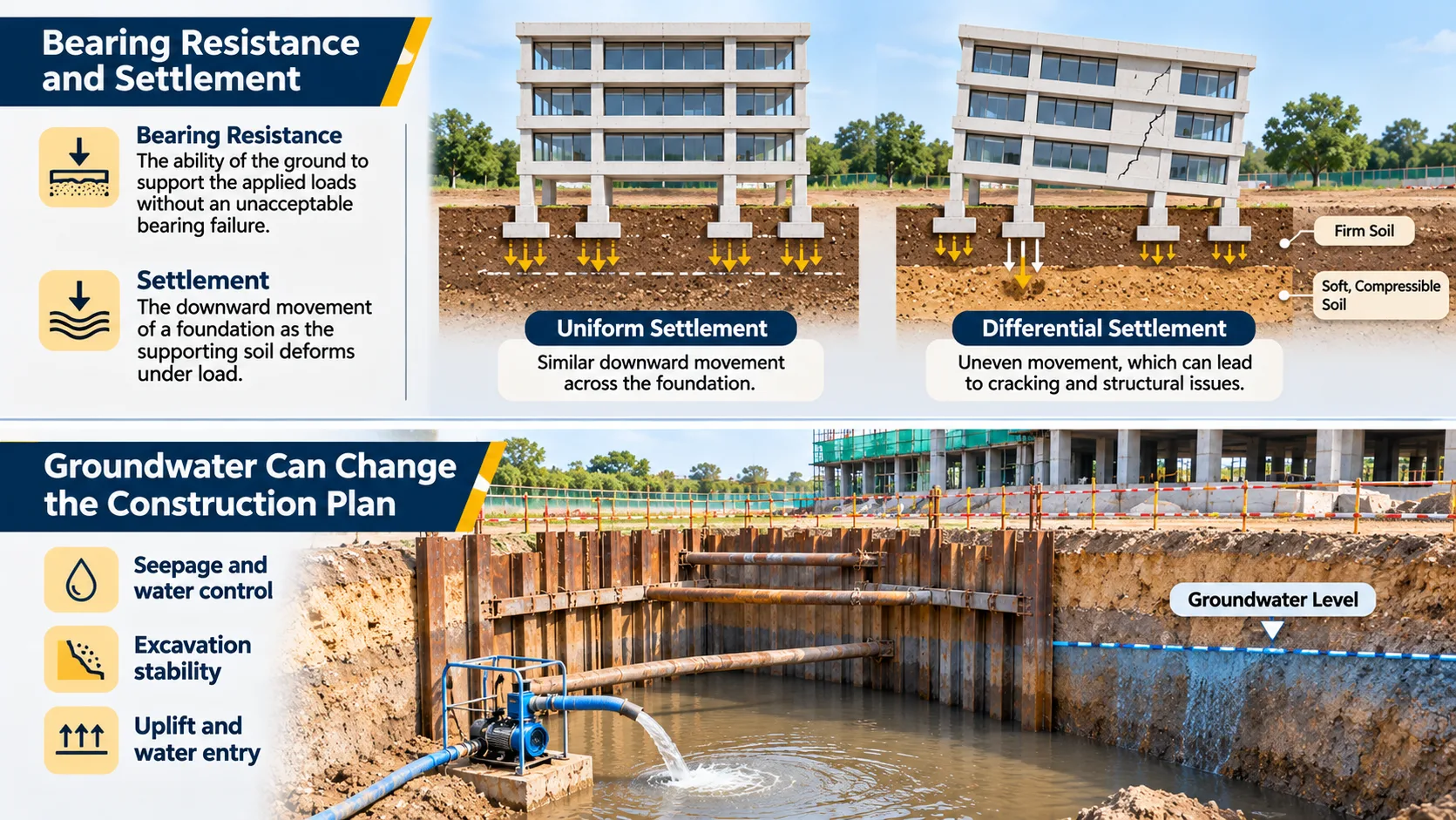
Bearing resistance concerns the ability of the ground to support the applied loads without an unacceptable bearing failure. Settlement concerns how much the foundation moves downward as the supporting soil deforms.
A foundation could have adequate bearing resistance yet experience settlement that is too large for the proposed structure. Uneven, or differential, settlement can be particularly troublesome because different parts of a building move by different amounts.
The acceptable movement depends on the structural system, loads, soil conditions and the sensitivity of the building and its finishes.
For this reason, sound foundation design evaluates both resistance and deformation, rather than selecting a footing size from a single reported value.
Groundwater Can Change the Construction Plan
Groundwater affects more than the moisture content of the soil.
An excavation may encounter seepage that requires a planned approach to water control. In some ground conditions, groundwater can influence excavation stability or the method used to construct foundations. Below-ground structures may also need to be assessed for uplift and water entry.
These considerations are especially relevant where sites experience seasonal water-level changes or have permeable soil layers.
A geotechnical investigation should therefore help the project team anticipate conditions that might affect temporary works as well as the permanent building.
How the Findings Influence Foundation Selection
There is no universally best foundation for all sites.
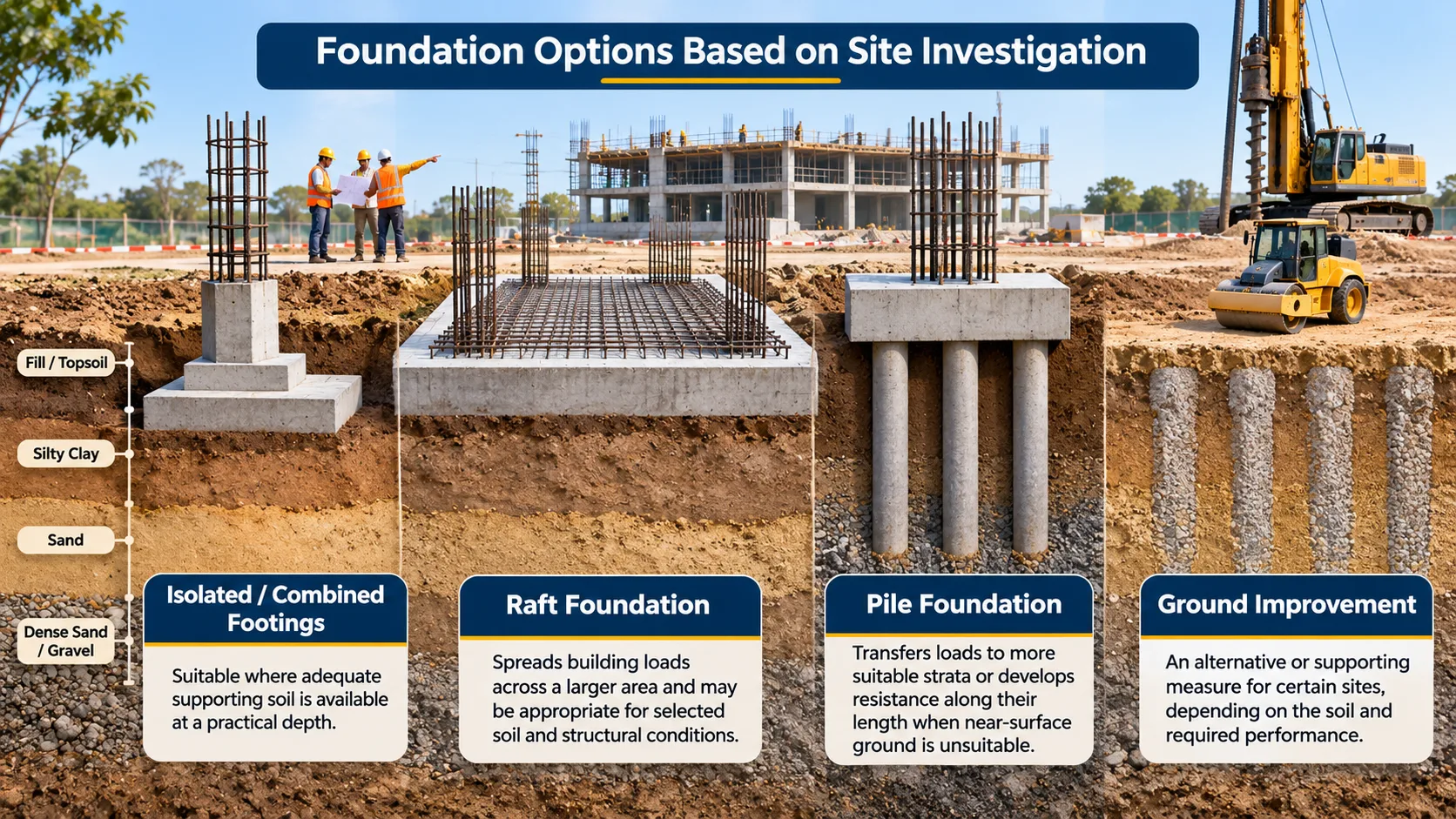
Depending on the ground conditions and the proposed structure, engineers may consider:
- Isolated or combined footings: Suitable in some cases where adequate supporting soil is available at a practical depth.
- Raft foundations: Spread building loads across a larger area and may be appropriate for selected soil and structural conditions.
- Pile foundations: Transfer loads to more suitable strata or develop resistance along their length when near-surface ground is unsuitable.
- Ground improvement: May provide an alternative or supporting measure for certain sites, depending on the soil and required performance.
The decision is not dictated by soil type alone. Structural loads, nearby buildings, groundwater, construction access, cost and settlement requirements all influence the choice.
In India, IS 1892:2021 addresses subsurface investigation for foundations, while IS 1904:2021 covers general requirements for the design and construction of foundations in soils. The applicable standards and project-specific design requirements should be checked by the responsible professionals.
Investigation Does Not End with the Report
Ground conditions can reveal surprises during excavation. A buried obstruction, unexpected fill or a soil layer different from the investigation record may require further assessment.
The important response is not to ignore the discrepancy or assume the original recommendation still applies. The findings should be communicated to the geotechnical and structural design team, who can decide whether additional investigation or changes are necessary.
Good documentation makes that conversation easier. Borehole locations, logs, test results, design assumptions and subsequent site observations should remain traceable as the project progresses.
As discussed in BIM in Civil Engineering, digital project models can incorporate site information. But a model cannot replace physical investigation or the engineer's interpretation of soil behaviour.
Frequently Asked Questions
Does every small building need a soil investigation?
The appropriate scope depends on the structure, local requirements, site history and ground conditions. A small building is not automatically free from settlement or foundation risks. The responsible engineer should determine what investigation is necessary.
How many boreholes are needed for a building site?
There is no single number suitable for every project. Borehole spacing, depth, and quantity should reflect the building, site variability, anticipated foundation loads, and the applicable investigation guidance.
Is an SPT result enough to choose a foundation?
No. SPT results can support an investigation, but foundation decisions also require interpretation of soil layers, groundwater, laboratory findings where needed, loading and settlement behaviour.
The First Design Decision Happens Below Ground
Most people first encounter a new building through drawings, renders or construction activity above the surface. Yet some of its most consequential design information is collected before those visible elements begin to take shape.
Soil investigation helps engineers understand the ground's opportunities and constraints. It supports appropriate foundation selection, safer construction planning and decisions that can reduce avoidable surprises later.
A reliable foundation begins with an accurate understanding of what lies beneath it.